Two stars on the edge of the Andromeda Galaxy spent about seven years becoming one. Telescopes caught most of it: the slow brightening, a strange fade, the flare at the end. Then the James Webb Space Telescope went to look at the wreckage. This slow stage of a merger had never been seen directly before.
Elsewhere tonight, a rocket goes looking for X-rays from the Moon and finds something much stranger. A mirror is ground with great care to the wrong curve. A probe lands on Titan, and the receiver meant to catch half its data was never switched on.
And the night ends with a man who looked at all the carbon in the universe and decided physics owed him an energy level.
1. 💥 Big Bao swallowed Little Bao, and Webb saw what was left
Until 2018, a certain giant star near the edge of the Andromeda Galaxy did nothing special. It shone steadily, one bright dot among billions. Then it began to brighten. Not by much, and not smoothly, but year after year.
Its official name is AT 2025abao. The astronomers who studied it call it Bao, which also happens to be a kind of filled bun. The giant is Big Bao, a star with about seven times the Sun's mass. It's 350 times wider than the Sun, and 18,000 times brighter.
Little Bao was a smaller star in orbit around it. By 2018, it had drifted into the giant's outer layers. Those layers are thin gas, but even thin gas drags on anything moving through it.
Each orbit, the small star lost a little energy and sank a little deeper. The drag heated the gas, and that was the slow brightening. For a while, two stars shared one atmosphere. Astronomers call this a common envelope.
It matters far beyond Andromeda. Pairs of stars that come out of a common envelope can go on to become neutron stars and black holes, or sources of gravitational waves. But the spiral itself had never been seen directly.
The clues came from a relay of telescopes, some of them busy with other things. In February 2023, the team spotted Bao flickering in data from NEOWISE, a retired NASA survey satellite. In September 2024, an infrared camera called WINTER saw it brightening and puffing out dust.
In July 2025, the SPHEREx space telescope happened to scan the spot during a routine survey. It caught Bao fading in visible light while it brightened in infrared.
On October 17, 2025, a survey camera called the Zwicky Transient Facility caught the finale. Within a week, Bao shot up to its peak. Little Bao had been dragged all the way into the giant's core. Kishalay De, one of the astronomers, compares it to "a bomb exploding inside a living star."

The whole fall took about seven orbits, roughly seven years. Mergers of two small stars had been caught before, and those took thousands of orbits to get there. Little Bao went down fast.
Webb looked on Christmas Eve 2025, just 47 days after the peak. No event like this had ever been followed up so soon. Its infrared camera found dust that the giant had shed over centuries, still in place around the pair. Some molecules, such as carbon monoxide, came through the blast intact.
The merger threw off the giant's outer tenth, at about ten times the speed needed to escape it. The team also measured how much of the orbit's lost energy went into flinging gas away. Models of how tight pairs of stars form depend on that number. Here it came out somewhere between 1 and 40 percent, which is a wide range from a single event.
Not every model said the stars had to merge. In one, Little Bao kept enough energy to escape. Closer analysis ruled that out. Nobody knows yet what the new, heavier star looks like, or how it will settle down.
2. 🪨 Ceres was found, lost and found again with arithmetic
On the first night of 1801, Giuseppe Piazzi was doing a careful, dull job in Palermo, Sicily. He was measuring star positions for a new catalog. While checking one catalogued star, he noticed another just ahead of it. Over the next nights, it moved. Stars don't do that.
Piazzi announced a new comet. Privately, he wasn't so sure. It had no fuzzy glow, and it crept along slowly and steadily. To one colleague, he wrote: "I surmise that it could be something better than a comet."
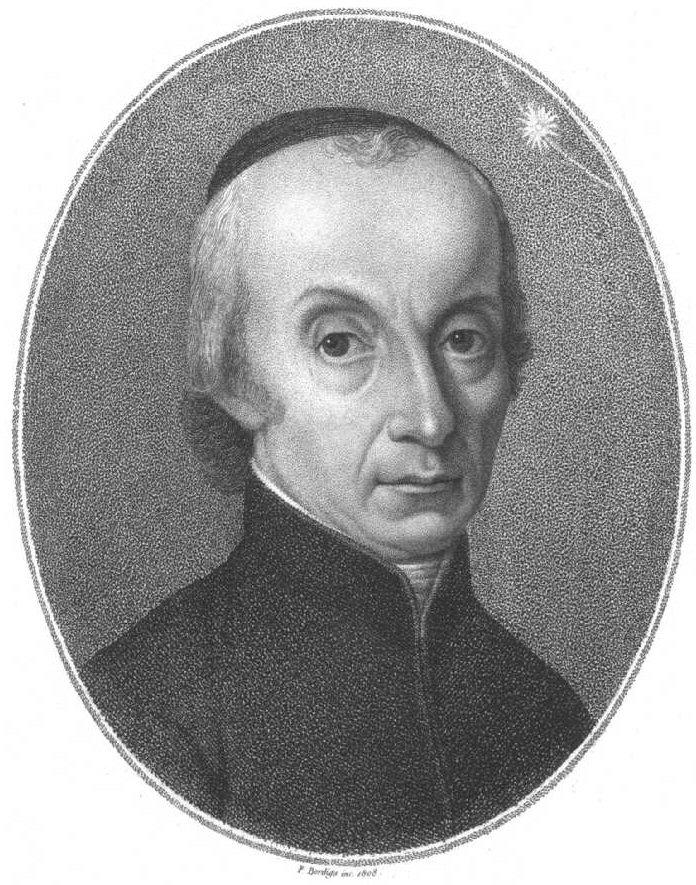
Astronomers were primed for something better. A simple number pattern seemed to give the distances of the planets from the Sun. Uranus, found in 1781, fit it neatly. But the pattern also called for a planet between Mars and Jupiter, and nobody had ever seen one.
A group of astronomers had just organized to hunt for it. They split the band of sky the planets travel along into 24 zones, one for each observer. Piazzi was on the list to be invited. He found the thing before his invitation was sent.
Then he lost it. He followed it until mid-February, about six weeks, when he fell ill and the object slipped toward the Sun's glare. His letters took weeks to arrive, and one was held up by Napoleon's occupation. By the time other astronomers knew, there was nothing left to see.
All anyone had was Piazzi's handful of positions. Over those six weeks, the object had moved only about three degrees across the sky. That's the width of six full Moons.
That was the hard part. A telescope tells you which direction something is in, but not how far away it is. An orbit needs six numbers to pin it down, and each night's sighting gives you only two. Most experts thought such a short track could never give a full orbit.
Carl Friedrich Gauss, a 24-year-old mathematician, disagreed. He took three of Piazzi's positions. His trick was to estimate the distance for the middle one first. From that came the other two distances, and a rough orbit.
Then he used the rough orbit to correct the distances, and went around again, until everything agreed. Older methods had to assume the orbit's shape in advance. Gauss's didn't.
Several astronomers published predictions of where to look. Gauss's differed greatly from the others. Franz Xaver von Zach found the object again in December 1801, near where Gauss said. Heinrich Olbers found it on his own soon after.
Piazzi named it Ceres, after the Roman goddess of farming, whose earthly home was said to be Sicily. Within six years, three more bodies turned up in the same gap. William Herschel coined a new word for them: asteroids. Two centuries later, the Dawn spacecraft would orbit Ceres and find a lonely mountain made of mud.
As for the number pattern that sent everyone looking, Neptune broke it. When Neptune was found in 1846, it sat far closer to the Sun than the pattern said. Most astronomers decided the pattern had been a coincidence all along. It just happened to point at Ceres first.
3. 🧲 A rocket looked for X-rays from the Moon and found Scorpius X-1
The first rocket misfired. On the second, the door in front of the detectors never opened. The third, in June 1962, worked perfectly, and found the wrong thing.
The idea had come from the physicist Bruno Rossi, at a party at his house: why not look at the sky in X-rays? Riccardo Giacconi took it up at a small company in Massachusetts. X-rays don't make it through our air, so the detectors had to ride a rocket above most of the atmosphere.
Their main target was the Moon. The idea was that sunlight might make its surface glow faintly in X-rays. NASA and the Air Force were interested enough to help pay for it.
The rocket flew above the air for about six minutes. It spun as it went, so its three detectors swept around the sky like the beam of a lighthouse. From the Moon, they picked up nothing.
But whenever they swept past one particular patch of sky, the counts jumped. Something out there was pouring out X-rays. It took weeks of checking before the team was sure it wasn't anywhere in the Solar System.
They named it Scorpius X-1: the first X-ray source in the constellation Scorpius. It was about 9,000 light-years away, and no known kind of star behaved like it.
In ordinary light, it's a nobody. In every square degree of sky, about a hundred stars look brighter. In X-rays, it outshines everything else in the sky. Most X-ray telescopes are kept from looking at it, because it would wear out their detectors.
The answer, worked out in the years after, is a pair of stars. One is a neutron star: the collapsed core of a dead star, about 1.4 times the Sun's mass, crushed into a ball the size of a city. The other is a small ordinary star, and the neutron star is pulling gas off it.
The gas doesn't fall straight in. It swirls inward, faster and faster, and slams into the neutron star at enormous speed. That motion turns to heat, millions of degrees of it, and gas that hot glows in X-rays.
In 2002, Giacconi shared a Nobel Prize for his pioneering work in X-ray astronomy.
There's one more thing astronomers want from Scorpius X-1. Falling gas may raise a tiny bump on the spinning neutron star. A lopsided spinning star should give off gravitational waves, ripples in space itself.
This year, the LIGO, Virgo and KAGRA detectors reported a search for those ripples. For the first time, they could have heard Scorpius X-1 over part of their range, if it were as loud as one hopeful estimate predicted. They heard nothing.
That silence argues against the hopeful estimate, at least for some spin speeds. But nobody knows how fast this neutron star actually spins. Until someone finds out, the listening goes on.
4. ⭐ Welopōʻai's red dwarf should have been swallowed
Étienne Artigau and his colleagues were hunting for planets. Their target was a small red dwarf star 28 light-years away, one of our close neighbors. Their instrument, SPIRou, measures how a star wobbles.
A planet tugs its star back and forth a little as it orbits. As the star moves toward us and away, its light shifts very slightly in color. For a planet, the swing is a few meters per second, slower than a jog.
This star was swinging by nearly 16 kilometers per second. That's more than a thousand times too much for a planet.
Whatever was pulling on it had to weigh more than half as much as the Sun. Yet nothing bright showed up beside it. Something heavy and dark was there. It could have been a white dwarf, a neutron star, or even a black hole.
A white dwarf is what's left when a star like the Sun runs out of fuel: a hot, dim core about the size of Earth. To look for one, the team used a camera on the Gemini North telescope in Hawaiʻi. It found a faint point right beside the red dwarf.
It was a white dwarf. Years of measurements pinned its mass at about 0.62 times the Sun's, with less than 1 percent uncertainty. It and the red dwarf circle each other every 9.8 years, a little closer together than Jupiter is to the Sun.
A second white dwarf was already known farther out, and it turns out to belong to the same family. That makes three: one living red dwarf and two dead stars. No other system like it is known within 100 light-years.
It's called Welopōʻai, a name chosen through a program of the ʻImiloa Astronomy Center that brings Hawaiian language experts and astronomers together. Welo means a trait handed down in a family, and pōʻai means an orbit. Together they suggest a path of family traits.
The trouble is in the family history. The nearby white dwarf was once a star about 40 percent heavier than the Sun. When it ran out of fuel, it would have swelled to hundreds of times its size.
The red dwarf was close enough that a violent tangle should have been hard to avoid. The swelling star could have swallowed it, the way Big Bao swallowed its partner in story 1. Instead, the red dwarf sits in a wide, calm orbit.
Patrick Dufour, a white dwarf specialist on the team, puts it bluntly: "The system should not exist. We have no clean explanation for how it got here."
One idea is that the outer white dwarf helped, nudging the inner pair with its gravity over a long time. That only works if the orbits are tilted the right way, and nobody knows their tilt yet. Webb and the Gaia spacecraft may help work out the system's shape in three dimensions.
5. 🌙 One stubborn test saved the Huygens probe's landing on Titan
In 2000, the Huygens probe was riding to Saturn on the back of the Cassini spacecraft. Its job was planned for late 2004: drop through the haze of Titan, Saturn's moon of methane rain, and radio what it saw on the way down.
Huygens was too small to call Earth itself. It would whisper to Cassini overhead, and Cassini would pass the message home. A full test of that radio link had been skipped before launch. It would have meant taking parts apart, and the budget was tight.
Boris Smeds, an engineer at ESA's operations center in Darmstadt, was asked in 1998 to design a test from the ground. He'd beam a signal from Earth to Cassini, pretending to be Huygens, and see whether it came through.
The plan was to send a bare radio tone. Smeds wanted fake data riding on it too, just like the real thing. As he put it: "If I do a test like this, I want to do it properly."
In February 2000, he set up at NASA's big radio dish at Goldstone, in the Mojave Desert. Cassini was out in the asteroid belt, 430 million kilometers away. Each signal took 48 minutes to get there.
The tone came back fine. The data didn't. Only short bursts of good data got through, and turning up the power made it worse.
On the drive to Barstow, Smeds had a hunch. His test copied the Doppler shift Huygens would have as it fell away from Cassini. The next day, he set that shift to zero. Suddenly, the data came through.
Doppler shift is the change in pitch you hear as an ambulance passes. Huygens would be pulling away from Cassini at about 5.5 kilometers per second. That would stretch its radio waves, and it would also stretch the rhythm of the data, so the bits arrived a touch late.
Cassini's receiver kept time with a fixed beat. Out of step, it turned good data into junk. And that beat was set in firmware that couldn't be changed after launch.
Not everyone believed Smeds at first. Some thought his test was the thing that was broken. By September 2000, ESA was convinced.
The fix was to change the route. Cassini would fly a new path, so that from its point of view Huygens moved mostly sideways, with little motion toward or away. The landing slipped to January 2005. Smeds got a plaque and a small cash prize.
On January 14, 2005, Huygens fell through Titan's air for about two and a half hours and landed. Then a second problem showed up. Cassini listened on two channels, A and B. The command to switch on Channel A was never sent.
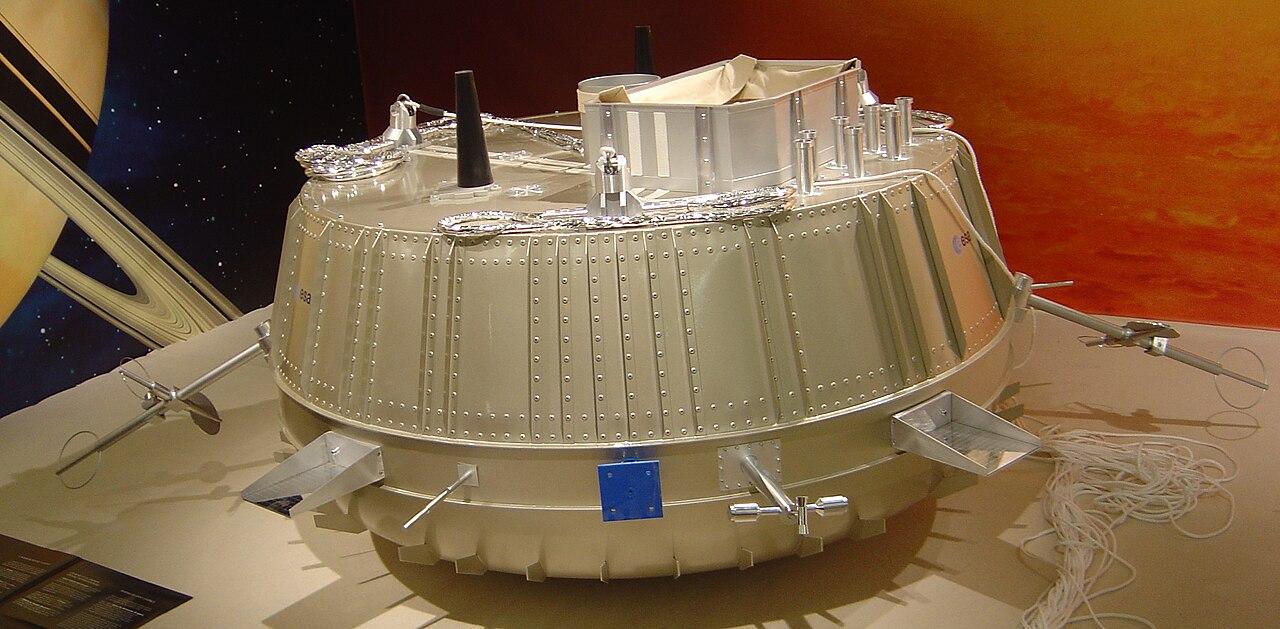
Most of the data went out on both channels, so it survived. The pictures didn't. To send more of them, the camera team had split them between the channels. Of more than 700 pictures planned, only about 350 arrived.
One experiment had used Channel A alone: a measurement of Titan's winds, read from tiny changes in the pitch of Huygens's signal. But radio telescopes on Earth had been listening to Huygens directly.
Its signal was about as strong as a mobile phone's, and at least 17 dishes picked it up. The winds were recovered from their recordings. The experiment's leader had bet a colleague 10 euros that this wouldn't work. He lost.
6. 🌌 Vera Rubin found Andromeda's outer stars moving too fast
In January 1965, Vera Rubin walked into the Department of Terrestrial Magnetism and asked for a job. She had a PhD, four children and an interest few astronomers shared: how stars move in the far outskirts of galaxies.
She got the job, and a partner. Kent Ford, a physicist there, had just built a new kind of spectrograph. On a telescope, it cut exposure times to a tenth.
They set out to measure how fast the Andromeda Galaxy spins at different distances from its center. In the Solar System, that's simple. Almost all the mass is in the Sun, so Mercury races around it and Neptune crawls.
A galaxy should work the same way, if most of its mass sits in the bright crowd of stars near the middle. Stars far out would feel less pull, so they should move more slowly.
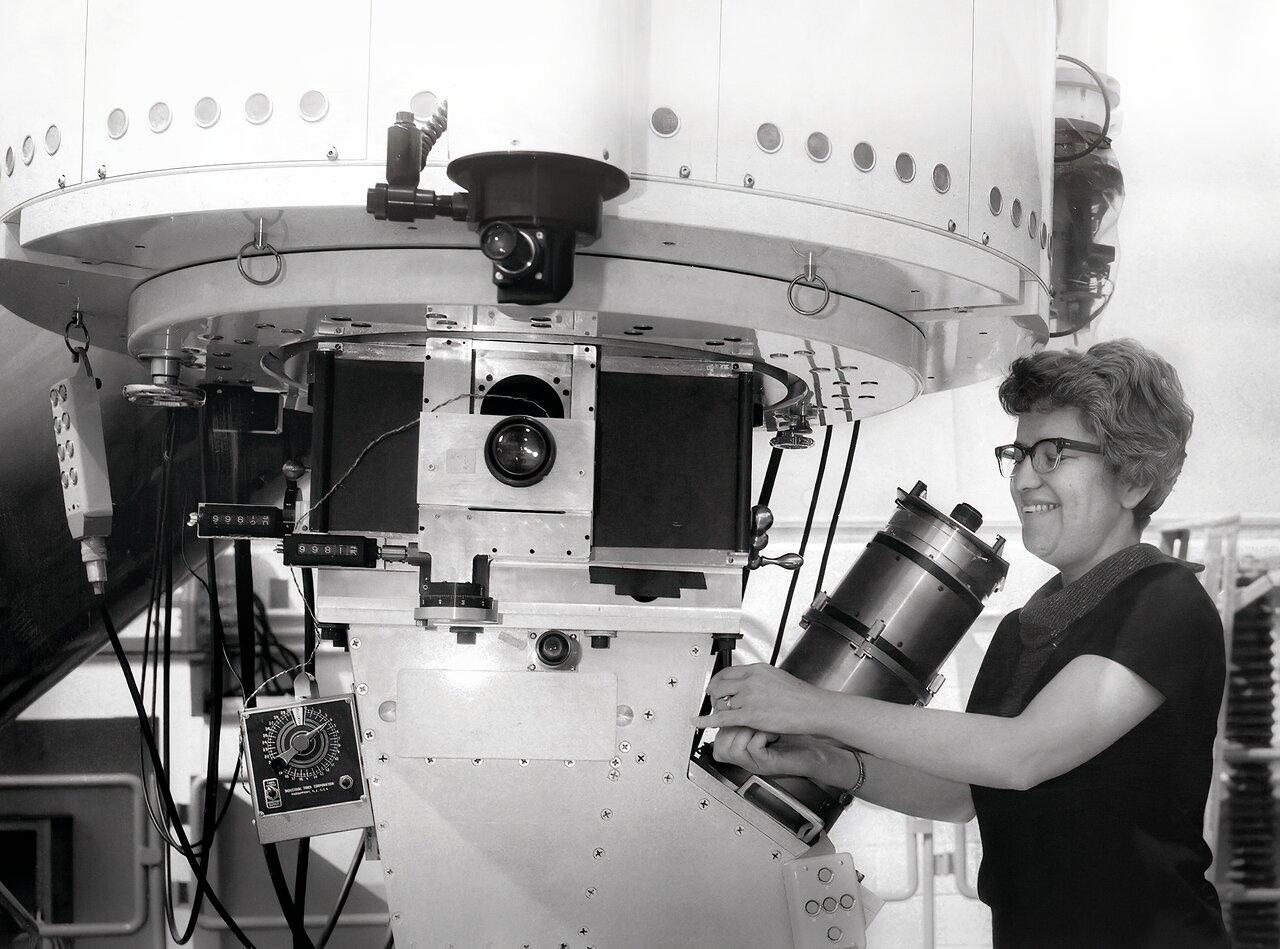
They measured speeds by color. Light from gas moving toward us shifts slightly bluer, and light from gas moving away shifts redder. They aimed at 67 glowing clouds of hydrogen, scattered across Andromeda. Many were too faint to see through the telescope, so they steered to them blind, by measured offsets from nearby stars.
Their first photographic plate was ruined. A visiting astronomer washed it in water that was too hot, and the picture slid off the glass. Rubin was euphoric anyway. Before it was ruined, the plate had shown that the method worked.
Over the next two years, the answer came in. The outer clouds were moving about as fast as the inner ones. The speeds didn't drop off. Plotted against distance, they made a nearly flat line.
A star's speed depends on all the mass inside its orbit. If the speed stays the same farther out, the mass inside must keep growing. Andromeda had to hold more and more mass, far past where its stars fade out. And most of that mass gave off no light.
Rubin and Ford were careful in their 1970 paper. The custom was to extend a curve past the last point as if it dropped. Instead, they wrote that going beyond their last point was "clearly a matter of taste."
Rubin wasn't the first to suspect hidden mass. Fritz Zwicky had argued for it in the 1930s, from how galaxies move in clusters, and was mostly ignored. Radio astronomers later traced Andromeda's flat curve even farther out. By 1980, Rubin and her colleagues had measured 21 spiral galaxies, and every one was flat.
Most astronomers now call the missing mass dark matter. Rubin stayed careful. She said she didn't know whether we have dark matter, need a change in gravity, or need something else. Astronomers are still arguing about gravity. Nobody has caught a particle of dark matter yet, though story 11 is about an experiment that says it might have.
7. 🛰️ BepiColombo spent eight years learning to stop at Mercury
Mercury is the closest planet to the Sun, and one of the hardest to reach. A spacecraft heading there doesn't need to speed up. It needs to slow down.
Falling toward the Sun is like driving down a very long hill. The closer you get, the faster you go. Arrive at Mercury like that, and its gravity can't catch you. You shoot straight past.
ESA's engineers compare it to falling off a cliff millions of kilometers high and landing softly on a moving target halfway down. You could brake with rocket engines, but you'd need so much fuel that the spacecraft would be too heavy to launch.
BepiColombo, a joint mission of ESA and Japan's space agency, took the long way instead. Since its launch in 2018, it has flown past Earth once, Venus twice and Mercury six times. Each flyby let a planet's gravity take away some of its energy, with no fuel spent.
Between flybys, gentle electric thrusters nudged it into place. They pushed out charged xenon gas, softly, for weeks or months at a time. In all, BepiColombo covered 9.9 billion kilometers. NASA's Mariner 10 made the trip much faster, in just 147 days. But that was in the 1970s, and it only flew past.
The mission is named after Giuseppe "Bepi" Colombo, a scientist from Padua. He was the one who showed, in 1970, that a pass by Venus could send Mariner 10 past Mercury three times instead of once.
On November 21, BepiColombo swept 635 kilometers above Mercury and fired four thrusters to brake. The burn was meant to last 37 minutes. Partway through, a software glitch put the spacecraft into safe mode, and the burn stopped early.
Around 1 a.m. in Darmstadt, the flight dynamics team came on the voice loop: "We confirm Mercury orbit capture!"
The burn had delivered about 77 percent of the planned braking. That was enough. BepiColombo is in a stable orbit, just a looser one than planned. One lap takes 75 hours instead of 58. ESA says the burns still to come have already been adjusted, and no extra ones are needed.
It got there with an unusual trick. BepiColombo arrived slowly enough that Mercury's gravity could hold it loosely for a few orbits, without any braking at all. This is called weak stability capture. Before, only some spacecraft going to our Moon had used it.
That loose hold would only have lasted a little while. The braking burn turned it into a lasting one. It's the first time a spacecraft has entered orbit around another planet this way.
On December 9, the spacecraft splits in two. ESA's orbiter will study Mercury itself, and Japan's Mio will study the space around it. Science starts in April 2027. Among the first questions: why does a planet this small have a magnetic field at all?
8. 🔭 Hubble's mirror was polished perfectly to the wrong shape
The Hubble Space Telescope went up in April 1990. Two months later, NASA had to announce that it was flawed. Its pictures were blurry, and every star came with a hazy halo.
Its main mirror is 2.4 meters across, and it was polished extremely smooth. Scaled up to the size of Earth, its biggest bump would stand about 15 centimeters high.
The trouble was its shape. Near the outer edge, it was too flat by about 2 micrometers. That's about a fiftieth of the width of a human hair, and ten times what the design allowed.
A telescope mirror has to bring all the light from a star to one sharp point. Light hitting Hubble's flattened edge came to a focus at a slightly different spot from light hitting the middle. With no single focus, every star smeared out. This is called spherical aberration.
Getting a shape that wrong, that precisely, took a faulty ruler. Mirror makers test a curved mirror with a small device called a null corrector. It's a set of lenses and mirrors arranged so that a perfect mirror looks perfectly even through it. You keep polishing until it does.
Hubble's null corrector had one lens sitting 1.3 millimeters out of place. The polishers hit their target perfectly. It was just the wrong target.
There had been warnings. Two other tests during manufacturing showed the error. Both were dismissed, on the grounds that they were the ones that must be flawed.
Then came the good news, of a sort. The faulty corrector had sat untouched for nine years, so investigators could measure it exactly as it was. The error was now known precisely. And an error you know precisely can be cancelled, the way glasses correct an eye.
While the fix was built, Hubble kept working. The middle of each image was still sharp. And because the blur followed a known pattern, software could push much of the light back where it belonged. Star clusters that looked like a single blob broke into separate stars.
Hubble also became a punchline. A Naked Gun movie from 1991 showed it beside pictures of the Titanic and the Hindenburg.
In December 1993, a crew of seven astronauts visited Hubble. They installed a new main camera with the correction built inside. They also added COSTAR, a box about the size of a large refrigerator, holding small mirrors on robotic arms. It acted like a pair of glasses for three other instruments.
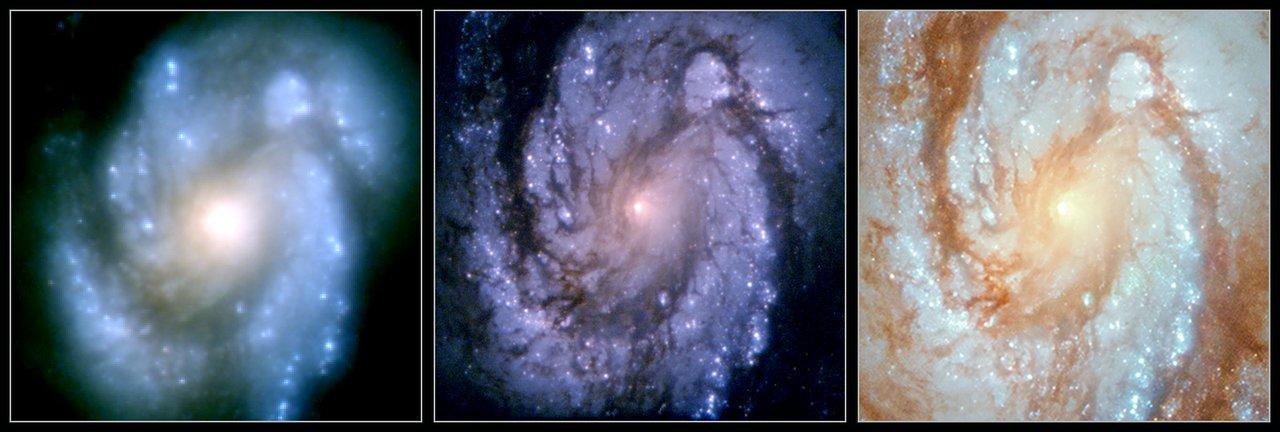
It worked. Every instrument after that had the correction built in, so COSTAR was taken out in 2009 to make room for a new one. It's now on display at the Smithsonian's National Air and Space Museum in Washington. The sharpened Hubble went on to take the Deep Field.
9. ⏱️ TIC 160582982's heartbeat gives away a hidden heavyweight
Some stars pulse like clocks. A delta Scuti star is one of them: a hot star, heavier than the Sun, that throbs in several steady rhythms at once. Each rhythm keeps very good time.
TIC 160582982 is one of these. It's about 860 light-years away, and nearly twice as heavy as the Sun. NASA's TESS satellite watched it for most of a year.
Its rhythms weren't quite steady. Over an 89-day cycle, its pulses drifted early, then late, by up to about two and a half minutes.
The reason is the time light takes to travel. The star is circling something. When it's on the far side of its orbit, each pulse has extra distance to cover to reach us, so it arrives late. On the near side, it arrives early.
How far the star swings, and how long each lap takes, tell you how hard it's being pulled. From that, you can weigh whatever it's circling. Here it comes out at at least 1.8 times the mass of the Sun.
That's a minimum, because nobody knows how the orbit is tilted toward us. A more tilted orbit would mean an even heavier partner.
Then where is it? An ordinary star that heavy would add about a fifth of the system's light. There's no sign of that extra light. Two old spectra show no second star either. But the main star spins so fast that its blurred lines could hide a faint one.
That leaves two ideas. The partner could be a dead star, such as a neutron star or even a small black hole. Or it could be two smaller stars orbiting each other tightly, each about 0.9 times the Sun's mass. A pair like that would give off far less light than one big star, little enough to stay hidden.
Chenglong Lv and his colleagues suspect the first. They're also clear that their data can't yet tell the two apart.
That caution is earned. HR 6819 was once called the closest known black hole to Earth, until better data explained it with two stars and no black hole at all.
What would settle it is a run of sharp spectra spread across the 89-day orbit. If faint lines from a partner show up, moving back and forth in step, it's one or two stars. If they never appear, the case for something dead gets much stronger.
10. 🪐 Neptune's hidden Trojans came out from behind the Milky Way
Neptune doesn't travel alone. Small icy bodies share its path around the Sun, in two loose swarms. One swarm runs about 60 degrees ahead of the planet, and the other trails about 60 degrees behind. They're Neptune's Trojans, and Jupiter has its own.
Those two spots are balance points. There, the pulls of the Sun and the planet combine so that a small body can keep pace with the planet. It doesn't sit still. It drifts slowly around the point, and can stay for billions of years.
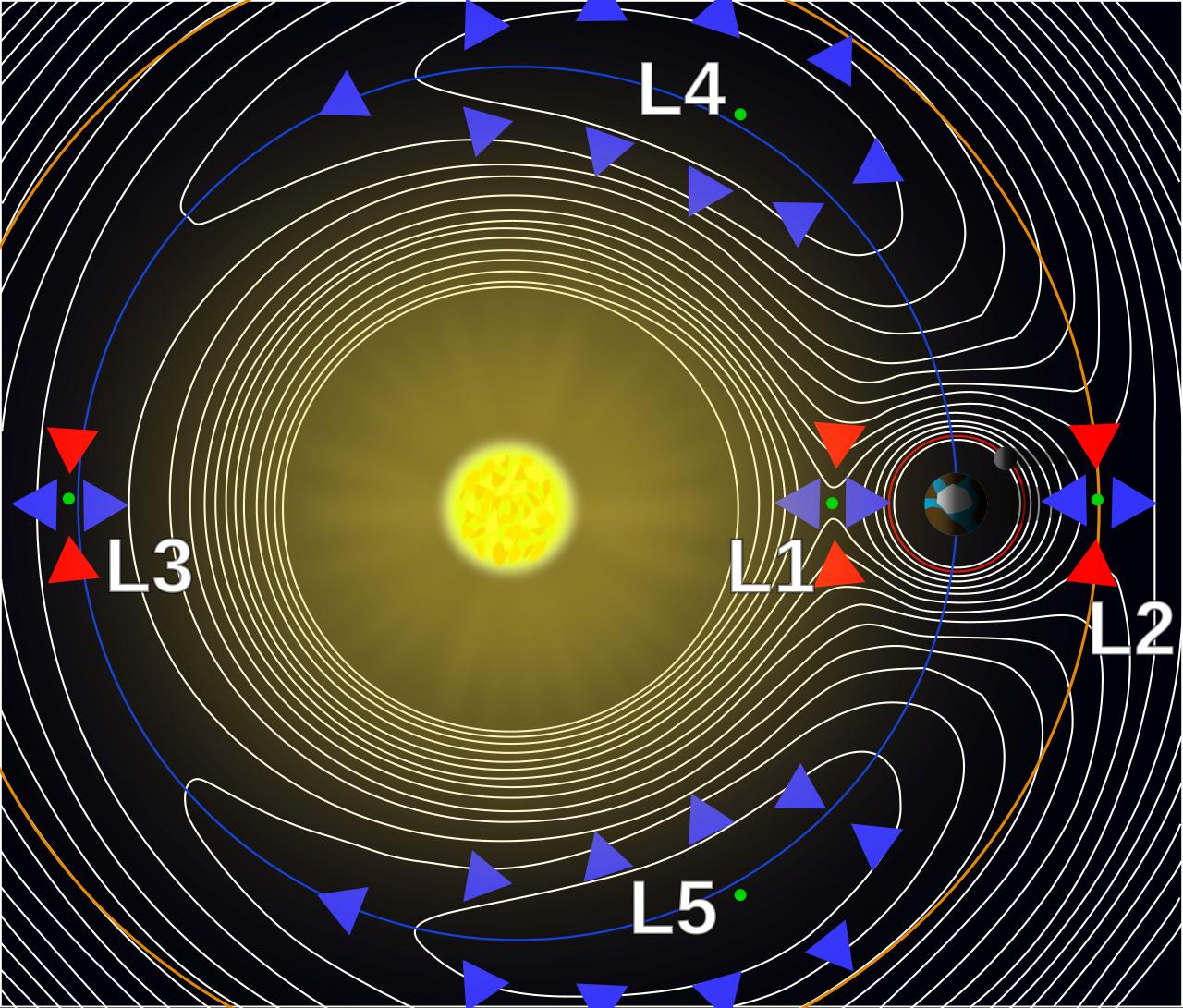
For more than 15 years, Neptune's trailing swarm had a terrible backdrop. From Earth, it sat in front of the middle of the Milky Way. Spotting a faint moving dot among that many stars was close to hopeless.
Almost everything known about Neptune's Trojans came from the leading swarm. Only two objects were known to have stayed in the trailing swarm for billions of years.
The swarm finally drifted clear of the crowded star fields in 2025. That June, the Vera C. Rubin Observatory in Chile began a test survey. The observatory is named after the astronomer in story 6. The survey wasn't looking for Trojans, but its patch of sky happened to cover the swarm.
Rubin's software picks out moving dots by comparing the same sky on different nights. One day after the survey started, it caught two objects in the swarm. A third turned up in July.
Older images from another survey telescope, Pan-STARRS, stretched their paths back years. Then the astronomers ran each orbit forward on a computer, along with 100 slightly varied copies. For two of the objects, every copy stayed a Trojan for a billion years.
That doubles the trailing swarm's known long-term members, from two to four. The third object is still a candidate. Its path is too short to be sure.
The new Trojans' colors match the leading swarm's. That supports the idea that both swarms came from the same starting population.
How they got there is still open. All four long-term members of the trailing swarm have orbits tilted by more than 25 degrees. That kind of tilt is a hint that Neptune captured them as it moved outward in the young Solar System. Some may have formed in place instead, and four objects can't settle it.
Rubin's main survey began in 2026. Over the years, it's expected to find tens to hundreds more in the trailing swarm. The first four are the tip of the iceberg.
11. ⛰️ DAMA/LIBRA sees a yearly dark matter signal, and its rivals don't
For almost 30 years, crystals under a mountain in central Italy counted tiny flashes of light. The lab sits beneath 1,400 meters of rock, which shields it from most of the radiation that rains down from space.
The flashes come when something hits an atom in a crystal. The experiment, called DAMA, was built to catch the rare hit from a particle of dark matter. And its count does something curious. It rises and falls a little every year, peaking in early June.
That's the pattern dark matter should leave. The Sun moves through the galaxy, and through the dark matter thought to fill it, so we feel a steady dark matter wind. Earth circles the Sun at 30 kilometers per second. In early June, Earth's motion adds to the Sun's. In December, it takes some away.
On a bike, a breeze hits you harder when you ride into it than when you ride away from it. In the same way, the wind past Earth should blow a little harder in June, and kick a few more atoms.
The yearly swing DAMA sees is small. But after so many years of data, it's far too strong to be a fluke.
The trouble is that nobody else sees it. Experiments built from other materials found nothing. But different materials respond differently, so those results could be argued away. The clean test is to build DAMA again: the same sodium iodide crystals, the same search.
Two teams did. COSINE-100 ran underground in South Korea for more than six years. ANAIS-112 ran underground in Spain for six. Neither saw a yearly swing. Combined, their data make DAMA's signal very hard to believe, though the case isn't fully closed.
What is DAMA seeing, then? Nobody knows. The crystals may respond to a hit a little differently from the copies. Seasonal effects underground have been suggested too, such as particles from cosmic rays that vary through the year. The DAMA team says none of them can mimic its signal.
Some physicists suspect the way the signal is pulled out of the data. DAMA subtracts each year's average count before looking for the swing. If the background drifts over time, that method can create a swing that isn't there.
DAMA's data have never been made public, so no one else can redo its analysis. The experiment stopped in 2024, and its crystals are now in the hands of Italy's national institute for nuclear physics. That means the very crystals that saw the signal can now be tested by others.
The cleanest test of all turns the seasons upside down. A dark matter wind peaks in June everywhere on Earth, but summer doesn't. A seasonal cause would show up differently in the Southern Hemisphere.
SABRE South, a detector deep in a gold mine in Stawell, Australia, is built for exactly that. It plans to start steady data-taking in January 2027.
12. ⚡ The Vela satellites watched for bombs and found gamma-ray bursts
In October 1963, a treaty banning nuclear tests in the air, underwater and in space came into force. A week later, the first two Vela satellites began watching for cheaters. The name comes from the Spanish for "to watch."
A nuclear blast in space gives off a flash of gamma rays, the most energetic kind of light. On a detector, it goes up sharp and comes down sharp. Pairs of Velas flew on opposite sides of a huge orbit, so no part of Earth was hidden from them.
In July 1967, a flash of gamma rays set off two Vela 4 satellites. The older Vela 3s caught it too. It wasn't a bomb. Instead of one sharp spike, it rose and fell unevenly. In one Los Alamos description, flashes like this go "spike, spike, spike … hiccup … and then off."
Nobody noticed at the time. Ray Klebesadel at Los Alamos had made a habit of filing away any trigger that clearly wasn't a bomb. He found this one in 1969, going back through Vela 4's records.
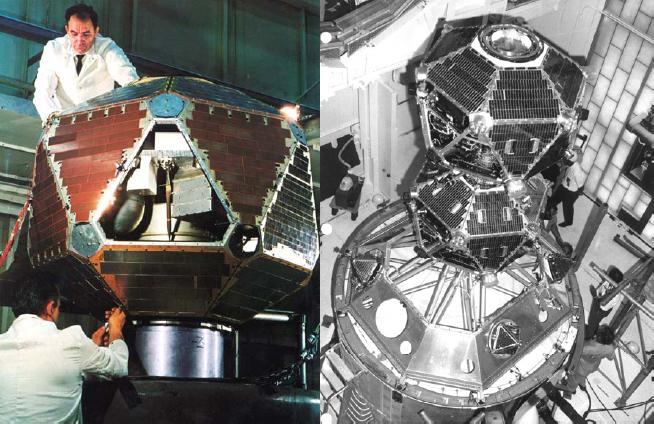
Vela 4 couldn't tell where the flash came from. The newer Vela 5 and 6 satellites had sharper clocks. A flash reaches one satellite a fraction of a second before another, and the delay gives the direction, roughly. You do the same with your ears, when a sound reaches one ear first.
By 1972, Klebesadel and two colleagues had 16 of these flashes. None came from the Sun or Earth. They announced in 1973 that the bursts came from somewhere out in space.
Then the guessing began. Theorists published more than 100 explanations, most involving neutron stars in our own galaxy. Gamma rays can't be focused into a sharp picture, so no burst could be pinned down well enough to point a telescope at.
The first big clue came from BATSE, an instrument on NASA's Compton Gamma Ray Observatory, launched in 1991. Over nine years, it recorded 2,704 bursts.
Our galaxy is a flat disk, and we sit inside it. Anything spread through the disk should crowd along the band of the Milky Way in our sky. The bursts didn't. They came evenly from every direction.
That left two choices. Either the bursts came from very close by, around the Sun, or from very far away, in other galaxies.
The answer came in 1997 from BeppoSAX, an X-ray satellite that wasn't built to study bursts. It could point its X-ray camera at a burst within hours. It found a fading X-ray glow, and telescopes on the ground found fading light at the same spot. The light from one burst that May showed it was billions of light-years away.
To be seen from that far, a burst has to release in seconds about as much energy as the Sun will give off in its whole life. Long bursts are now linked to the collapse of massive stars, and short ones to colliding neutron stars. The brightest ever seen, the BOAT, went off in 2022.
13. ⭐ The Hoyle state, the carbon level Fred Hoyle said had to exist
The carbon in your body was made inside stars. That's easy to say now. In the early 1950s, nobody could see how a star actually managed it.
The raw material is helium. A carbon nucleus is three helium nuclei stuck together. But three particles rarely meet at the same instant, so the job has to go in two steps.
First, two helium nuclei join to make beryllium-8. That's a dud. It falls apart in about a ten-thousandth of a trillionth of a second.
The second step only works if a third helium nucleus hits the beryllium in that instant. Inside an old star's core, at about 100 million degrees, that happens now and then. But by the numbers of the day, it happened far too rarely to make the carbon we see.
Fred Hoyle, an astronomer at Cambridge, turned the problem around. Carbon exists, and plenty of it. So stars must have a way to make it. And the way, he argued, had to be a resonance.
A resonance is like pushing a child on a swing. Push in time with the swing's own rhythm, and it goes higher and higher. Push off the rhythm, and not much happens.
In a nucleus, the match is one of energy, not timing. Carbon can only hold certain amounts of energy, the way a ladder only has certain rungs. If beryllium plus helium carry just the energy of one of those rungs, they join far more easily.
No such rung was known. Hoyle predicted one anyway, in 1953. He even said where: a little above the energy that beryllium and helium carry together. The heat of a collision would make up the difference.
He was visiting Caltech, and he pressed the nuclear physicists in its Kellogg lab to look. They were skeptical. Ward Whaling, new to the lab, took it on anyway.
Within months, they found the level close to where Hoyle had said. Their paper ends with a thank-you: "We are indebted to Professor Hoyle for pointing out to us the astrophysical significance of this level."

William Fowler, a senior physicist in the lab, later wrote that this made him a believer. He went on to work with Hoyle on how stars make the elements. Fowler shared a Nobel Prize for that work in 1983. Hoyle didn't.
Even with the resonance, making carbon is a near miss. The excited carbon nearly always falls straight back into three helium nuclei. Only about once in 2,400 times does it calm down into stable carbon. Stars just try an enormous number of times.
In 2020, one team measured it settling about a third more often, which would have changed models of how stars age. Two later measurements, the last in 2025, found problems with that result and brought it back to about one in 2,400.
Hoyle's prediction is often told as a story about life. One calculation found that if the level sat a few percent higher or lower, stars would make far less carbon. So, the story goes, Hoyle predicted it because we exist.
The historian Helge Kragh went back to the record. Hoyle and his colleagues didn't connect the level with life at the time. That reading only arrived in the 1980s.
I think what Hoyle actually did is better. He looked at the carbon that was already there, and he took it seriously. The universe had made it, so there had to be a way.
🌙 One last thought before you sleep
I keep coming back to two tests. Boris Smeds was asked to run a simple one and insisted on a harder one, and it caught a flaw that would have wrecked a landing on Titan. Hubble's makers had two tests telling them something was wrong, and they trusted the one that said everything was fine.
It's easy to judge from here. But I think the hardest part of checking your work is believing the answer you didn't want, especially when it's going to cost you.
That's all for tonight. Thanks for wondering along with me. Good night, and clear skies. 🌌
— Kasi