A supernova is a one-time event. Whatever is left of the star afterward, it doesn't do it again. Back in 2012, a giant star in another galaxy flared up as if it were exploding. Then it did it again, and kept on doing it. This March, an X-ray telescope finally caught what sets it off.
Later on, a graduate student grumbles that little green men picked her telescope, and a spacecraft flies into Halley's Comet with no promise of coming out. Two radio astronomers evict some pigeons and find the afterglow of the Big Bang anyway. The pigeons are my favorite part.
1. ⭐ AT 2016blu, the star that keeps faking its own supernova
AT 2016blu kept setting off a robotic telescope that hunts for exploding stars. It's a star in the galaxy NGC 4559, about 30 million light-years away. And its outbursts seem to keep a schedule.
A supernova doesn't repeat itself like that. Astronomers have recorded at least 27 outbursts, and the star is still there. Astronomers file it with the supernova impostors: stars that brighten like an explosion without dying.
The star is a luminous blue variable, a rare kind of hot, huge and unstable star. Old Hubble images suggest it was born with at least 33 times the Sun's mass. The most famous of its kind is Eta Carinae, whose Great Eruption in the 1840s briefly made it the second-brightest star in the sky.
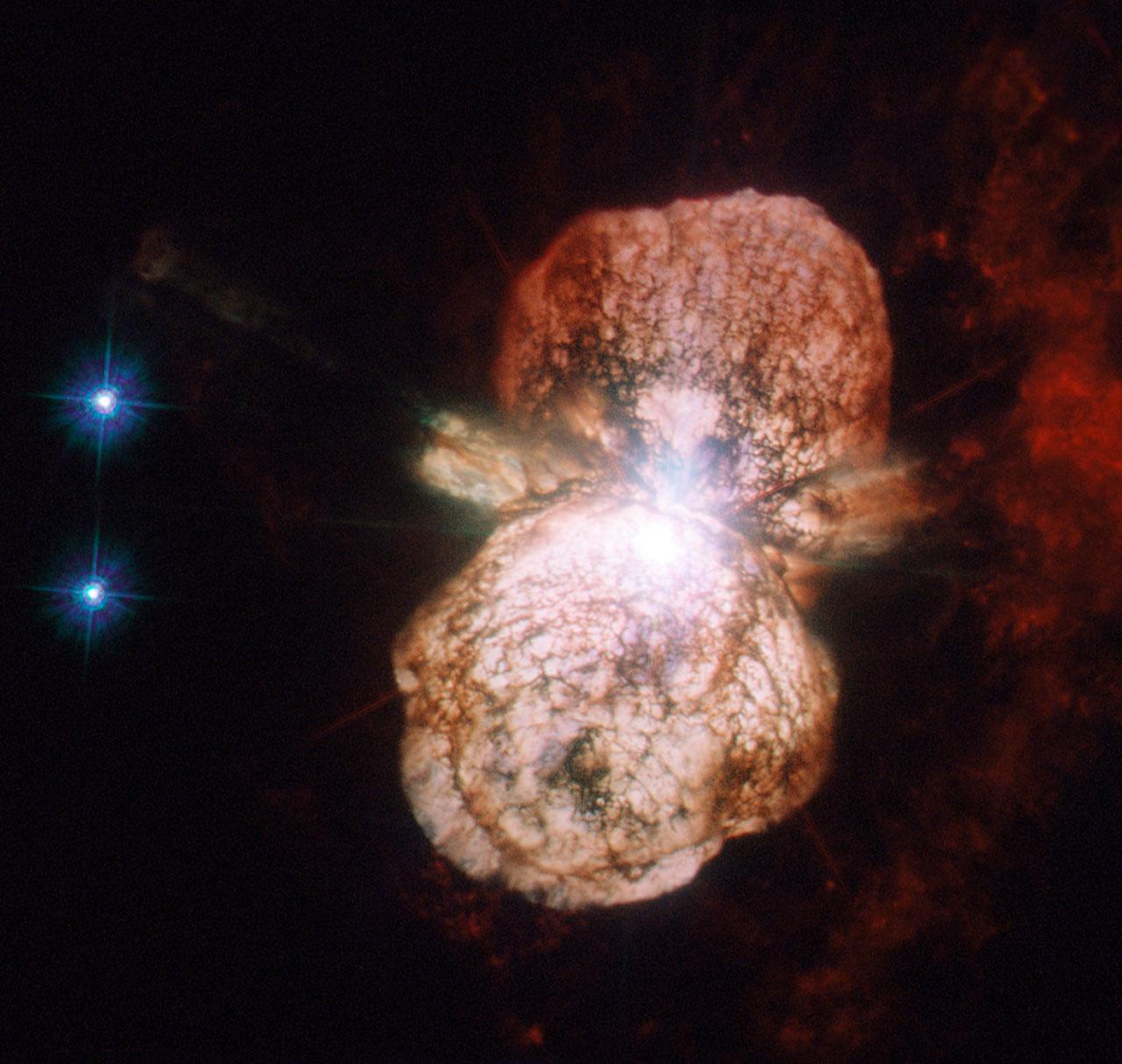
Stars like these are known for erupting whenever they like. AT 2016blu doesn't. Each outburst lasts a few weeks and has several peaks. But the outbursts bunch together on a rhythm of about 113 days, and the star had been quiet for at least a decade before the first one, in 2012.
A rhythm that steady usually means an orbit. The likely picture is a partner on a long, oval path. Every 113 days or so it swings in close, and something about that close pass sets the star off.
But what kind of partner? An ordinary star would stir things up. A dead one could do more. Gas falling onto a black hole or a neutron star gets squeezed and heated until it glows in X-rays.
Ordinary stars give off some X-rays too, and so do the winds of two big stars crashing together. But a dead star swallowing gas can glow far brighter than either.
Mojgan Aghakhanloo and colleagues decided to look for it. They watched the star in ordinary light, waited for the outburst their rhythm predicted, and asked NASA's Chandra X-ray Observatory to look at the right moment.
In March, Chandra caught AT 2016blu glowing in X-rays. It was at least 100 times brighter than before. Chandra had happened to photograph the same spot years earlier, long before the outbursts began, and seen nothing there.
The partner, the team concludes, is a black hole or a neutron star, the crushed core left behind when a massive star dies. On each close pass it pulls gas off the giant star, and the gas heats up as it falls in.
Other impostors have had dead partners. But AT 2016blu is the first impostor of the luminous blue variable kind whose outbursts are driven by a dead companion feeding. Nobody yet knows whether that companion is a black hole or a neutron star.
There's an uneasy note, too. The outbursts resemble the close passes Eta Carinae went through before its Great Eruption. They also resemble SN 2009ip, a star that flared for years before a much bigger blast. Astronomers still argue over whether that blast destroyed the star.
Back in 2022, the team suggested AT 2016blu may be headed for a catastrophe of its own. If so, it's giving fair warning every 113 days or so.
2. 🧲 Jocelyn Bell's bit of scruff was the first pulsar
In the summer of 1967, a radio telescope near Cambridge was producing about 30 meters of paper chart every day. A graduate student went through all of it by hand.
She was Jocelyn Bell, and she had helped build the telescope. It covered an area the size of 57 tennis courts. Its antennas were simple wires strung between posts. About five people and a few summer students hammered it together over two years.
It was built to find quasars, tiny and very distant sources of radio waves, by the way they twinkle. Stars twinkle because their light passes through moving air. Radio waves from a tiny, distant source twinkle too, as they pass through the wind of particles streaming off the Sun.
Six to eight weeks into the survey, Bell noticed a smudge on the charts. It didn't look like twinkling, and it didn't look like interference from radios or cars. She called it "a bit of scruff." It kept turning up from the same patch of sky, in the middle of the night.
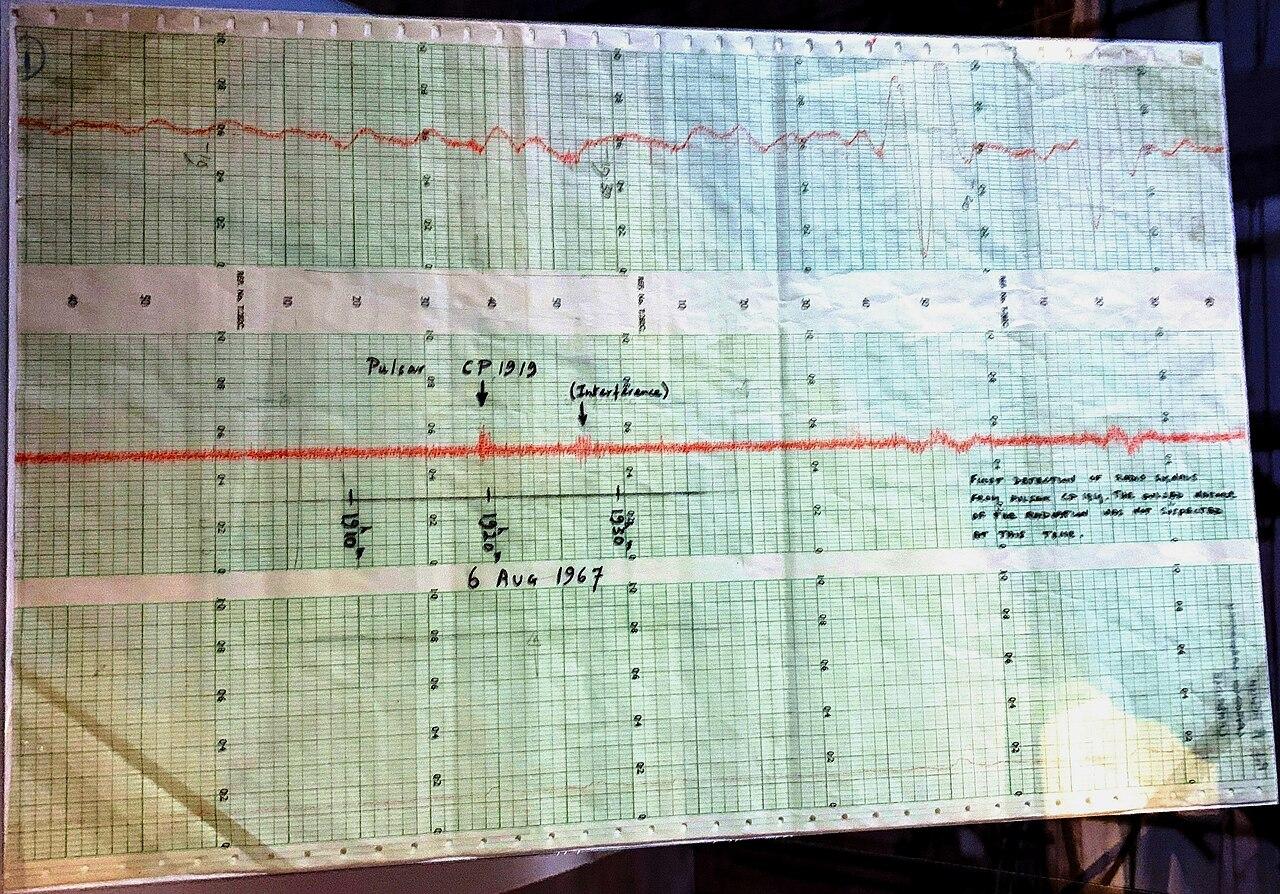
She began making faster recordings to see it in detail. For weeks they showed nothing. Then one day she skipped the session to go to a lecture. The next day's normal chart showed the scruff had come while she was away.
At the end of November she finally caught it on a fast recording. It was a row of pulses, evenly spaced, one every one and a third seconds.
Her supervisor, Antony Hewish, thought it must be man-made. But it kept time with the stars, not with our clocks. Earth turns once against the stars about four minutes faster than it turns against the Sun. Anything fixed in the sky comes back four minutes earlier each day, and the scruff did.
They ruled out radar bouncing off the Moon, satellites in odd orbits and a big corrugated metal building next to the telescope. Another telescope saw it too.
There was one more clue. Lower radio frequencies arrived a fraction later than higher ones. Thin gas between the stars causes that delay, and the more gas the signal crosses, the longer it gets. The size of the delay put the source well outside the Solar System but inside our galaxy.
That left an awkward possibility, and the team half-jokingly called the source LGM-1, for little green men. A planet's orbit around its sun would make the pulses drift slightly. Hewish measured carefully, and the only drift came from Earth's own orbit.
Just before Christmas, Bell walked in on a meeting about how to announce it responsibly. She went home cross that "some silly lot of little green men had to choose my aerial and my frequency."
After supper she went back to the lab and spotted scruff in a completely different part of the sky.
It would pass overhead in the early hours. The night was freezing, and the receiver lost sensitivity in the cold. She flicked switches, swore at it and breathed on it. Finally it gave her five good minutes. The pulses came 1.2 seconds apart.
Two lots of aliens picking the same odd frequency at the same time seemed unlikely. The real answer soon emerged. The first pulsar is a neutron star, the collapsed core of a massive star, about as wide as a city. It spins, and beams of radio waves from its magnetic poles sweep past Earth like a lighthouse.
The 1974 Nobel Prize in Physics went to Hewish and Martin Ryle, for their work in radio astronomy. Bell wasn't included, and Fred Hoyle argued that she should have been.
The pulses had a second life, too. An image of them ended up on the cover of Joy Division's 1979 album, Unknown Pleasures.
3. 🪐 TOI-1338 b was found by a high school intern
"About three days into my internship, I saw a signal from a system called TOI 1338." That's how Wolf Cukier remembers it. He had just finished his junior year of high school. It was the summer of 2019, and he was interning at NASA.
His job was to look through stars that volunteers had flagged as eclipsing binaries. These are pairs of stars that orbit each other edge-on to us. Each time one star passes in front of the other, their combined light dips.
The data came from TESS, a NASA satellite that watches millions of stars for tiny dips in brightness. Cukier took his dip for one star eclipsing the other. But the timing was wrong.
The two stars of TOI-1338 circle each other every 15 days. One is a little heavier than the Sun. The other is a third of the Sun's mass, cooler and dimmer. The extra dips didn't fit their schedule, because they came from TESS's first planet orbiting two stars.
Planets like this are hard to find, and the reason is neat. A planet around one star crosses in front of it like clockwork. Around two stars, the stars themselves keep moving. Each time the planet comes around, it meets the bigger star at a different point in that star's own little orbit.
The planet's crossings came 93 to 95 days apart. Their depth and length changed from one to the next. Computer searches look for dips that repeat exactly, so they struggle with this. A person scrolling through the brightness records can spot the pattern.
The planet, TOI-1338 b, lies about 1,300 light-years away, in the southern constellation Pictor. The latest measurements make it about 7.7 times as wide as Earth, between Neptune and Saturn in size. (It has a bigger sibling farther out, found later by the wobble it gives the stars.)
For a while it looked as if Cukier's planet would vanish. The discovery team expected its slowly tilting orbit to stop the crossings after 2023. But a 2024 study with more TESS data found the planet's orbit lines up almost perfectly with the two stars' orbit. In that model, it keeps crossing the bigger star as its orbit slowly wobbles.
It's also astonishingly light for its size, about 11 Earths. On average, it's only about a seventh as dense as water.
A light, puffy planet that crosses its star is just what atmosphere hunters want. Starlight filtering through its air picks up the fingerprints of the gases there. Astronomers call TOI-1338 b the first planet around two stars that the James Webb Space Telescope could study this way.
4. ☀️ The Maunder Minimum, when the Sun's spots went missing
For almost three decades in the late 1600s, astronomers watching the Sun recorded fewer than 50 sunspots in all. Over a stretch that long today, they'd see tens of thousands. Was the Sun really that quiet, or were people just not writing the spots down?
Sunspots are dark patches where tangled magnetic fields break through the Sun's surface and hold back some of its heat. Their number rises and falls over a cycle of about 11 years. For about 70 years, starting around 1645, the cycle almost disappeared.
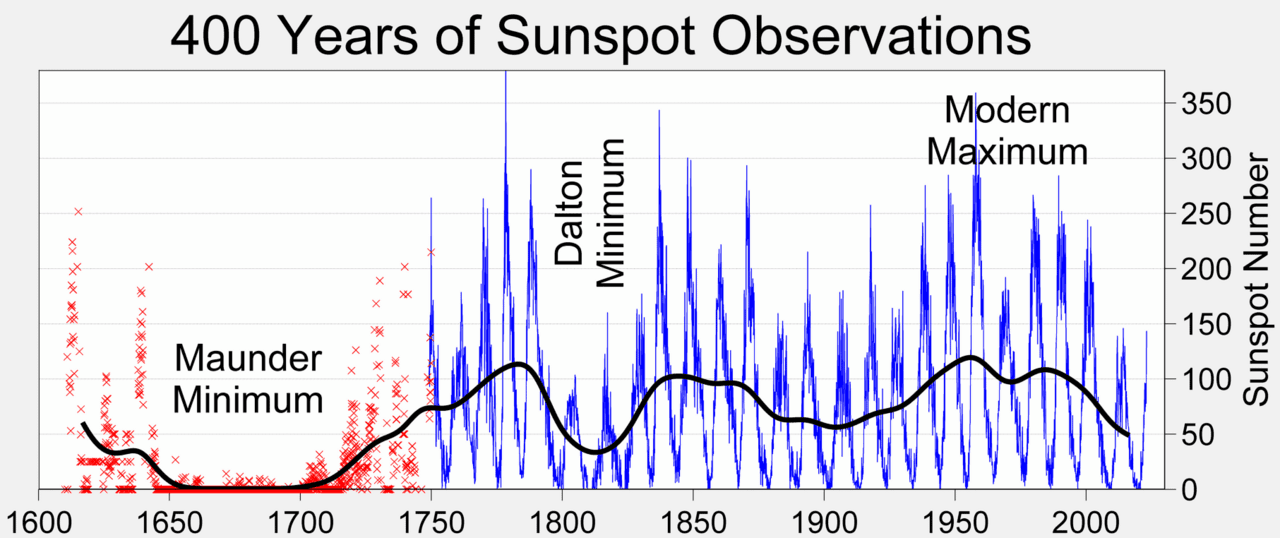
It wasn't for lack of looking. At the Paris Observatory, Giovanni Domenico Cassini ran a regular program of solar observations. This is the same Cassini who doubted Rømer about the speed of light. Johannes Hevelius kept watch too.
Gustav Spörer noticed the gap in the old records in the 1880s. Edward Walter Maunder and Annie Maunder took the work further. The name Maunder Minimum caught on after John Eddy published a landmark paper about it in 1976.
Old records alone can't settle it. But the Sun leaves other traces, and they agree.
Space is full of cosmic rays, fast particles from far beyond the Solar System. The Sun's magnetic field pushes many of them away from Earth. When the Sun is quiet, that shield weakens and more cosmic rays get through.
When they hit the upper air, they make rare atoms like carbon-14 and beryllium-10. Tree rings keep a record of the carbon-14, and ice cores keep the beryllium-10. Both show extra amounts in the late 1600s.
Eclipses help too. Witnesses of the total eclipses in 1652 and 1706 described the Sun's outer glow, the corona, without the long rays it usually shows.
A drawing of the 1706 eclipse, long thought lost, turned up again in 2012. It was by Maria Clara Eimmart, a skilled observer and artist in Nuremberg. Her corona has no big rays either.
The quiet Sun had quirks of its own. The few spots that did appear crowded into its southern half. A faint 11-year rhythm kept ticking underneath, and auroras were still seen.
It's tempting to blame the Little Ice Age, the long cold spell in Europe, on the quiet Sun. But the cooling began before the lull, and volcanic eruptions are thought to be the main cause.
Some researchers have argued that the Sun wasn't really so quiet. But a 2015 review that weighed every kind of evidence came down on the side of a very quiet Sun, quieter even than during its next big lull, around 1800.
The Maunder Minimum wasn't the only lull. Tree rings and other records point to about 18 such lulls in the last 8,000 years. By some estimates the Sun spends up to a quarter of its time in them. Nobody can say when the next one will start. Nobody knows exactly what brings the Sun's activity back afterward, either.
5. 🌌 I Zwicky 18 looked like a newborn galaxy
I Zwicky 18 is a small galaxy about 59 million light-years away, in Ursa Major. It's made almost entirely of hydrogen and helium, the raw mix that came out of the Big Bang.
That makes it odd. Most galaxies near us are old. Their stars have been forging heavier elements for billions of years, so their gas is laced with oxygen, carbon and iron.
Heavier elements are made inside stars and spread when the stars die. A galaxy with almost none of them seemed to have made few stars. One explanation stood out: maybe I Zwicky 18 had only just started.
Decades ago, studies at Palomar Observatory suggested exactly that. The galaxy seemed to have burst into star formation billions of years after its neighbors. Some later work put its age at under 500 million years.
That would make it a prize. Newborn galaxies are normally seen only at enormous distances, in light that left them in the young universe. Here was one close enough to study in detail.
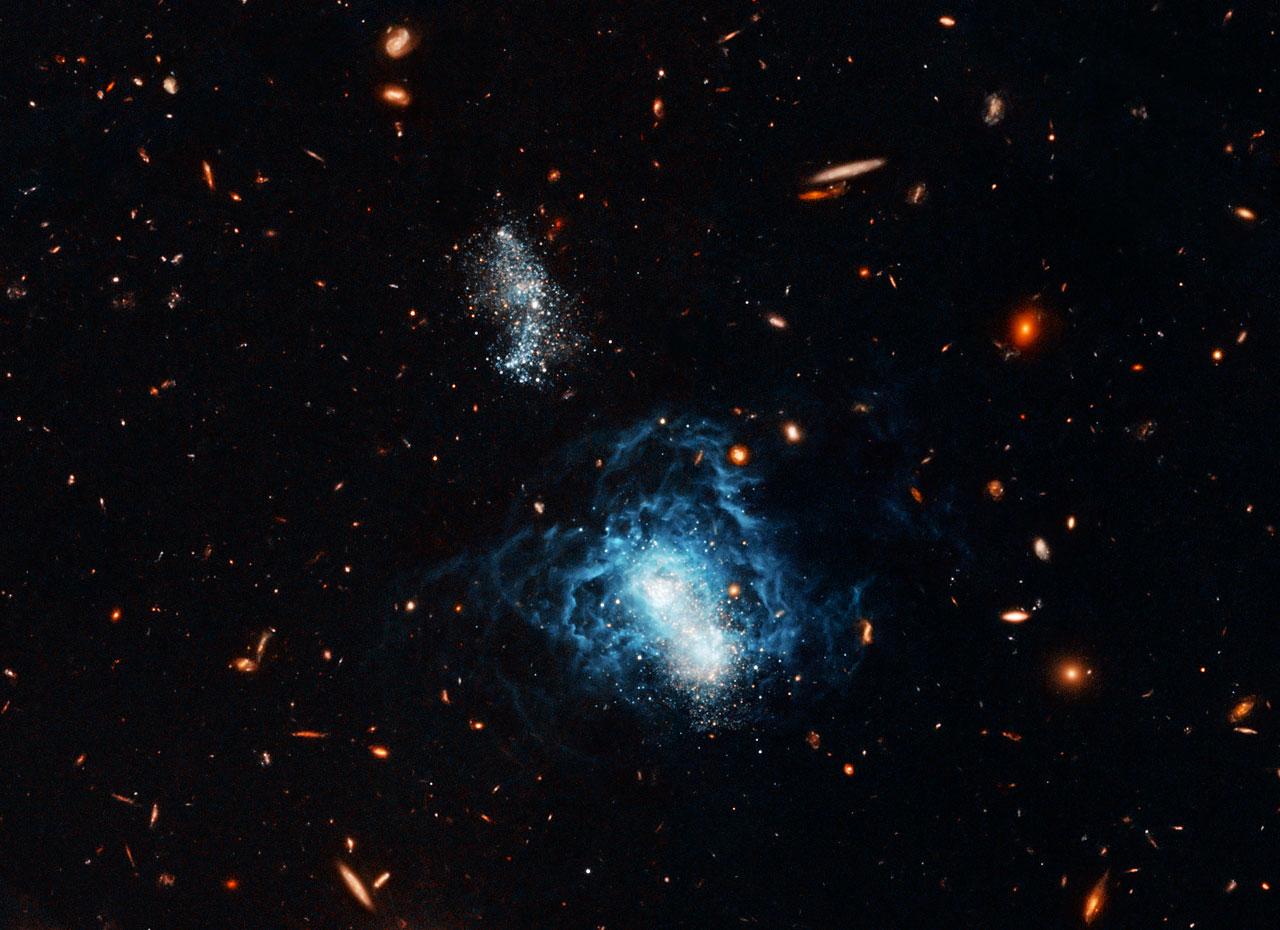
There's a straightforward test. Heavy stars swell into red giants quickly. Small, light stars take more than a billion years, and they make fainter red giants. Find a crowd of those faint red giants in a galaxy, and the galaxy must be at least a billion years old.
The catch is that they're faint, and from this distance they're very faint.
Alessandra Aloisi and colleagues used Hubble's Advanced Camera for Surveys to look again in 2005 and 2006. This time the red giants were there. The galaxy started making stars at least a billion years ago, and possibly 10 billion.
It also turned out to be farther away than thought, by almost 10 million light-years. That helped explain why the old stars had been so hard to see. They sat right at the limit of what Hubble could pick out.
I Zwicky 18 isn't a newborn after all. But if it has been around for billions of years, why did it make so few stars for so long? And why is it suddenly making so many now? Its small companion may be tugging on it and setting off the current burst, but nobody knows for sure.
6. 🕳️ The suspected black hole in NGC 1850 that nobody could see
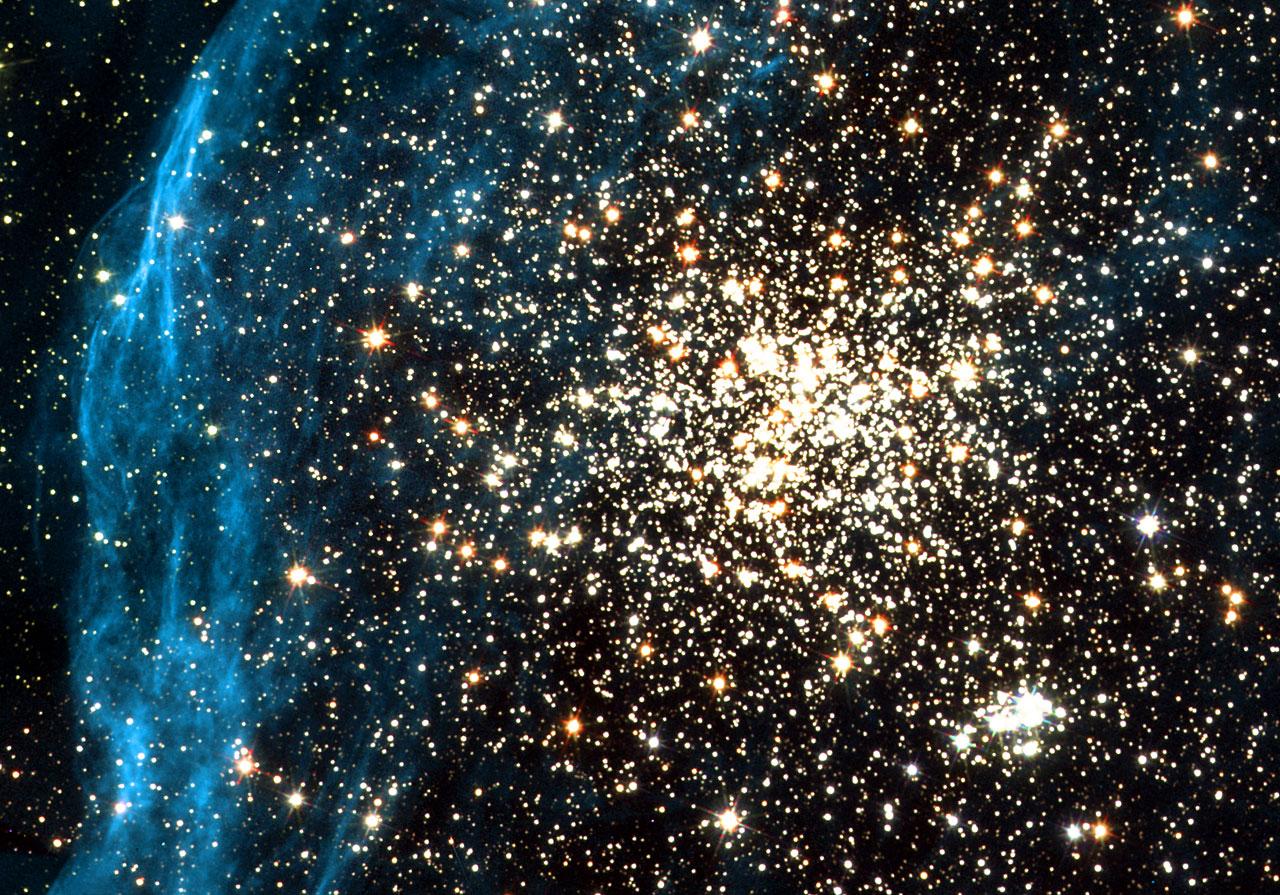
A star in NGC 1850 was being whipped around by a heavy partner. Yet the partner gave off no light anyone could find. NGC 1850 is a young cluster of stars in the Large Magellanic Cloud, and in November 2021 astronomers announced that the partner was a black hole. They called it the first black hole found that way outside our galaxy.
"That way" matters. A black hole that isn't eating gas gives off no light at all. But if it has a companion star, you can watch the star swing back and forth.
The star's light shifts slightly toward blue as it comes toward us and toward red as it moves away. The size of that swing hints at how heavy the unseen partner is. To pin it down, you also need the visible star's own mass and the tilt of the orbit.
Sara Saracino and colleagues used a spectrograph on ESO's Very Large Telescope to track thousands of stars in the cluster. One was swinging back and forth so hard that its speed toward us changed by more than 300 kilometers per second.
They took it to be a star of about 5 Suns. With that, its invisible partner came out at about 11 Suns.
A normal star that heavy would outshine the one they could see. Since nothing showed, they concluded it was a black hole.
Within days, Kareem El-Badry and Kevin Burdge pushed back. Their argument hangs on the visible star's shape.
The partner's gravity stretches the star into an egg. As it orbits, we see its long side and then its end, so its brightness rises and falls twice per orbit.
Around each star in a pair there's an invisible boundary. If a star swells past it, its gas starts spilling onto the partner. Those big brightness swings suggested this star nearly fills its boundary.
A star that fills its boundary can't be too fluffy. The faster the pair orbits, the denser the star must be to hold itself together. That means the length of the orbit tells you the star's density. Combine that with the star's size, and you get its mass.
This one came out far too light for 5 Suns. It looked like a puffed-up star of about one Sun, stripped of most of its outer layers by its partner. With a lighter star doing the swinging, the partner only needed a few Suns. An ordinary star that size could be hiding in the glare.
The same thing had happened with HR 6819, once called the nearest black hole to Earth.
The question stayed open for years. Then new observations split the starlight into finer bands of color. They also reached further into blue light, where a hidden hot star would show up best.
Rhys Seeburger's team, with Saracino among them, pulled the mixed light apart. As two stars orbit, the dark lines in their light shift in opposite directions. Tracking that lets you separate one star's light from the other's. The second star was there: hot, about 5 Suns, and spinning fast.
The visible star came out at about 1.7 Suns. Its partner spins at least 275 kilometers per second at its equator, probably because it has been swallowing gas from the puffed-up star. Gas falling onto a star brings spin with it, like a push on a merry-go-round.
One thing still doesn't fit. The new spectra say the hidden star gives off about a third to half of the red light. The original data had put it under a tenth. Nobody knows why yet, and the new study is still under review.
7. ☄️ Giotto's close call with Halley's Comet
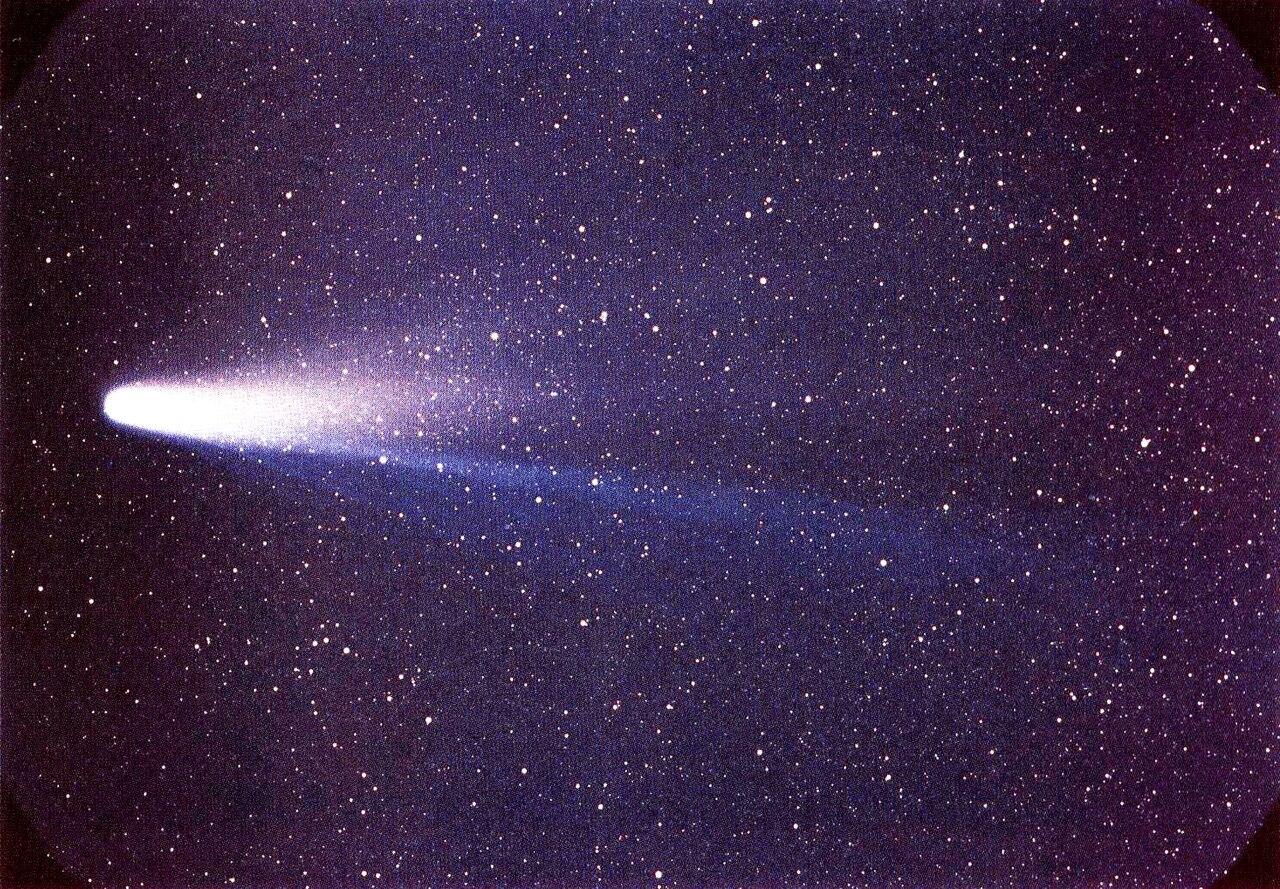
In March 1986, a small European spacecraft named Giotto headed into the cloud of gas and dust around Halley's Comet. It was aiming to pass about 540 kilometers from the solid core. Estimates of its chances of surviving ran from about 90 percent all the way down to zero.
Giotto was the European Space Agency's first mission into deep space. It was named after the painter Giotto di Bondone, who saw Halley's Comet in 1301 and painted it as the Star of Bethlehem.
The danger was speed. Giotto and the comet were rushing toward each other at about 245,000 kilometers per hour, fast enough to cross the Atlantic in 11 minutes. At that speed, a dust grain weighing a tenth of a gram could punch through 8 centimeters of solid aluminum.
A solid shield thick enough would have weighed far too much. Engineers used an idea Fred Whipple had in 1947 instead. A thin sheet of aluminum in front turns most incoming grains into a spray of vapor. A thicker sheet of Kevlar, 23 centimeters behind it, catches what's left.
Giotto didn't go in alone. Two Soviet probes, Vega 1 and Vega 2, flew past the comet days earlier and pinned down where its core was. Two Japanese probes and an American one measured the comet from farther off. With the Vegas' help, Giotto could be aimed very precisely.
It passed the core on March 14, at 596 kilometers. Just 7.6 seconds before its closest approach, a grain hit it hard enough to knock it off balance. Its dish antenna swung away from Earth, and for 32 minutes its signal came and went until it steadied itself.
Another impact destroyed the camera, but only after it had photographed the core.
The core turned out to be a dark, lumpy peanut about 15 kilometers long. Its surface was very dark, probably from a thick coat of dust. Only about a tenth of it was active, with jets of gas and dust bursting from the sunlit side. The gas was mostly water.
Its work wasn't done. Controllers put it to sleep, woke it in 1990 and swung it past Earth for a boost. It became the first spacecraft to return from deep space and use Earth this way. In 1992 it flew within about 200 kilometers of a second comet, Grigg–Skjellerup.
No spacecraft had visited two comets before. Giotto did it with a broken camera.
8. ⭐ Technetium in red giants showed that stars make elements
Technetium should be long gone from an old star. Every kind of technetium atom is radioactive. Even the longest-lived kind loses half its atoms in about 4 million years, so any the Earth began with is long gone too. Why, then, was it showing up in red giants?
On Earth, chemists hunted for element 43 for decades and never found it in nature. It finally turned up in scrap. Emilio Segrè asked Ernest Lawrence for discarded parts of his cyclotron, an early particle accelerator.
Inside a molybdenum foil Lawrence mailed him in 1936, Segrè and Carlo Perrier found element 43. It was the first element to be made artificially, and it was named technetium, from the Greek word for artificial.
Then, in 1952, the astronomer Paul Merrill found it in the sky.
Each element absorbs light at its own exact colors. That leaves a pattern of thin dark lines in a star's light, like a fingerprint. Merrill saw technetium's lines in the light of a group of cool, swollen red giants.
These stars have lived far longer than a few million years, and technetium can't. Any they were born with would be gone. They must be making it now, deep inside, and bringing it up to the surface.
It was the first unmistakable proof that stars build elements.
Here's how. The center of every atom holds protons and neutrons. The number of protons decides which element it is. Add a neutron and the atom gets heavier but stays the same element. But a neutron can later turn into a proton, and then the atom becomes the next element up.
These stars are giants near the end of their lives. Deep inside, between two shells where they burn hydrogen and helium, atoms like iron catch free neutrons one by one. Step by step, heavier elements build up.
Every so often, the star's churning drags this material up to the surface. The kind of technetium these stars make loses half its atoms in about 200,000 years. Seeing it means the churning happened recently.
9. 🌍 Did Earth make its own water?
The rock was bone-dry when it went into the furnace. Once it met hot hydrogen, water vapor came off it. Could the same reaction have helped fill Earth's oceans?
The usual story is that it didn't need to. Close to the young Sun, it was too warm for ice. Water, the thinking goes, came in on icy material from colder regions farther out. But it's hard to see how enough could have reached Earth from so far out, or whether that delivery fits Earth's chemistry.
A team at the University of New Mexico has tested a different idea: that Earth made much of its own water while it was still growing.
Many astronomers now think planets grow partly by sweeping up pebbles, bits of rock from millimeters to centimeters across. As the young Earth grew, it could have wrapped itself in a thick, hot atmosphere rich in hydrogen. Pebbles would rain down through it.
Here's the chemistry. Rock contains iron oxide, which is iron bound to oxygen. Rust is a kind of iron oxide too. Hot hydrogen can pull the oxygen away. The iron is left behind as metal, and the hydrogen and oxygen together make water.
Susmita Garai and her colleagues tried it. They melted dry, basalt-like rock in a stream of hydrogen gas, at 1,200 to 1,400°C. Each run lasted between 15 minutes and three hours.
Almost 80 percent of the iron oxide turned into metal, giving off water vapor. With helium instead of hydrogen, nothing happened. The water came quickly, within hours, and in large amounts. Scaled up to the young Earth, the team estimates the process could have made hundreds of oceans' worth.
Her coauthor Zachary Sharp put the picture plainly: the water we look out over today "may have been produced 4 ½ billion years ago in a hell-like atmosphere."
The experiments show the chemistry works. They don't show how much of today's ocean was actually made this way. Comets and meteorites may still have brought some, and the balance between the two is open.
If the idea holds, though, water may not depend on lucky deliveries. Any Earth-sized planet built from pebbles in a hydrogen atmosphere could make oceans of its own.
10. 🌌 The CfA2 stick figure and the Great Wall of galaxies
In 1986, a map of the nearby universe showed a little stick figure standing in the middle of it. It was a slice from the CfA2 survey. Astronomers had mapped about 1,100 galaxies in a long, thin strip of sky. Each dot marked a galaxy's position and its distance.
The team was Valérie de Lapparent, Margaret Geller and John Huchra.
To make a map like that, you need each galaxy's distance. The universe is expanding, so distant galaxies are moving away from us, and the farther they are, the faster they go. That motion stretches their light toward red, which is called a redshift. Measure a galaxy's redshift and you have a rough distance.
Their strip ran through the Coma cluster, a huge swarm of galaxies. They plotted each galaxy by its position across the strip and its distance. The result was a fan-shaped slice of the nearby universe.
The pattern changed how astronomers pictured the universe. The slice showed galaxies crowded onto thin walls around big empty bubbles. In the middle stood a little figure, with a body and outstretched arms.
The body is the Coma cluster, and it's an illusion of the method. Galaxies in a cluster zip around inside it at high speeds. A galaxy moving away from us inside the cluster gets extra redshift and looks farther away. One moving toward us looks closer.
On the map, the whole round cluster gets stretched into a spike pointing straight at us. Geller calls it the "finger" of the Coma cluster.
The arms are real. They're a cut through a sheet of galaxies that runs all the way across the survey. With more data, Geller and Huchra reported in 1989 that the sheet is enormous. It became known as the Great Wall, and it snakes for at least 500 million light-years.
The empty bubbles are voids. Later slices suggested voids fill most of the space, with galaxies gathered on the thin surfaces between them. Today this pattern is called the cosmic web. The little stick figure was one of the first clear pictures of it.
11. 🪐 Neptune's dark spots keep vanishing
In August 1989, Voyager 2 flew past Neptune and found a dark oval about the size of Earth in the planet's southern half. It looked like a cousin of Jupiter's Great Red Spot, and it was named the Great Dark Spot.
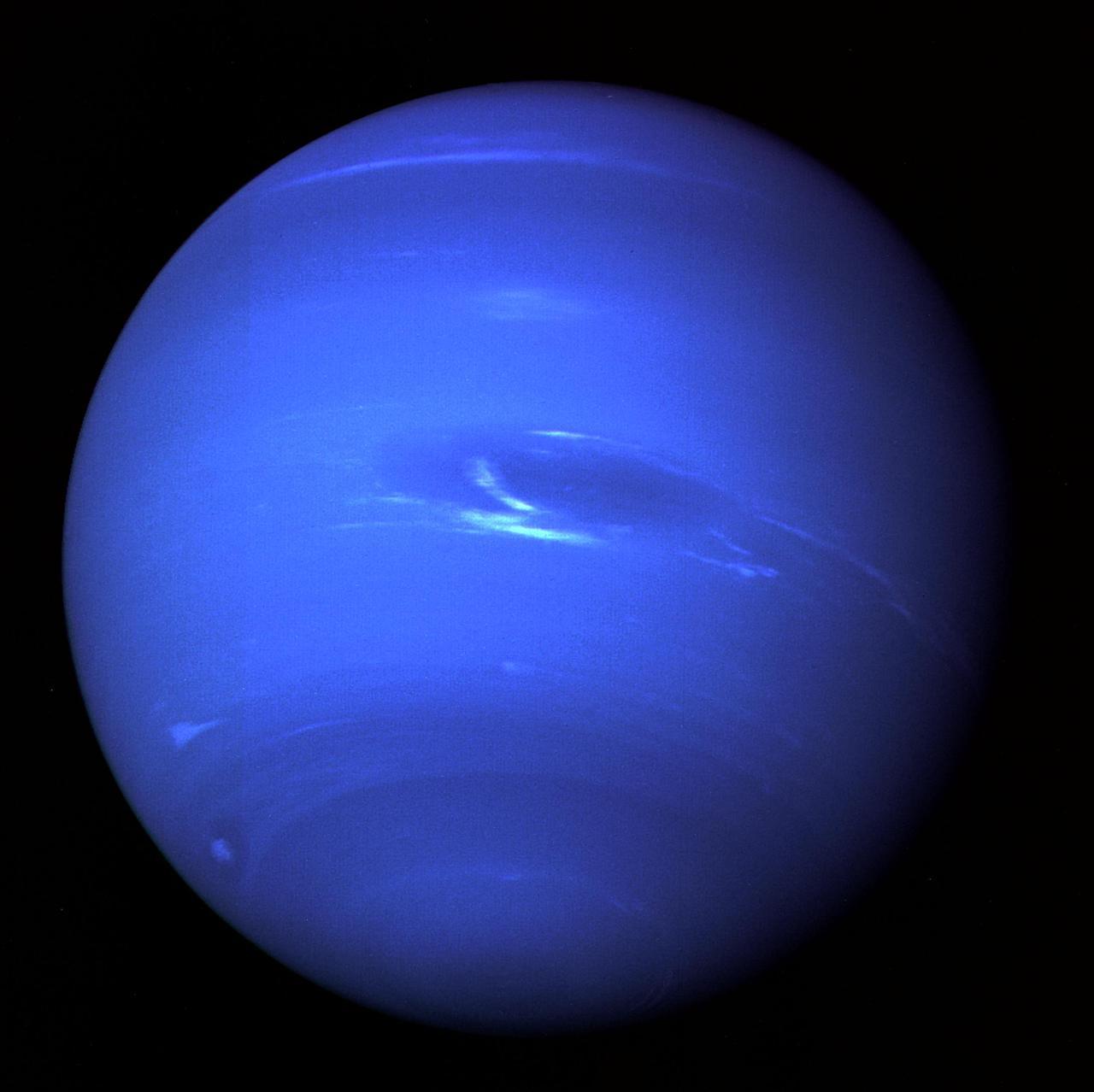
Bright white clouds hung around its edges, made of frozen methane, like wisps of high cirrus on Earth. Winds near the spot reached about 2,100 kilometers per hour, among the fastest anyone has measured in the Solar System.
Jupiter's Great Red Spot has been watched for nearly two centuries. In November 1994, the Hubble Space Telescope looked for Neptune's spot. It was gone.
Since then, Hubble has watched dark spots come and go. One formed in the north in 1994, and another in 1996. A southern one turned up in 2015 and drifted toward the pole before fading. A dark spot is present somewhat more than half the time, but none lasts long.
Then Hubble caught a new spot from its birth in 2018, the first time that had happened. It drifted south toward the equator, where spots are expected to break up. Then it stopped and turned back north.
Around the time it turned, in January 2020, a smaller spot appeared beside it. Astronomers nicknamed it Dark Spot Jr. By August, Hubble's images showed the big spot clearly heading north.
For years, the leading idea was that a dark spot is a hole in the clouds. Through it, we'd see down into deeper, darker layers.
Patrick Irwin and colleagues tested that idea in 2023 with ESO's Very Large Telescope. It was the first time anyone had seen one of Neptune's dark spots from the ground. Their instrument split the light from the planet into its colors, and different colors reach different depths in the atmosphere.
A hole in the clouds and a patch of darker particles would change those colors in different ways. The team compared the spot's colors with models of Neptune's atmosphere. The spot wasn't a hole. It's more likely a patch where particles have darkened, in a layer below the main haze, as ices and hazes mix.
Not bad for a telescope on the ground, looking at a planet 4.5 billion kilometers away.
What darkens those particles, what sets each spot spinning and what finally kills it are all still open. The next spot will form somewhere, and nobody knows when.
12. 📡 The pigeons in the horn and the cosmic microwave background
In 1964, Arno Penzias and Robert Wilson had a hiss they couldn't get rid of.
They worked for Bell Labs, on a hilltop in Holmdel, New Jersey. Their antenna was a large horn, built to pick up radio signals bounced off Echo, a giant balloon satellite. They wanted to use it for radio astronomy, and that meant knowing every bit of noise in the system.
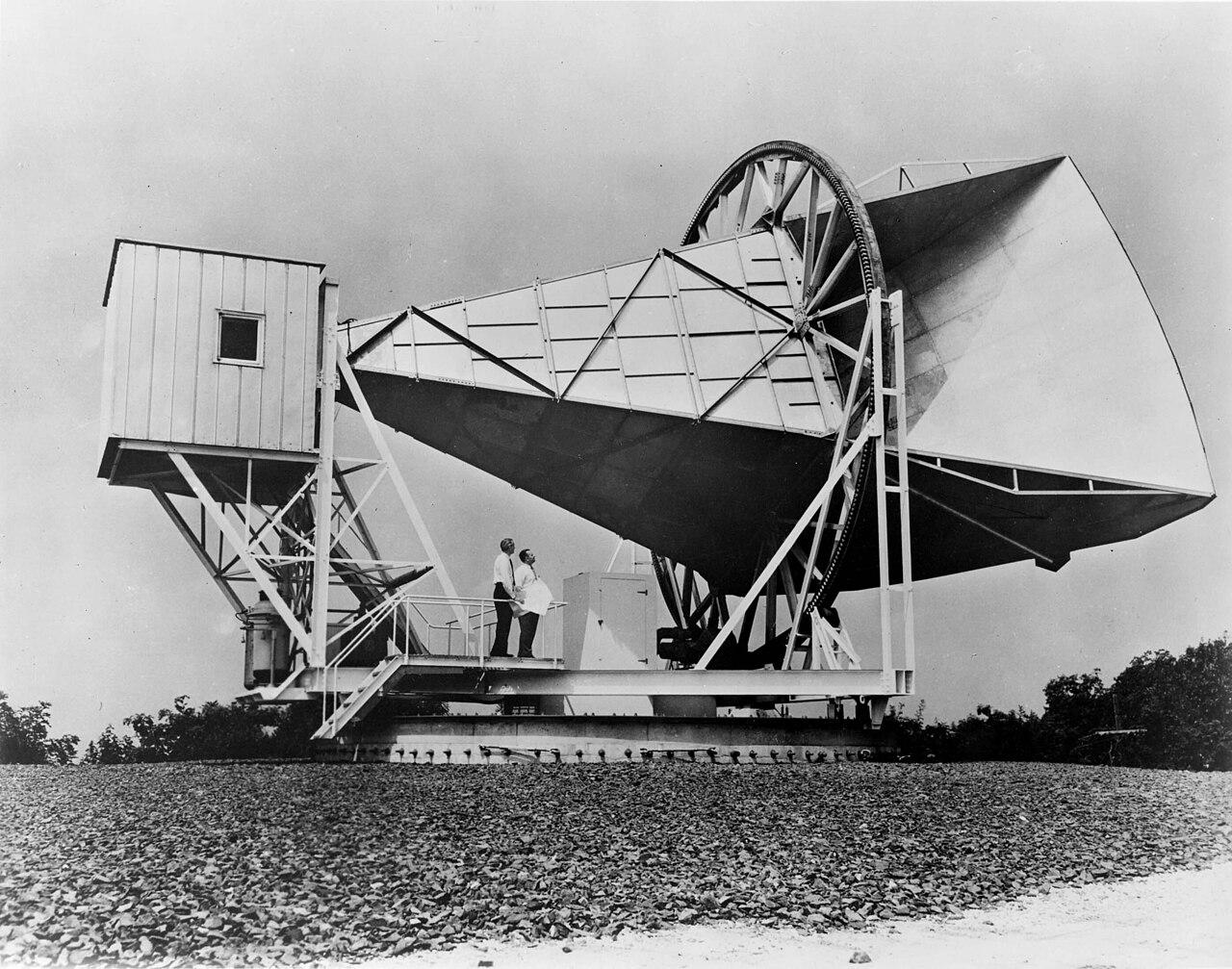
They cooled their receiver with liquid helium to about 4 degrees above absolute zero. They accounted for radar, broadcasting and every known source of noise in their equipment. A faint, steady noise was still there.
It came evenly from every direction, day and night. That ruled out the obvious suspects. Anything on Earth, the Sun or our galaxy would be stronger in some directions than others.
Next suspect: the antenna itself. Some pigeons had been nesting inside the horn, and they had coated it with droppings. Penzias and Wilson evicted the pigeons and cleaned up the mess. The noise remained.
Meanwhile, about 60 kilometers away at Princeton, Robert Dicke, Jim Peebles and David Wilkinson were getting ready to look for exactly this.
Their reasoning went like this. If the universe began hot and dense, it would have been filled with glowing gas. At first, free electrons kept bouncing the light around, like fog. As the universe cooled, the electrons joined atoms, and the fog cleared. The light could travel freely.
That light would still be crossing space today. Expanding space would have stretched its waves, from the glow of hot gas into faint microwaves.
A friend, the physicist Bernard Burke, told Penzias about a paper by Peebles on that leftover radiation. Penzias phoned Dicke, then invited the Princeton group over to see the horn and hear the noise.
The two groups published side by side in 1965. Penzias and Wilson reported their leftover noise. It matched a glow from something about 3.5 degrees above absolute zero, coming from every direction. They pointed to Dicke's letter for a possible explanation: the leftover glow of a hot young universe.
The glow became known as the cosmic microwave background. It's the oldest light we can see, and strong evidence that the universe had a hot beginning.
Penzias and Wilson shared the 1978 Nobel Prize in Physics. Peebles won one in 2019.
Back in 1941, Andrew McKellar had studied molecules floating in space between Earth and a hot star. Some of them were spinning a little, as if something was nudging them. The amount of spin matched a bath of radiation about 2.3 degrees above absolute zero. McKellar thought the number "will have its own, perhaps limited, significance."
Without knowing it, he had measured the same glow indirectly, more than 20 years early.
13. 🌌 Could the universe end in a Big Rip?
For most of the 20th century, the end of the universe came in two flavors. Either it expands forever and slowly goes cold, or gravity pulls it back together in a Big Crunch.
A 2003 paper by Robert Caldwell, Marc Kamionkowski and Nevin Weinberg described a third ending, stranger than either.
It hinges on dark energy, whatever is making the expansion speed up. In its simplest version, dark energy belongs to empty space itself. Every cubic meter holds the same amount forever, even as space grows. That's Einstein's cosmological constant.
Now suppose each cubic meter held a little more as space expands. Physicists call that phantom energy. Its push would keep growing, and the expansion would speed up faster and faster.
The paper worked through one simple rule for how phantom energy grows, and assumed the rule never changes. Under that rule, distances across the universe stretch without limit at a definite moment in the future.
That changes what happens to things held together. Today, gravity holds the Milky Way and the Solar System together easily. Constant dark energy is far too weak to pull them apart, and it never gets any stronger. Phantom energy does. Sooner or later it beats every force holding anything together.
The biggest and loosest things go first. The team picked one example, with phantom energy growing slowly. In that example, the end comes about 22 billion years from now.
Galaxy clusters come apart about a billion years before the end. The Milky Way goes about 60 million years before.
After that it speeds up. The Solar System comes unbound about three months before the end. Earth itself flies apart about 30 minutes before. Then molecules, atoms and even the particles inside atoms are torn apart, in the last tiny fraction of a second.
In 2003 this wasn't idle speculation. The data then allowed dark energy that was a bit stronger than a constant, and some fits even preferred it.
Lately the hints have pointed the other way. Last year the DESI galaxy survey, combined with other measurements, found signs that dark energy's influence may be weakening over time. That's the opposite of what a Big Rip needs.
Then, in July, a new DESI analysis of gas between distant galaxies agreed with a constant instead. The evidence is unsettled, and none of it tells us for sure how the far future will go.
There's one detail in the 2003 paper I can't shake. When the Milky Way is being pulled apart, other galaxies might still be close enough to see. But their light takes time to arrive, so we'd see our own galaxy go first.
🌙 One last thought before you sleep
Bell's scruff would have been so easy to dismiss. Most odd signals really are faults in the equipment, and cleaning them up is the sensible thing to do.
Still, I keep wondering how many real discoveries have been cleaned away with the mess.
That's all for tonight. Thanks for wondering along with me. Good night, and clear skies. 🌌
— Kasi