"If you want to say 'hello' to Voyager," says Suzanne Dodd, the mission's project manager, "you send your message and then you go home and you wait two days before you finally get a response." On November 18 that wait becomes a round number. Voyager 1 will be one light-day from Earth, the first thing people have built that is so far away its radio signal needs a full day to get home.
That's where tonight starts. Further on there's a small star plowing through the air of Betelgeuse, a pulsar wearing away the star that orbits it, and a mountain of frozen salty mud on Ceres named after a harvest festival in Nagaland. Five atoms of iron, fished out of half a tonne of Antarctic snow, close the issue. They came from a dead star, and they may be the nearest I'll ever get to touching one.
1. 🛰️ Voyager 1 is about to be a light-day from home
At 5:16 in the morning, Eastern time, on Wednesday, November 18, a spacecraft launched in 1977 will cross a line that exists only in our arithmetic. NASA has worked it out to the second: Voyager 1 will be 25,902,068,356 kilometers from Earth, the distance light covers in 24 hours. Nothing else people have made has ever been that far away.
It helps to count in light. Moonlight reaches us 1.3 seconds after it leaves the Moon, and sunlight takes eight minutes and 20 seconds. Neptune, the farthest planet, is on average four hours and ten minutes away. Voyager 1 needed 49 years, two months and 11 days to put a whole day of light between itself and us.
That delay now shapes everything its team does. A command takes a day to arrive, and the answer takes another day to come back. The spacecraft itself is getting harder to keep alive, too. It runs on heat from decaying plutonium, and both Voyagers lose about 4 watts of power every year. Voyager 1 launched with 10 science instruments. Some were turned off after its encounters with the planets, and two more have been shut down in recent years to save power.
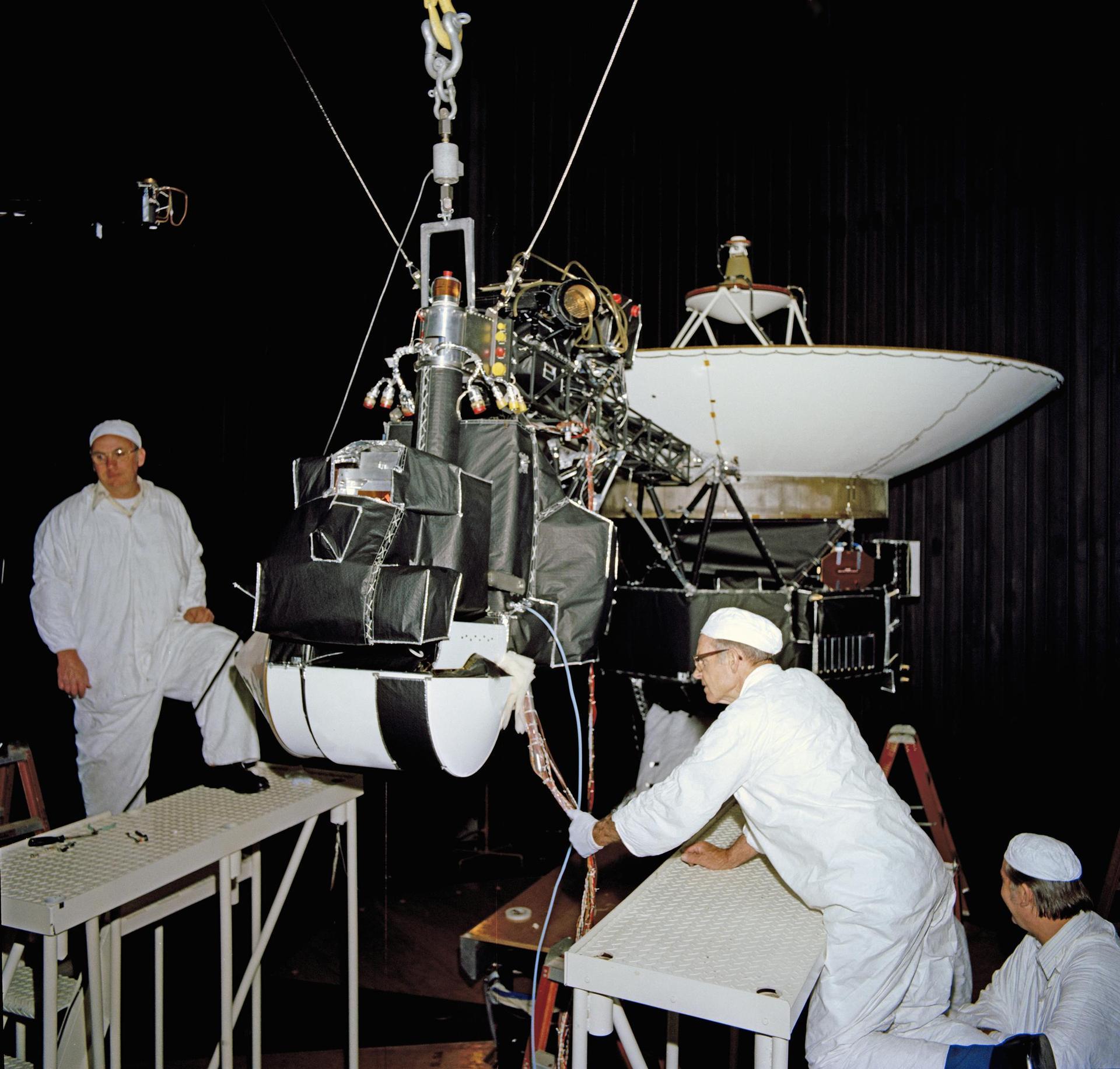
In early September, the team carried out a swap they nicknamed the "Big Bang". They switched off three devices that help keep the spacecraft warm and switched on three that do the job with less electricity. All three had to change at once, so that the heat stayed spread across the spacecraft the way it needed to be. Voyager 2 had the same operation six weeks earlier. Without it, another of Voyager 1's instruments might have had to go as early as summer 2027.
Then, on October 18 and again on October 19, NASA's Deep Space Network listened for Voyager 1 and heard nothing. The signal came back on October 20. Engineers found that one set of thrusters had gone offline and the spacecraft had switched to its backups by itself, a response programmed in for when its computers sense something wrong. "This is the first time we've seen the spacecraft do something like this, but we are also at a point in the mission where we have to expect the unexpected," said Kareem Badaruddin, the mission manager.
Voyager 1 is heading in the direction of a dim star in the Little Dipper called AC +79 3888, more than 17 light-years away. It will pass within about 1.7 light-years of it in 40,000 years. The nearest star to the Sun, Proxima Centauri, is 4.24 light-years away, which is a little over 1,500 light-days. Voyager 1's first light-day took half a century.
Voyager 2, which took a different route past Uranus and Neptune, should reach its own light-day in November 2035. In the meantime NASA is asking people to go outside after sunset on November 17 and flash the mission's call sign, V-G-R, at the sky in Morse code. Any beam pointed the right way would pass Voyager 1 about a day later, far too faint to notice.
2. ⭐ Something is stirring Betelgeuse's air
Betelgeuse, the red star at Orion's shoulder, is so large that the Sun would be lost inside it. Measured at millimeter wavelengths, its radius is about 1,400 times the Sun's. Astronomers now think a much smaller star orbits inside that bloated atmosphere, close enough to skim through it. They named it Siwarha, which means "her bracelet".
Nobody has a clear picture of it. Two studies proposed it in 2024 to explain a slow rhythm in Betelgeuse's brightness, a cycle of about 2,100 days, or close to six years. In their models the companion circles at only about 2.3 times Betelgeuse's radius. Since then, speckle imaging has given a tentative sighting, and the Very Large Telescope picked up a faint point of light where the companion was predicted to be. Mostly, though, astronomers have had to look for its effects, the way you'd spot a boat at night by its wake.
The first sign of a wake came in January. Andrea Dupree and her colleagues went through years of spectra from the ground and from Hubble. Gas around the star absorbs light more strongly just after the companion crosses in front of Betelgeuse, and lines in the ultraviolet show more gas flowing outward at the same time. Then both slowly fade until the next crossing. That's the pattern you'd expect if a trail of disturbed gas, spreading as it goes, follows the companion around its orbit.
Now a second team has found signs of it in radio light. Lynn Matthews of MIT's Haystack Observatory and her colleagues watched Betelgeuse from 2021 to 2026 with the Very Large Array in New Mexico and ALMA in Chile, at seven frequencies from 22 to 485 gigahertz. Each frequency sees to a different depth, so together they show the layers of the star's outer atmosphere. "This companion is orbiting so close to the star that it actually passes through its extended atmosphere," Matthews said in ALMA's announcement.
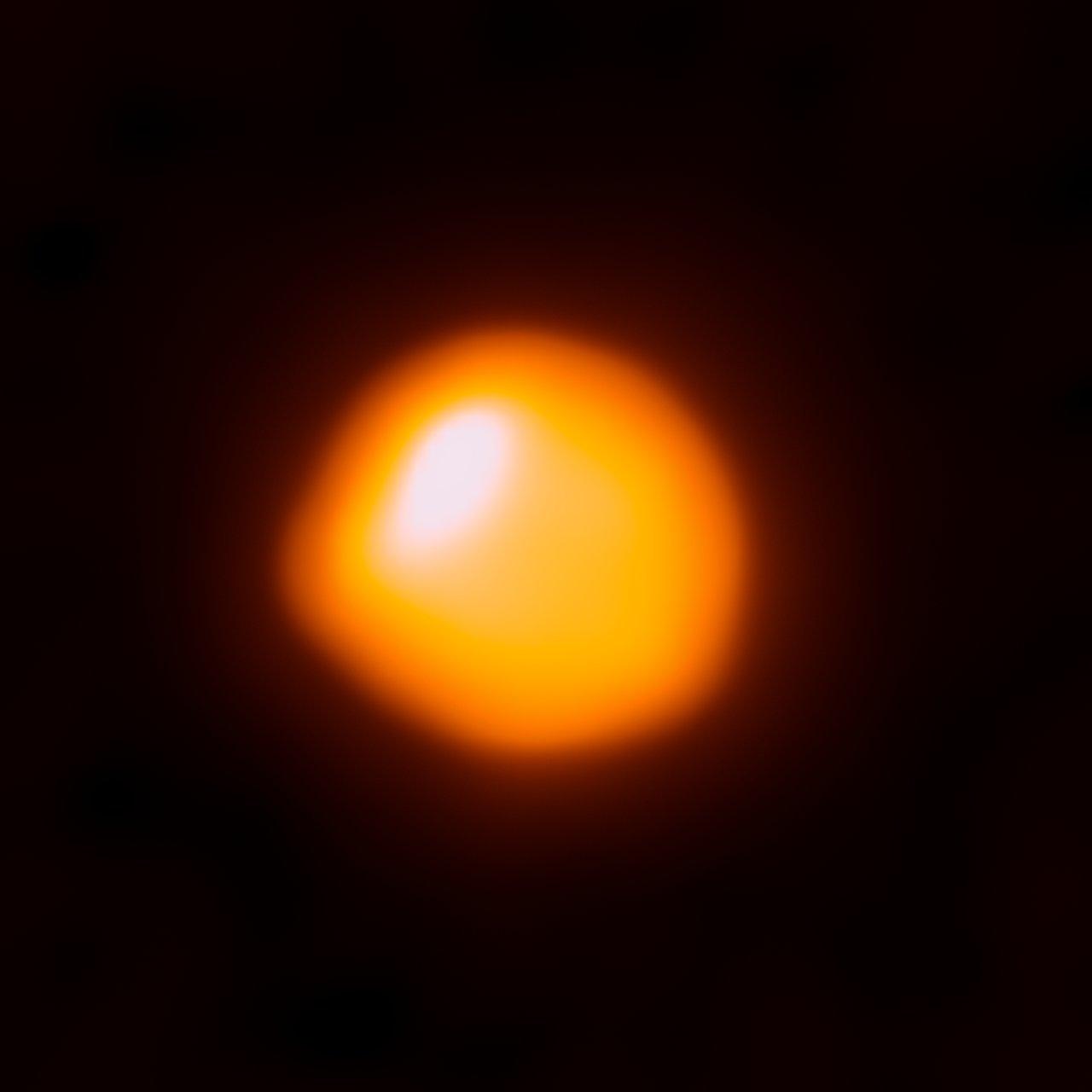
The companion itself is out of reach. If it's a hot star about twice the Sun's size, its radio glow would be tens to hundreds of times too faint for these telescopes. But Betelgeuse's radio disk isn't always round. When the team plotted its shape against the companion's predicted position, the star looked most stretched when Siwarha was farthest from it on the sky, and roundest when Siwarha was passing in front of it or behind it.
The same data say Betelgeuse has recovered from the Great Dimming of 2019 and 2020, when it briefly became fainter than it had been in more than a century. Its outer atmosphere, unusually cold just before that episode, has warmed back to about 3,500 kelvin at 2.7 times the star's radius. Lower down, just above the visible surface, the team confirmed a layer of molecular gas at about 2,200 kelvin, more than 1,000 degrees cooler than the surface beneath it.
The authors say they need to watch more of the companion's orbit to be sure of the link. If it holds, a star we can barely see is leaving its fingerprints on one of the best-known stars in the sky.
3. 🕳️ The Black Widow pulsar is wearing away its partner
In 1988, Fruchter, Stinebring and Taylor reported a pulsar that spins once every 1.6 milliseconds, more than 600 times a second. Fast pulsars were already known. This one was strange because, once every 9.17 hours, it vanished.
Their paper in Nature described the pattern. At the radio frequency they were using, the pulses disappeared for about 50 minutes on every orbit. For a few minutes before each disappearance, and for more than 20 minutes after the pulses came back, they arrived late, by as much as several hundred microseconds. Something around the pulsar's partner was getting in the way, and the delays suggested a cloud of charged gas that slowed the radio waves. The orbit also told them the partner was tiny, only a few percent of the Sun's mass.
PSR B1957+20 became known as the Black Widow, after the spider said to eat its mate. The pulsar throws off a fierce wind of particles and radiation, and its companion is close enough to be scorched by it. Gas boils off the companion into space, and that escaping gas is what blocks the signal. Later timing put the companion's mass at about 0.025 Suns, roughly 26 times the mass of Jupiter.
X-ray telescopes see where the two flows meet. Chandra found that the system's X-rays change with the orbit, and the team traced them to a shock, where the pulsar's wind slams into the gas coming off the companion and lights up.
The scorched companion turned out to be useful. Its heated side glows brightly enough for spectra, and in 2010 van Kerkwijk, Breton and Kulkarni used them to clock how fast it swings around. Their best estimate for the pulsar was 2.4 times the mass of the Sun, which would put it among the heaviest neutron stars known. They flagged the uncertainty themselves: their conservative lower limit was 1.66 solar masses.
Robert Main and colleagues found another use for the companion's gas in 2018. Near the eclipses, clumps in the outflow sometimes act like lenses, focusing the pulsar's radio waves. During these events the signal brightened by factors of up to 70 or 80 at particular frequencies. The lenses were sharp enough to separate parts of the pulsar's emission on scales of about 10 kilometers, about the size of the pulsar itself.
The authors noticed that the lensed signal looked a lot like a repeating fast radio burst, FRB 121102, which suggests that source may also be seen, and sometimes magnified, through clumpy gas near it. A pulsar slowly burning off its partner may help explain one of the strangest signals in radio astronomy.
4. 🌌 The Leo Ring was supposed to be older than galaxies
Radio astronomers mapping hydrogen in the constellation Leo in 1983 found a vast loop of gas around a pair of galaxies, M105 and NGC 3384, about 38 million light-years away. It's about 650,000 light-years across and holds roughly two billion Suns' worth of gas. In ordinary light it's almost invisible. Deep images reaching very faint levels find no glow tracing the ring as a whole.
The Leo Ring has been argued over ever since. One camp has said it's primordial, gas left over from the early universe that never fell into a galaxy. The other has said it's wreckage, thrown out of a galaxy in a collision and left to coast around the group.
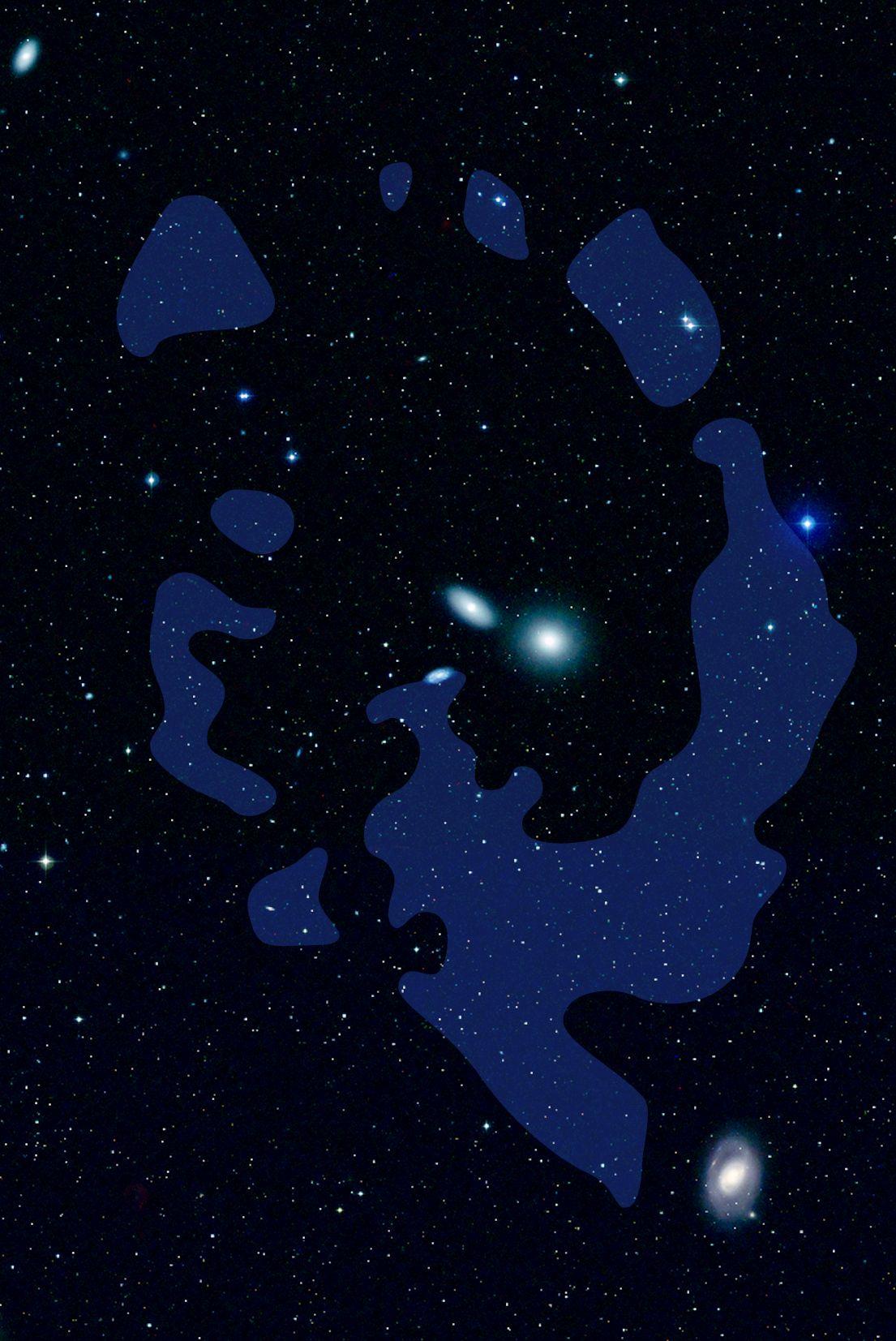
Ultraviolet images from NASA's GALEX satellite, released in 2009, caught small blue clumps of young stars in part of the ring. NASA's caption at the time described them as dwarf galaxies forming out of pristine gas, something never seen before.
A year later the other camp answered. Leo Michel-Dansac, Pierre-Alain Duc and colleagues found faint visible counterparts to several of the clumps, and the light of one looked typical of stars forming in debris that had already been enriched. They then ran a simulation in which NGC 3384 and M96, another galaxy in the group, collide head-on. The collision throws out a ring that matches the real one's main features.
The deciding clue is chemistry. Gas straight from the Big Bang is almost pure hydrogen and helium, while gas that has passed through stars carries heavier elements. A 2014 study used Hubble to look at quasars behind the ring and measured about 10 percent of the Sun's share of heavy elements in its gas. That was more than primordial gas should have but less than a collision seemed to predict, and both sides could adjust their models to fit.
Then, in 2021, Edvige Corbelli and her colleagues pointed the MUSE spectrograph on the Very Large Telescope at three of the densest clumps. They found glowing hydrogen around massive young stars, and its spectrum gave heavy-element levels close to the Sun's or above. The ring's few stars could have made less than 3 percent of those elements themselves. The gas must have been enriched inside a galaxy's disk and later pulled out by tides, which, in the team's words, "convincingly demonstrates that the gas in the ring is not primordial".
The ring is still making stars, very slowly. Corbelli's group found young stars as massive as type O7, but in places the gas would last as long as 100 billion years at the current rate. The best candidate anyone had for gas older than galaxies has turned out, most likely, to be the leftovers of a galaxy.
5. ☄️ The smallest things we've seen beyond Neptune
Beyond Neptune, the Solar System is full of icy leftovers from the time the planets formed. The small ones are hard to see. Most of these objects are more than 100 million times fainter than anything you can see without a telescope.
Teams from the University of Victoria in Canada and Northern Arizona University went after them anyway. They aimed Hubble and the James Webb Space Telescope at the same small patch of sky at nearly the same time, Hubble in visible light and Webb in infrared. The patch covered 0.05 square degrees, about a quarter of the area of the full Moon.
The faintest of these objects barely register, and they drift against the stars. So the team stacked many images, shifting each one to follow a path a distant object might take, so that a faint mover would pile up into a visible dot while the stars smeared out. Stacking like this throws up false alarms, so they trained a machine-learning network to weed them out. What survived was the deepest survey of the Solar System yet, with 27 objects nobody had seen before.
Spotting the faintest one, in NASA's comparison, is like seeing a small swarm of fireflies on the Moon from Earth. NASA puts the smallest find at about 5 kilometers across. The paper's own estimate for its faintest is about 10 kilometers, if its surface reflects 15 percent of the sunlight. Either way, that's around five times smaller than anything the best telescopes on the ground can pick up out there.
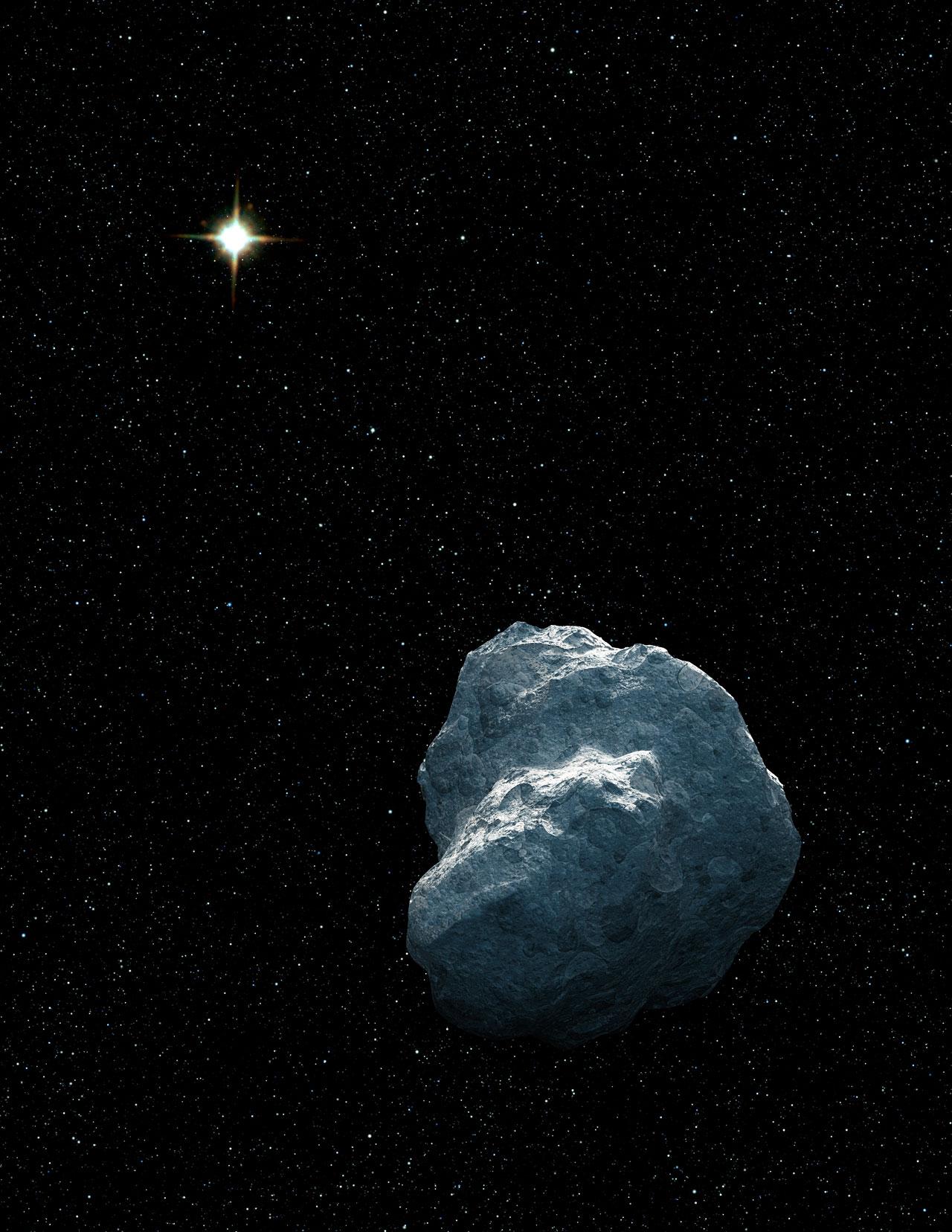
Two populations live out there. The "cold" objects travel on fairly circular, flat orbits, close to where they formed, about 45 times farther from the Sun than Earth. The "hot" ones formed closer in, around 25 times Earth's distance, and were scattered outward when the giant planets shifted early on. Despite their different birthplaces, both came out with the same mix of sizes. "The process seems to be insensitive to disk conditions," said Marielle Eduardo, the PhD candidate who led that analysis.
The colors were the bigger surprise. Astronomers expected small objects to have been battered by billions of years of collisions, exposing fresh material and changing their color. Instead, the little cold objects fall on the same color sequence as the big ones, and the hot ones show the same spread of colors as larger hot objects. "It's really fascinating to see that the smallest objects are somehow 'remembering' and preserving the history of how they were made," said Anastasia Morgan, who led the color study. Either collisions are rarer than expected, or these bodies hold onto their original surfaces anyway. Nobody knows which.
The survey also found fewer small objects than some formation models predict. A related study using the Webb data finds that the cold population's mass is concentrated in bodies around 75 kilometers wide. Add the whole cold population together and you get between a seventh and a fifth of the mass of our Moon, spread across billions of kilometers.
6. 💥 The brightest star anyone ever wrote down
Some time in late April or early May of the year 1006, a new star appeared low in the southern sky. It was probably the brightest star in recorded history, reaching an estimated magnitude of −7.5, roughly sixteen times brighter than Venus. For weeks it could be seen in daylight.
People wrote about it from China to Switzerland. In Egypt, the astrologer and astronomer Ali ibn Ridwan described a round body two and a half to three times the size of Venus, its light a little more than a quarter of moonlight, so that the sky shone. The official history of China's Song dynasty says it was bright enough to see objects on the ground at night. An astrologer named Zhou Keming told the emperor it was a lucky yellow star that would bring prosperity, a color he may have chosen for political reasons.
The farthest north it was seen was the abbey of St. Gall in Switzerland. The monks there wrote, in a common translation, that it was "sometimes contracted, sometimes diffused, and moreover sometimes extinguished", and that it was seen "for three months in the inmost limits of the south".
There may be an earlier sighting, too. Two Yemeni chronicles, translated by Wafiq Rada and Ralph Neuhäuser in 2015, put the first sighting on an evening around April 17, about a week and a half before the earliest reports known until then.
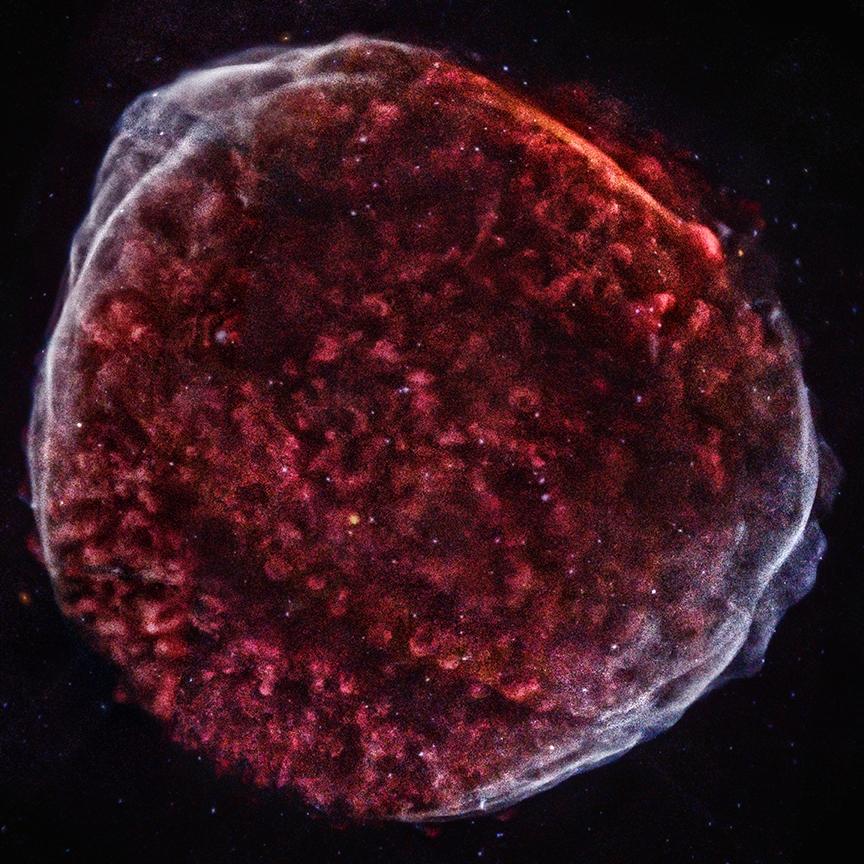
The remains were identified in 1965, when Doug Milne and Frank Gardner used the Parkes radio telescope to link the old star to a radio source in the constellation Lupus. Chandra's 2013 portrait, ten pointings and more than eight days of observing in all, mapped silicon, oxygen and magnesium still flying outward. Its fastest knots move at almost 11 million miles an hour, about 18 million kilometers an hour, and the remnant is about 7,000 light-years away.
SN 1006 was a white dwarf blowing itself apart, the kind of supernova astronomers use to measure the expansion of the universe. A white dwarf can get there by pulling matter off a companion star until it's too heavy, or by merging with another white dwarf. Only the first leaves a survivor. Jonay González Hernández and colleagues checked the stars near the explosion site in 2012 and found no giant or subgiant star that could have been the companion. Combined with earlier searches, they concluded that fewer than one in five of these supernovas come from a white dwarf feeding on a companion.
That makes two dead stars spiraling together the likeliest cause. The brightest star anyone ever wrote down was, a day earlier, a pair of objects no one on Earth could have seen.
7. 🟤 A weather report from the nearest brown dwarfs
Brown dwarfs are more massive than planets but too light to keep up the fusion that powers a star, so they spend billions of years slowly cooling. The nearest ones weren't found until 2013, when Kevin Luhman spotted an object moving unusually fast in images from NASA's WISE infrared survey.
He had been searching WISE for exactly that, because nearby objects shift quickly against the distant stars. This one, cataloged as WISE J104915.57−531906.1, turned out to be in older sky surveys too, once he knew where to look. From its shifts he measured a distance of about 2 parsecs, around six and a half light-years, making it the third-closest system to the Sun. An image from the Gemini telescope split it into two objects about 3 astronomical units apart. It's now known as Luhman 16.
Within weeks, Gillon and colleagues were watching it with the robotic TRAPPIST telescope. The pair's brightness wobbled by as much as 11 percent in a cycle of about 4.87 hours, and the pattern changed from one night to the next. The wobble came from the cooler of the two, Luhman 16B, and it read like weather: patchy clouds rotating in and out of view and changing as they went.
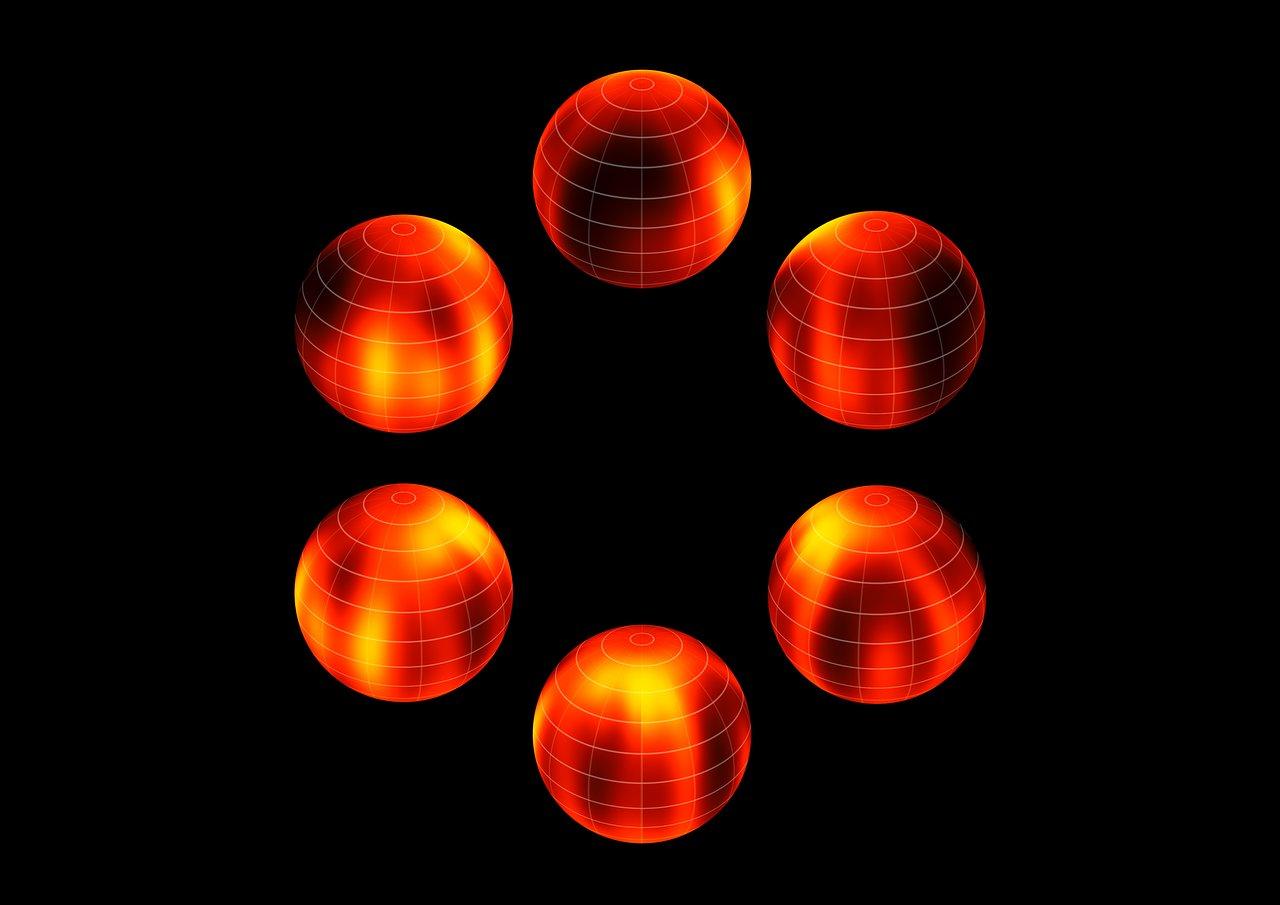
These clouds aren't made of water. Below about 2,300 kelvin, grains of calcium aluminates, silicates and iron condense in a brown dwarf's air, and they disappear again at around 1,300 kelvin. The next year, Crossfield and colleagues used the Very Large Telescope to make the first map of a brown dwarf's surface. Its bright and dark features pointed to clouds broken into patches, the way they are on Jupiter.
There was a false alarm along the way. Irregularities in the pair's motion led one team, in 2013, to suspect a third, smaller companion. Hubble tracked the system for several years and found no third body down to the mass of Neptune, for orbits longer than about a year.
The James Webb Space Telescope has since turned Luhman 16 into a regular weather station. Its spectra show water, methane and carbon monoxide in both objects, and possibly tiny silicate grains in the warmer one. By watching how different colors of light brighten and fade, the team found layers behaving in different ways. Deep down, patchy clouds seem to drive the changes. Higher up, hot spots, perhaps from shifting chemistry, seem to take over. A second Webb visit seven months later found each layer still behaving the same way.
The pair even has an age now. It seems to belong to a loose family of stars called the Oceanus moving group, which is about 500 million years old, a tenth of the Sun's age.
8. 🔭 Swift has come down after 22 years
At 7:39 a.m. Eastern time on November 4, NASA's Neil Gehrels Swift Observatory came down through the atmosphere over North Sumatra, in Indonesia. NASA expected most of it to burn up. It had been built for a two-year mission and lasted almost 22.
Drag brought it down. Every satellite in low orbit is slowed by the thin upper atmosphere, and recent solar activity made that drag stronger. A fast, risky mission to boost Swift into a higher orbit ended in August without making the attempt. On October 20 Swift sank to 275 kilometers, could no longer cope with the drag, and went into safe mode. The operations team at Penn State then sent the command that ended its science for good.
Swift was built to catch gamma-ray bursts, flashes of gamma rays from the most powerful explosions in the universe, often over within seconds. It had to spot a burst, work out where it was, tell other observatories, and then swing around so its X-ray and ultraviolet/optical telescopes could catch the fading afterglow. "This typically took Swift about a minute to do," said S. Bradley Cenko, its principal investigator.
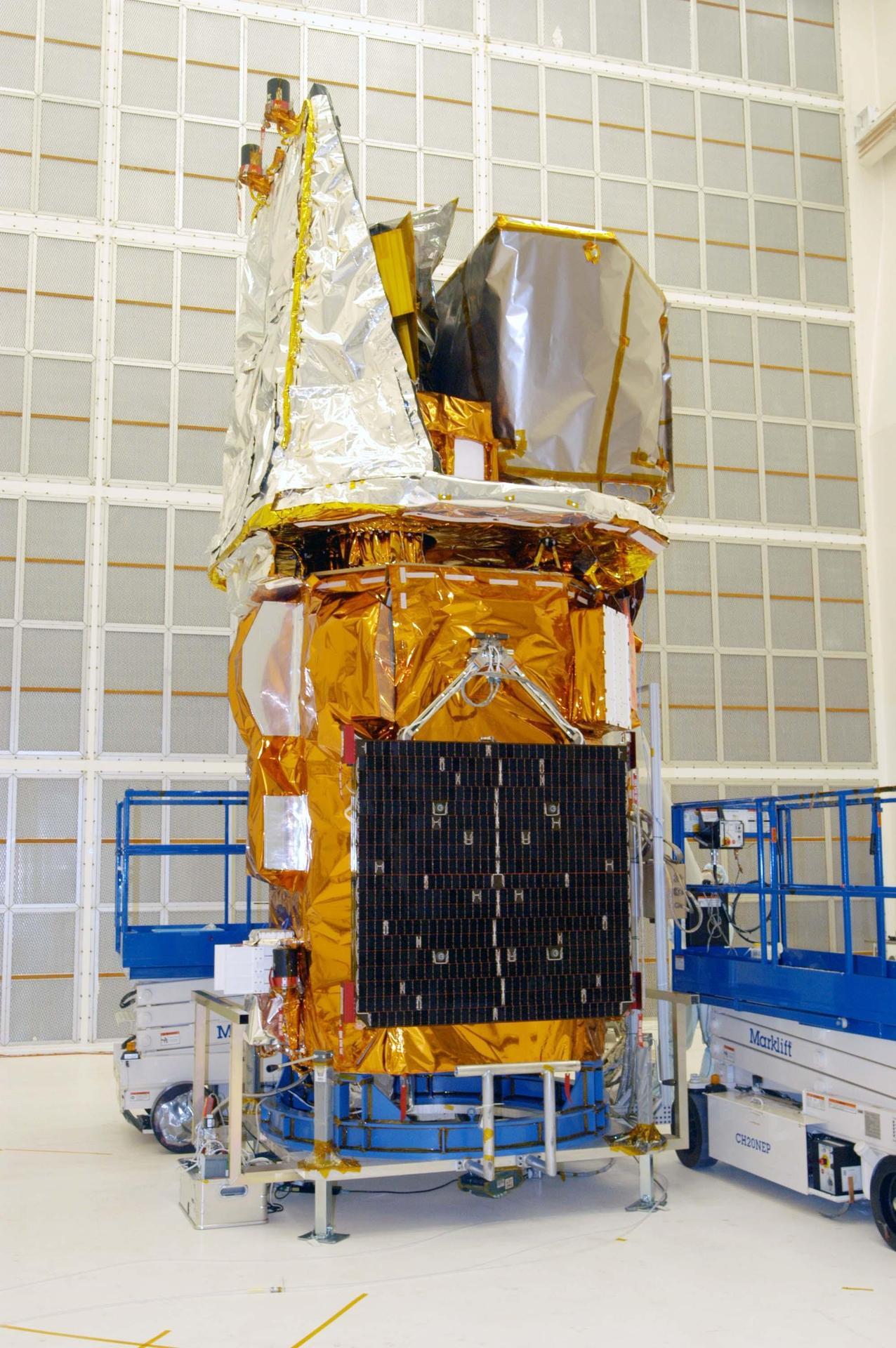
That speed mattered most for the short bursts, the ones that last less than two seconds. For 30 years nobody had pinned one down fast enough to see what it left behind. On May 9, 2005, less than six months after launch, Swift caught its second burst of the day, GRB 050509B, which lasted a few hundredths of a second. Its X-ray telescope was on target in time to collect 11 X-ray photons from the afterglow. "Seeing the afterglow from a 'short' gamma-ray burst was a major goal for Swift, and we hit it just a few months after launch," Neil Gehrels, who led the mission, said at the time.
Those few photons placed the burst near a giant elliptical galaxy about 2.7 billion light-years away, the kind of galaxy that is full of old stars and makes almost no new ones. Long bursts, thought to come from collapsing massive stars, turn up in young galaxies busy making stars. A short burst among old stars fit a different idea, the merger of two neutron stars or a neutron star and a black hole. NASA now counts it as the observation that showed short bursts likely come from merging neutron stars.
That was the first year. By the end, Swift had seen more than 2,000 gamma-ray bursts, studied more than 1,400 supernovas, watched black holes shred stars, kept an eye on active galaxies and looked at comets and asteroids. Its data went into about 7,000 scientific papers. Astronomers could request a new target from the ground in as little as a few minutes, and it could schedule up to 75 targets a day. NASA renamed it for Gehrels in 2018, after his death.
NASA says it's now looking at existing telescopes, commercial options and new missions to respond quickly to sudden events "in a post-Swift world". Swift's archive, about 12 terabytes, stays open to anyone.
9. 🪨 The gaps in the asteroid belt are Jupiter's doing
In 1866, the astronomer Daniel Kirkwood noticed that the asteroid belt had holes in it. When the known asteroids were sorted by the size of their orbits, almost none had certain sizes. He also saw why: the gaps fall where an asteroid's year would be a simple fraction of Jupiter's.
One of the biggest gaps sits about 2.5 times Earth's distance from the Sun. An asteroid there would take 3.95 years to go around, so it would make exactly three laps for every one of Jupiter's. That's called the 3:1 resonance, and others sit at 5:2, 7:3 and 2:1. In each, the asteroid and Jupiter keep meeting at the same points of the orbit, and Jupiter's small tugs add up instead of averaging out, like pushing a swing at the same moment on every pass.
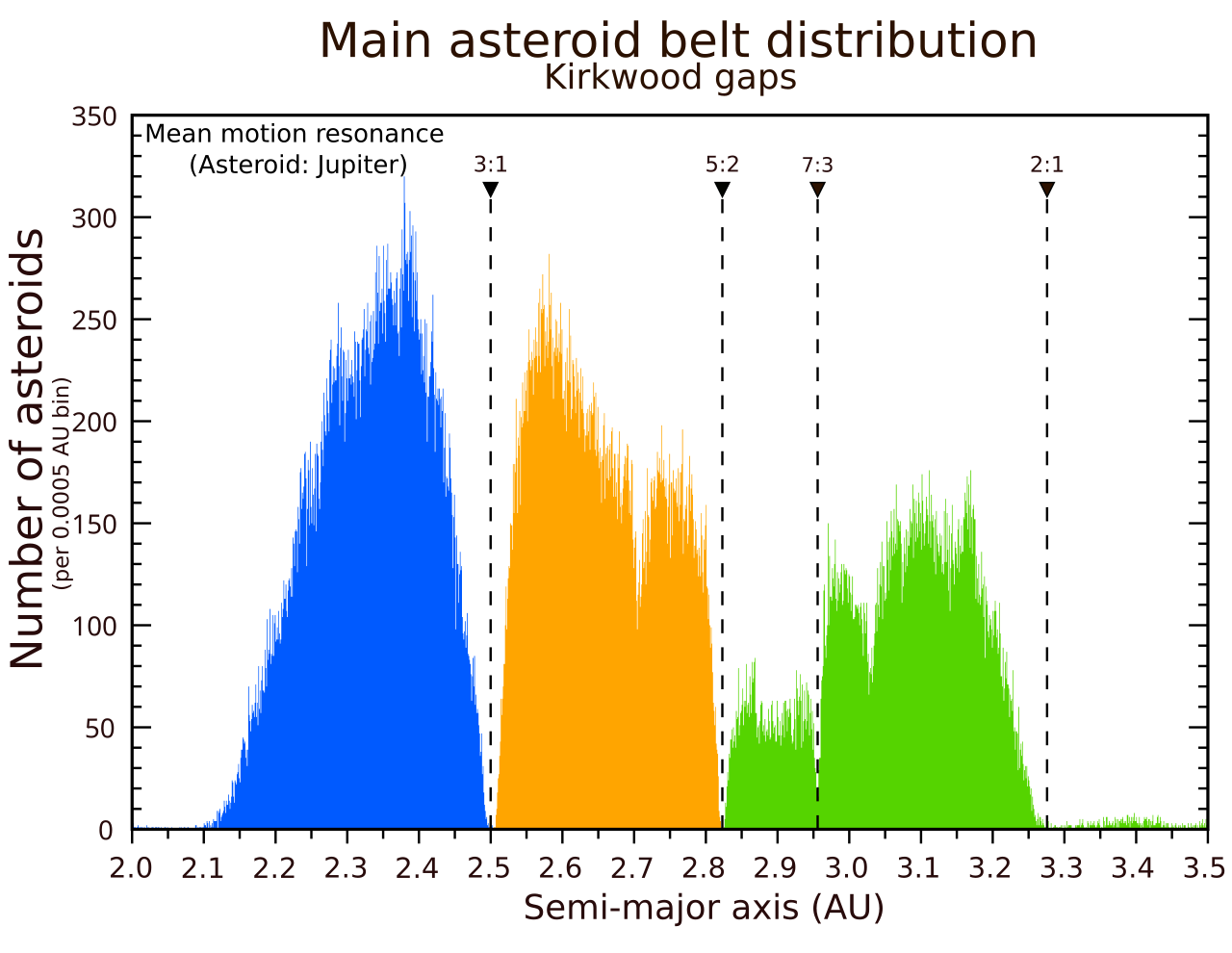
A snapshot of the belt wouldn't show the gaps. Asteroid orbits are stretched, so plenty of asteroids pass through those distances on their way in or out. The gaps are in the sizes of orbits, not in space.
How a resonance actually empties a gap took more than a century to work out. Jack Wisdom showed in the early 1980s that the region around the 3:1 resonance is chaotic. An orbit there doesn't settle down, and how stretched it is can swing widely. One that starts out nearly circular can be pulled into a path that crosses Earth's.
That also helped solve a second puzzle, about meteorites. The most common kind, the ordinary chondrites, have typically spent less than 20 million years exposed to cosmic rays in space. More of them fall in the afternoon than in the morning, about two to one, which says something about the orbits they arrive on. George Wetherill had concluded that these facts needed an "unobserved source" of material on orbits stretching from Earth's out to Jupiter's. Wisdom then followed orbits forward in a computer, in a 1985 paper, and showed that chaos near the 3:1 gap could send pieces of asteroids along exactly that kind of path.
Not every resonance clears out. At the 3:2 position, where an asteroid goes around three times for every two of Jupiter's orbits, the asteroids called the Hildas cluster instead. The gaps mark the resonances that throw asteroids out, and some of what they throw lands here.
10. ⭐ Kapteyn's Star came from somewhere else
The Dutch astronomer Jacobus Kapteyn was working through star charts and photographic plates of the southern sky, taken at the Cape of Good Hope, when he noticed in the 1890s that a star cataloged in 1873 seemed to be missing. Robert Innes found an uncataloged star about 15 arcseconds away. It was the same star. It was moving across the sky at more than 8 arcseconds a year, faster than any star known at the time, until Barnard's Star took the record in 1916.
Kapteyn's Star is a dim red subdwarf 12.8 light-years away, with about a quarter of the Sun's mass. It's also moving away from us at about 245 kilometers per second. Most nearby stars travel around the Milky Way's center with the Sun, in the galaxy's flat, spinning disk. Kapteyn's Star goes around backward. It belongs to the halo, the old, sparse swarm of stars around the galaxy, and it's the closest halo star to us. It came within 7 light-years of the Sun about 11,000 years ago and has been leaving ever since.
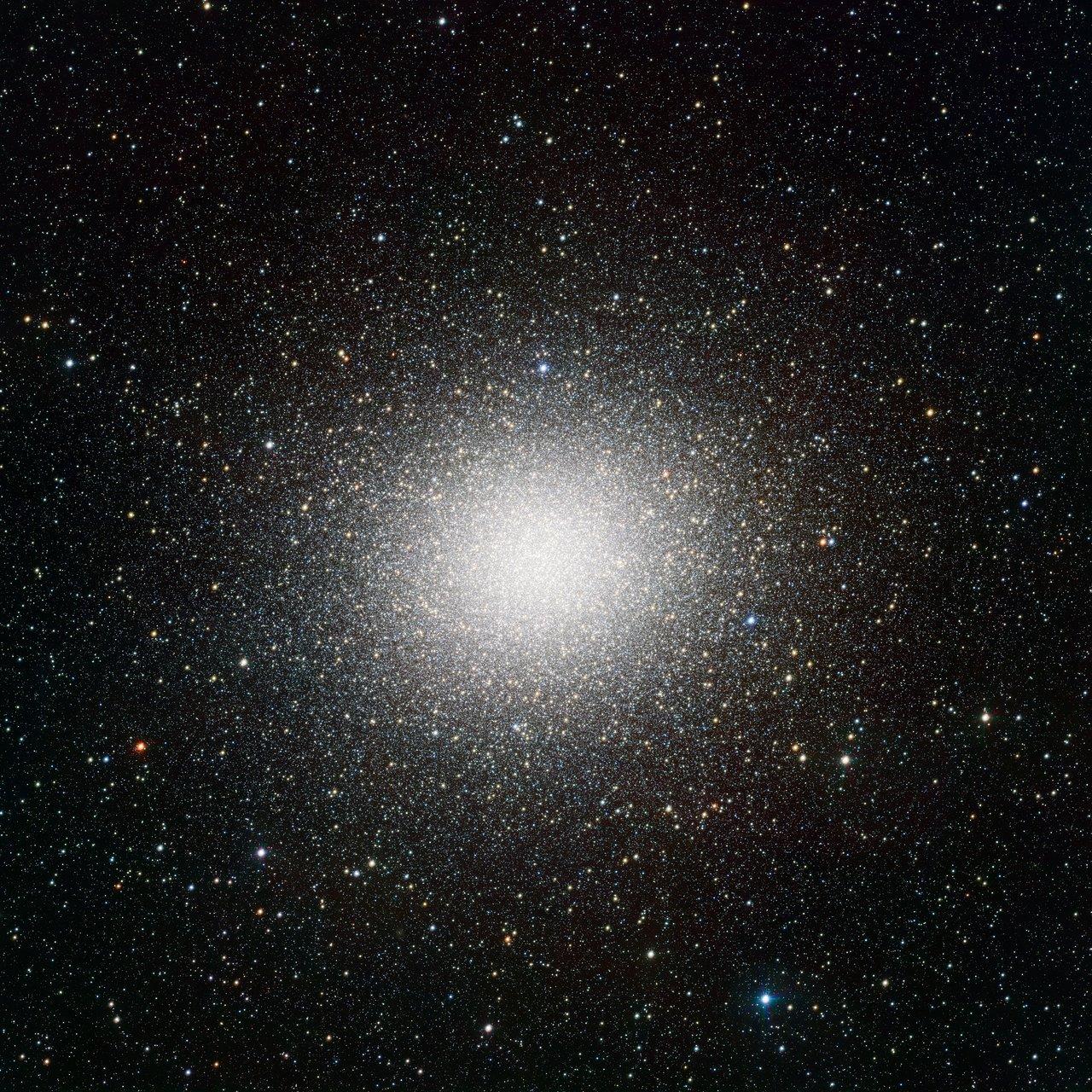
Where it came from is one of the best stories in the neighborhood. It travels with a loose stream of stars called the Kapteyn moving group. When Wylie-de Boer, Freeman and Williams measured 16 of them in 2009, 14 resembled the stars of Omega Centauri in both their motion and their mix of elements. Omega Centauri is the giant star cluster thought to be the core of a small galaxy the Milky Way swallowed long ago. Kapteyn's Star may be a piece of that galaxy, stripped off along the way.
Then came the planets, or so it seemed. Guillem Anglada-Escudé and colleagues reported two super-Earths around it in 2014, found in the star's slight back-and-forth wobble, with orbits of 48 and 120 days. The inner one, Kapteyn b, orbited where liquid water might be possible, and at about 11 billion years old the system would hold the oldest potentially habitable planet known.
A year later, Paul Robertson and colleagues pushed back. Signs of magnetic activity on the star repeated every 143 days, and 48 is one third of 143. Activity rotating across a star's face can mimic a planet's wobble, and they argued that Kapteyn b was an artifact of stellar activity. The discoverers replied that the 143-day rotation wasn't justified. The argument went back and forth.
In 2021, Anna Bortle and colleagues modeled the star's rotation and the wobble together, using a statistical method that copes better with the uneven, wandering signals that activity makes. They found a rotation period of 125 days and active regions that last about 694 days. Once that was taken out, no planet signal was left. Both planets, they concluded, were artifacts of the star's rotation and activity. The oldest habitable world turned out to be starspots, and what remains is an old star that may have been born in another galaxy.
11. 🌋 Ceres has a lonely mountain made of mud
When NASA's Dawn spacecraft reached Ceres in 2015, it found a dwarf planet about 940 kilometers across with one strange mountain near its equator. It stands about 4 kilometers high on average, 5 on its steepest side, and about 20 kilometers wide. It's called Ahuna Mons, after Ahuna, a post-harvest festival of the Sümi Naga people of Nagaland in India.
Ottaviano Ruesch of NASA's Goddard Space Flight Center and his colleagues compared its shape with mountains built every way they knew. Colliding plates make long chains, and impacts leave peaks inside craters. Ahuna Mons is neither. It's a dome, the kind that forms when thick material pushes up through the crust and piles up instead of flowing away, squeezing out like toothpaste.

Here the toothpaste was frozen salty mud. "Ahuna Mons is evidence of an unusual type of volcanism, involving salty water and mud, at work on Ceres," Ruesch said when the work came out in 2016. The mountain also looks young. Its slopes are sharp, with debris from rockfalls, it has few craters, and it's brighter than its surroundings, all of which fade with time on an airless world. The team thinks it formed within the last billion years, possibly within the last few hundred million.
That's the puzzle. Small worlds lose their heat quickly, and Ceres has no big neighbor to squeeze and warm it the way Saturn warms Enceladus. "Ahuna Mons is telling us that Ceres still had enough heat to produce a relatively recent cryovolcano," Ruesch said. His co-author Lucy McFadden was blunter: "There is nothing quite like Ahuna Mons in the solar system."
Dawn's gravity measurements later showed what lies underneath. Ruesch's team reported in 2019 a mass anomaly beneath the mountain that they read as a plume rising from Ceres's mantle, the likely source of the material that built the dome. The dome's shape points to a slurry of brine and solid particles, a mixture that would also explain why it seems to be slowly sagging.
Ceres has a couple of other dome-like features, but they're broader and more heavily cratered, so they look older. Nobody knows whether they're worn-down cryovolcanoes. If they are, Ahuna Mons may only seem lonely because it's the youngest of its kind.
12. ⚛️ Two ways of timing a neutron disagree by nearly ten seconds
Inside most atomic nuclei, a neutron is stable. On its own, a free neutron falls apart in about a quarter of an hour, into a proton, an electron and an antineutrino. Physicists have measured its average lifetime in two independent ways, and the answers don't match.
The first way is to fill a bottle with very slow neutrons, wait, and count how many are left. One of the most precise, the UCNtau experiment at Los Alamos, holds its neutrons with magnets and gravity and gets 877.8 seconds. The second way sends a beam of neutrons through a detector and counts the protons their decays leave behind. The most precise beam result is 887.7 seconds. Each is quoted to within about two seconds or better, and the gap between them has lasted for years.
This matters beyond the lab. The neutron's lifetime is a key number for working out how much helium the Big Bang made in its first minutes.
A few physicists found a third way, from space. Cosmic rays hitting a planet's ground or air knock neutrons loose, and some fly upward. The slower ones can decay before they get far, so a detector on a spacecraft sees fewer of them the higher it goes. Comparing counts at different heights gives the lifetime.
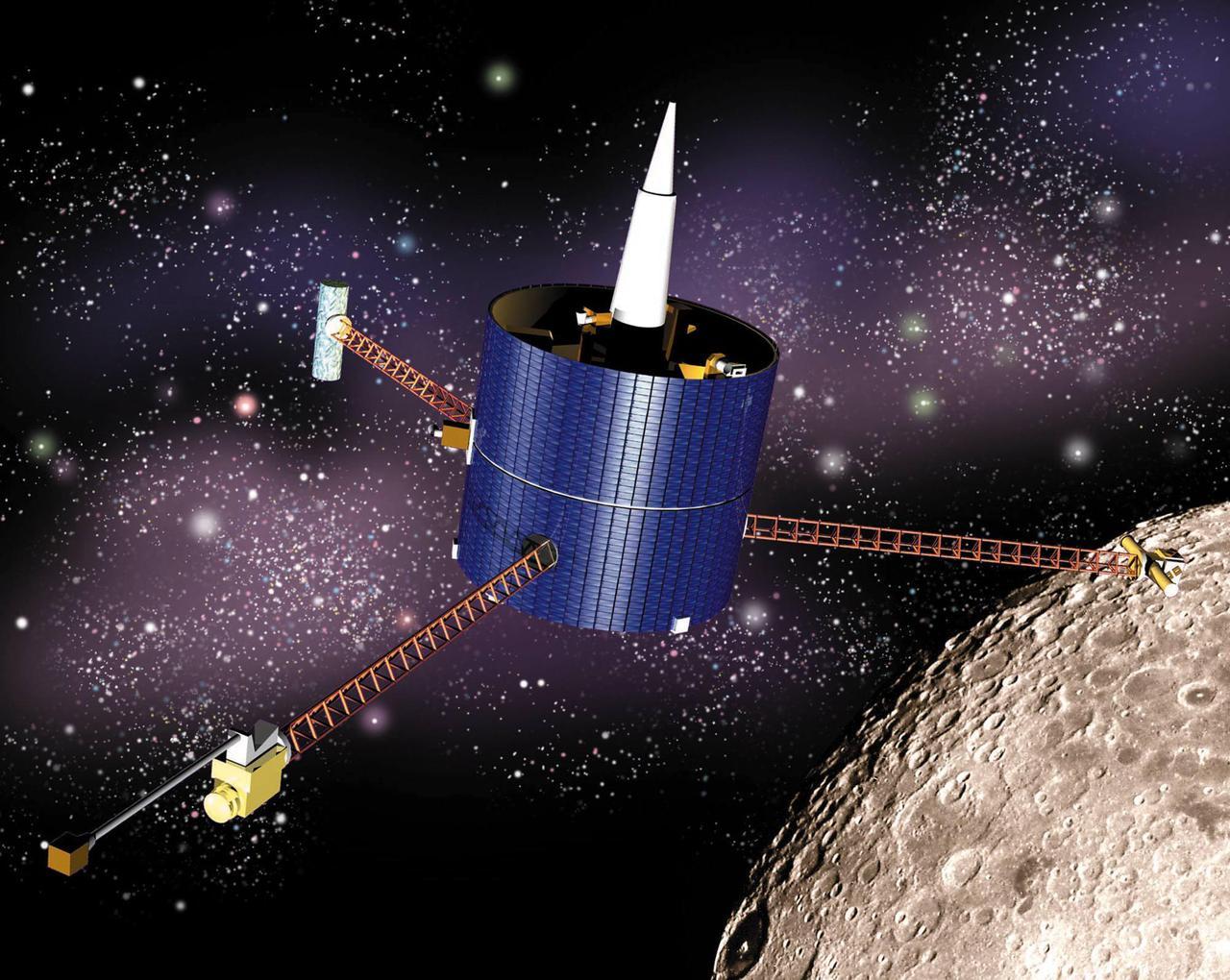
Jack Wilson, David Lawrence and Patrick Peplowski tried it first, in 2020, with data from NASA's MESSENGER spacecraft, gathered during flybys of Venus and Mercury in 2007 and 2008 by an instrument never designed for this. They got 780 seconds, give or take about 90. That was far too rough to settle anything, but it showed the method could work. Later that year they applied it to Lunar Prospector, which launched to the Moon in 1998, and got 887 seconds, give or take about 15.
Then the method ran into its own trouble. A 2025 reanalysis of the Lunar Prospector data, with different maps of the Moon's surface chemistry and different models of its temperature, got answers between about 740 and 780 seconds. The result depends heavily on what you assume about the ground the neutrons come from.
Space hasn't broken the tie yet. The 2020 team's stated goal is a future measurement from space with errors as small as the lab experiments'. Until then, the bottle and the beam each stand by their own number, and nobody has found the mistake, if that's what it is.
13. 🌍 Antarctic snow holds dust from dead stars
Iron-60 is a radioactive form of iron. Half of any sample decays in about 2.6 million years, so none of the iron-60 that Earth was born with is left, and nothing on Earth makes it naturally. Exploding stars do. Iron-60 in the ground came from space, and much of it from supernovas that went off near the Sun.
People have been finding it for more than two decades. A team at the Technical University of Munich first reported it in deep-sea deposits in 1999, and a 2004 study traced an excess in a slowly growing crust on the ocean floor to a layer about 2.8 million years old. Not everyone found it at first. A 2008 study of a dated core of ocean sediment found no peak at the expected level, though the same team confirmed the signal in the crust.
In 2016, Anton Wallner and colleagues settled that. They tested deep-sea samples from every major ocean and found iron-60 in all of them, arriving in two waves, one between 1.5 and 3.2 million years ago and another between 6.5 and 8.7 million years ago. The signal was global and spread out in time, which pointed to more than one supernova. Iron-60 has since turned up in the Moon's soil and in cosmic rays. One review calls it the first established case of a dated event outside the Solar System leaving a measurable mark on Earth.
Then the search moved to fresh snow. Dominik Koll and Gunther Korschinek, at the Technical University of Munich, had 500 kilograms of snow collected at Kohnen Station in Antarctica and shipped to Germany. They melted it, extracted the dust, and counted its atoms with a particle accelerator. They found five atoms of iron-60. The snow was less than 20 years old, so this iron was arriving now, and they ruled out cosmic rays, nuclear weapons tests and reactor accidents as its source.
Their best guess was the gas the Solar System is passing through today, a cloud of interstellar gas and dust that the Sun entered around 40,000 years ago and will leave within a few thousand years. They also made a prediction. If the cloud was the source, ice older than 40,000 years shouldn't contain interstellar iron-60.
In May, Koll, now at the Helmholtz-Zentrum Dresden-Rossendorf, and his colleagues reported their test. They took 300 kilograms of an Antarctic ice core from 40,000 to 80,000 years ago. Cosmic rays striking dust inside the Solar System can make a little iron-60 too, along with manganese-53, so they measured both. There was more iron-60 than that local source could explain. The old ice wasn't empty after all, but putting it together with the snow and recent seabed sediments gave a record covering 80,000 years: very little iron-60 around the time the Sun entered the cloud, a peak while crossing it, and a slow decline as the Sun nears the far side. The simplest reading is that the cloud is itself part of what's left of a single supernova, though other explanations are still possible.
If that's right, Earth is passing through the debris of a dead star right now, and some of it is settling in the snow.
🌙 One last thought before you sleep
I keep coming back to how little some of tonight's answers rested on. Eleven X-ray photons placed a burst near a galaxy of old stars. Five atoms of iron, from half a tonne of snow, pointed to the cloud we're flying through. A slightly oval radio image hinted at a star nobody can quite see. That isn't a weakness. It's what careful measurement looks like when the thing you're measuring is very far away, very faint or very old.
Voyager 1 belongs on that list. Every message it sends will soon be a full day old by the time anyone reads it, and people are still reading them.
That's all for tonight. Thanks for wondering along with me. Good night, and clear skies. 🌌
— Kasi