About 900 million years after the Big Bang, two quasars seem to have been shining side by side. Each would be a supermassive black hole swallowing gas so fast that the gas outshines its whole galaxy, and the heavier one weighs 1.5 billion Suns. Astronomers have no settled account of how even one black hole got that heavy so early. This could be two.
Further on, a gas that volcanic vents give off on Earth turns up every early summer over cracks on Mars. A cloud that was supposed to be shredded by our galaxy's black hole comes out the other side. The night ends 350 years ago, with the first measurement showing that light takes time to get anywhere. That one is my favorite.
1. 🕳️ Two giant black holes may be neighbors at cosmic dawn
Silvia Onorato and her colleagues were checking Webb's spectra of distant quasars by eye when one of them turned out to have what looks like a neighbor.
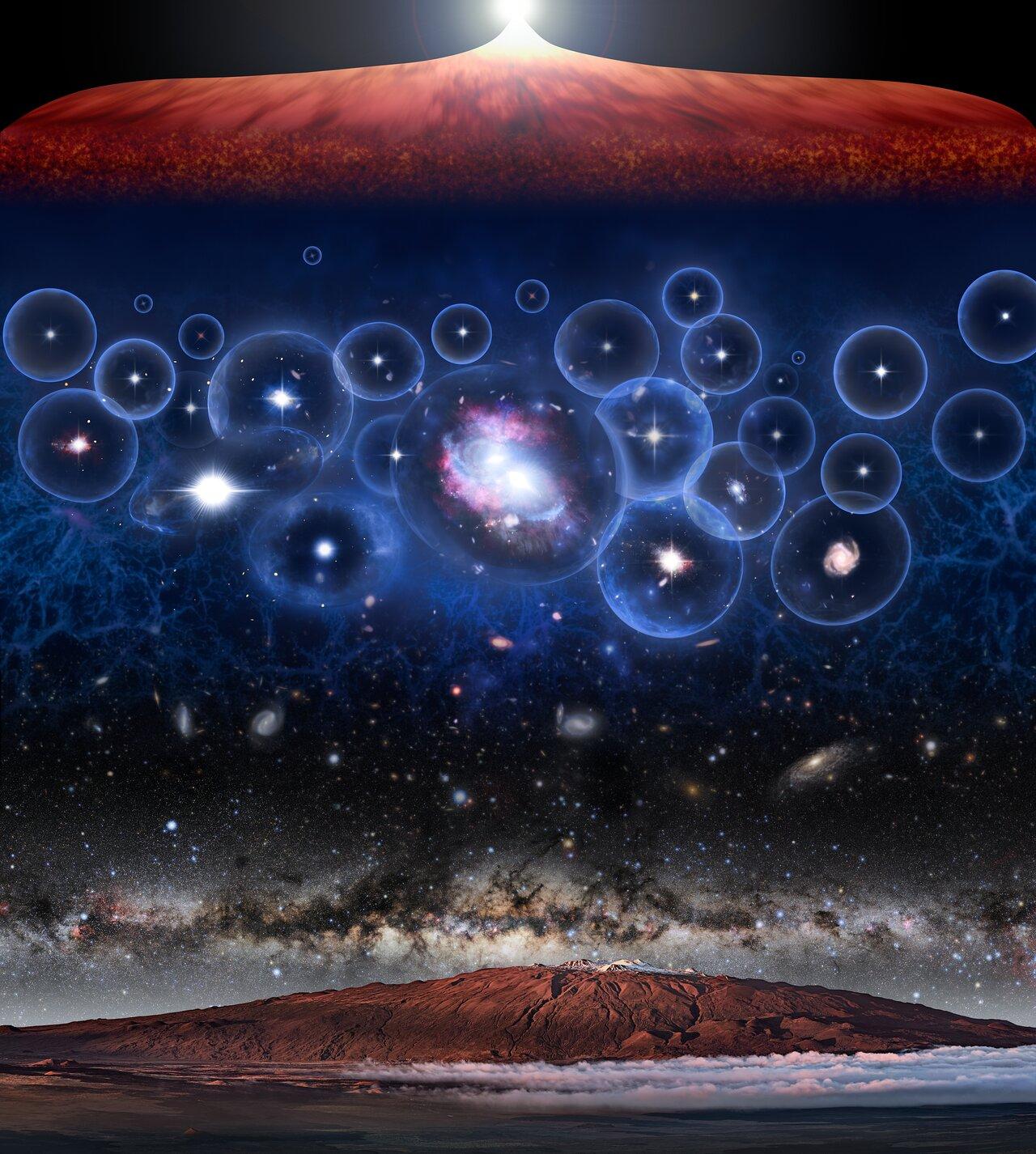
The spectra, each one a target's light spread out by color, came from the Aether survey, a James Webb Space Telescope program led by Emanuele Paolo Farina of NSF NOIRLab. Its 200 targets are quasars: supermassive black holes pulling in gas so quickly that the hot, swirling gas around them outshines every star in their galaxies. Together they make up 43 percent of the quasars known from that stage of cosmic history. Onorato, a postdoctoral researcher at NOIRLab, noticed that one of them, J1602+4228A, had a fainter companion.
The two sit less than one arcsecond apart on the sky, under a thousandth of the width of the full Moon, and the second is much fainter, so telling them apart from the ground should have been close to impossible. Gemini North, on Maunakea in Hawaiʻi, did it with its GNIRS spectrograph. "The sky over Maunakea was so clean and sharp that we managed to collect the data in only two nights," Onorato said.
Their light left them about 900 million years after the Big Bang, when the universe was about a fifteenth of its present age. Side by side on the sky, they're about 18,100 light-years apart, roughly a fifth of the width of the Milky Way, and they may be farther apart along our line of sight. One black hole weighs about 1.5 billion Suns, the other about 400 million. Both seem to be eating near or a little above the rate at which the push of their own light on the incoming gas matches the pull of their gravity, which is usually treated as the practical limit on how fast a black hole can grow.
Growing a black hole that big in under a billion years is hard. "There is no definitive theoretical explanation for how a single one of these giant quasars exists so early in the age of our Universe, much less two," Onorato said. The pair's black holes are already as heavy as the ones in big galaxies today.
Close pairs should be rare, too. The team compared this one with how quasars cluster on larger scales and found that a pair this tight turns up a hundred to a thousand times more often than that would predict. One reading is that merging galaxies switch on both quasars at once. Another is that this corner of the early universe is unusually crowded.
The pair's name, Nāpōwawāʻenakaulua, was created by Larry Kimura of the Hawaiian language college at the University of Hawaiʻi, through the A Hua He Inoa naming program. It translates to "Two celestial bodies of fathomless powerful darkness in the brilliance of heat reincarnating energy into the Universe." It's a relative of Pōwehi, the name given to the first black hole ever imaged.
One doubt is left. A galaxy in the foreground could, in principle, bend the light of a single quasar into two images. The team used another Gemini instrument, GMOS, to look for signs of that, and the two spectra differ in shape, which favors two real objects. They say a model of a possible lens is still needed to rule it out completely. If the pair holds up, it's the most compact quasar pair known from cosmic dawn.
2. 🔴 Hydrogen chloride keeps turning up over cracks on Mars
Each year, as early summer reaches the northern slopes of the Martian volcano Alba Mons, a gas shows up in the air there that on Earth seeps from vents above magma.
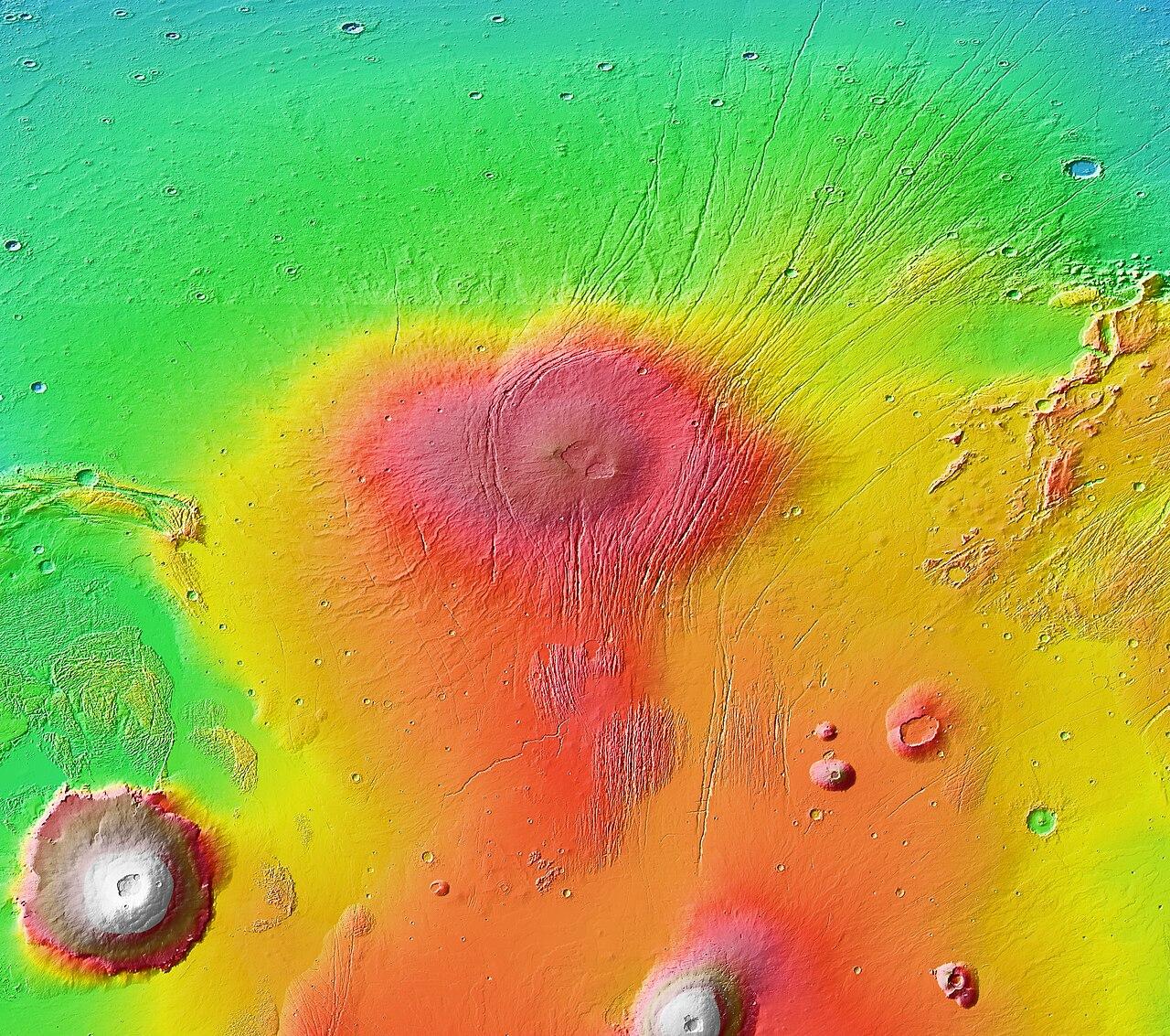
The gas is hydrogen chloride. ESA's ExoMars Trace Gas Orbiter first found it in the Martian air in results reported in 2021, and since then it has followed a seasonal rhythm: most abundant in northern winter, scarce by summer. Scientists link that cycle to the planet's dust and water. Over Alba Mons, though, the orbiter's Atmospheric Chemistry Suite kept finding raised levels in early summer, in the same small area, soon after the winter frost had gone.
The amounts are tiny, about two molecules in every billion. The study, published in Science Advances, comes from an international team led by Alexander Trokhimovskiy. "It was like looking for a needle in a haystack," said Daniel Mège of the Space Research Centre of the Polish Academy of Sciences, one of its lead authors. The orbiter spotted "a handful of molecules from a perhaps intermittent source, whilst moving continuously along its orbit to monitor the whole Martian atmosphere."
Mège is a geologist, and he came to the gas through the orbiter's camera, CaSSIS. At a meeting in Madrid in 2023, ESA's Colin Wilson introduced him to Kevin Olsen of the University of Oxford, who told him the atmosphere team suspected some of their detections had a geological source. When Mège saw where the gas was, he said later, "it became instantly obvious to me that there was something volcanic behind."
CaSSIS images of the same region show narrow, fresh-looking fractures, some running hundreds of meters, with changes in surface color around them. One image from February 2023, about 20 kilometers across, shows white spots that may be minerals left by escaping gas, like the deposits around fumaroles, the volcanic gas vents found on Earth.
The team's explanation involves ice. Martian winters can drop to −120°C, and the researchers suggest that ice plugs the cracks through the cold months. In early summer the ice would turn straight to vapor, opening the cracks again and letting gas from below escape. Much of the work went into ruling out other chemistry in the air before the authors concluded that the likeliest source is a dormant magma chamber under Alba Mons. "Our findings suggest that Mars has retained enough internal heat to support volcanic activity until recently, and possibly still does," Mège said.
No one has ever seen lava erupt on Mars. Images from orbit show eruptions within the past few million years, and instruments on the surface have recorded marsquakes, so a quiet, still-warm interior has seemed possible for a while. ESA calls the new result the first sign of young volcanism on present-day Mars from the orbiter's data.
Where there's magma and groundwater, there can be warm water underground, and Mège thinks the fissures would be a sensible place to look for Martian life. He doesn't credit the gas itself, though. Hydrogen chloride, he said, "is more effective at eradicating life than at sustaining it!"
3. ⭐ A star whose age was read in its uranium
For seven and a half hours, spread over 2005 and 2006, one of the four 8.2-meter telescopes of ESO's Very Large Telescope in Chile gathered the light of a single red giant in the constellation Libra, about 10,000 light-years away.
The star, HE 1523-0901, had turned up among bright stars poor in heavy elements picked out of the Hamburg/ESO survey, which recorded half the southern sky on photographic plates. Astronomers wanted its age, and stars don't give that up easily. "Surprisingly, it is very hard to pin down the age of a star," said Anna Frebel, who led the work. "This requires measuring very precisely the abundance of the radioactive elements thorium or uranium, a feat only the largest telescopes such as ESO's VLT can achieve."
The idea is the same as carbon-14 dating, stretched over billions of years. Thorium-232 and uranium-238 were forged in the same violent events as stable heavy elements like europium, osmium and iridium. The stable ones stay put. The radioactive ones decay: half of any thorium-232 is gone after 14 billion years, and half of any uranium-238 after about 4.5 billion. Compare how much of each is left against a stable partner, and you can read off how long the clock has been running. Uranium is the better clock because it decays faster, so its share changes more.
HE 1523-0901 is close to ideal. It has about a thousandth of the Sun's share of iron, so it formed before many generations of stars had enriched the galaxy. Yet relative to its iron, it's about 60 times richer than the Sun in the heavy elements made by the rapid capture of neutrons, and their pattern matches the Sun's very closely.
Even so, the uranium was hard to see. Each element in a star's outer layers absorbs light at its own particular colors, leaving thin dark lines in the spectrum. Uranium's strongest line in visible light is a faint one at 386 nanometers, at the violet edge of what eyes can see, and it overlaps the edge of a strong iron line and a feature from molecules of carbon and nitrogen. It can only be measured well in a star with little carbon and nitrogen, which this one has.
For the first time, the team could use several clocks in one star, comparing uranium and thorium with each other and with europium, osmium and iridium. "Until now, it has not been possible to measure more than a single cosmic clock for a star. Now, however, we have managed to make six measurements in this one star," Frebel said. Together they read 13.2 billion years. The universe is about 13.8 billion years old.
The number comes with error bars of several kinds. Fitting the spectrum adds about 0.7 billion years of uncertainty, and the assumed temperature and gravity of the star's atmosphere about 1.5 billion. The weak point is the starting line. To read the clock, you need to know how much uranium and thorium those first events made, and in the worst case that adds up to 2.7 billion years of uncertainty. The first star with uranium detected, CS 31082-001, was reported in 2001, and HE 1523-0901 was the first where several clocks could be checked against each other.
A study in 2015, which tracked the star's speed for eight years, found it wobbling every 303 days. The team read that as the pull of a companion, one with at least 11 times the mass of Jupiter. Depending on how its orbit is tilted, the companion could be anything from a giant planet or a brown dwarf to a small red star.
4. 🌌 Two faint companions of the Milky Way, found in a preview
The Milky Way has about 65 known satellite galaxies, small galaxies held in orbit around it, and some estimates say hundreds more are still out there, too faint to have been noticed.
The Vera C. Rubin Observatory in Chile was built partly to find them. Its 8.4-meter Simonyi Survey Telescope and 3.2-gigapixel camera, the largest digital camera ever built, began a 10-year survey of the southern sky in June. Before that, astronomers had preview data taken between April 2025 and January 2026, covering about 7 percent of the sky. That was enough for two discoveries.
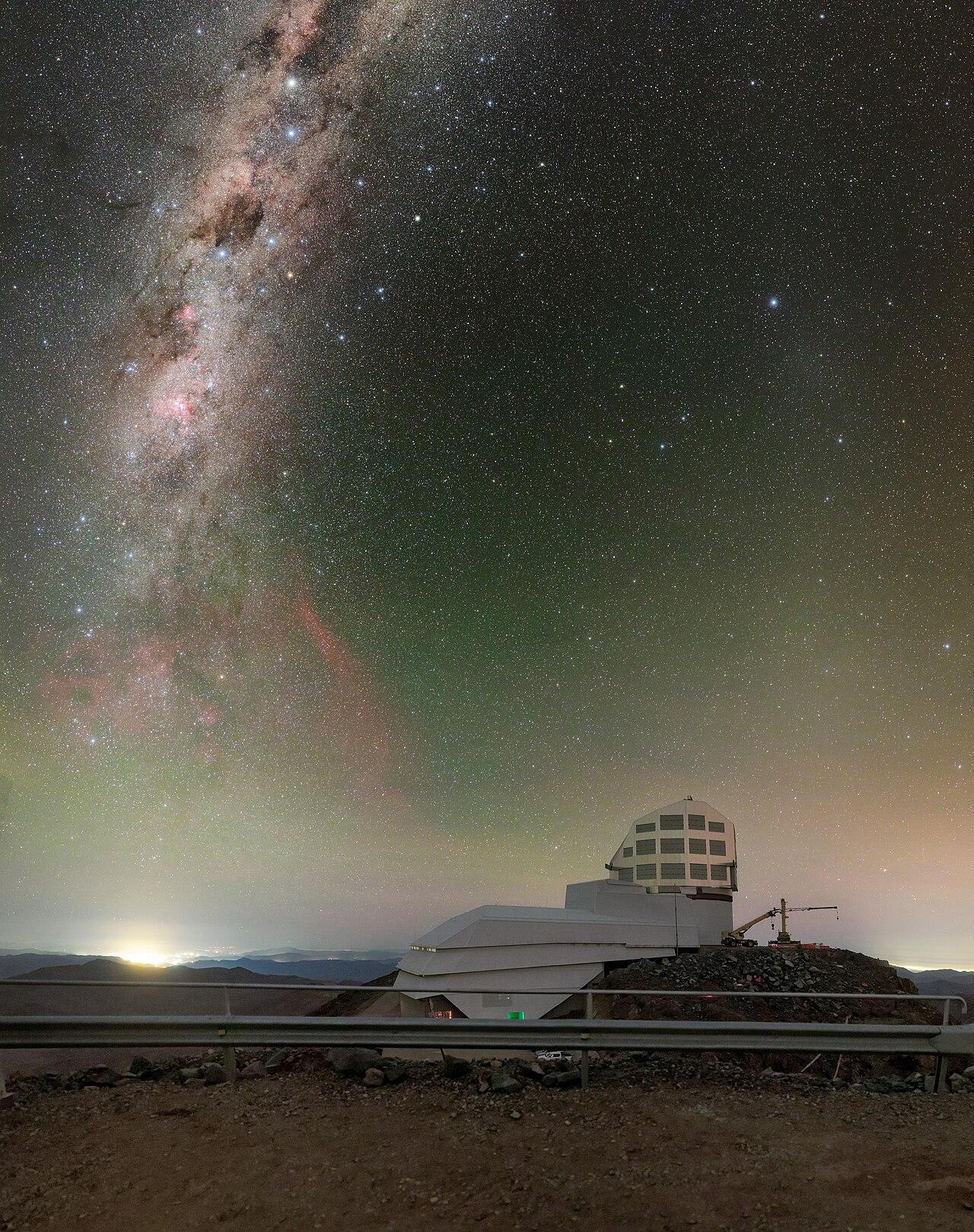
The first, Aquarius IV, is about 355,000 light-years away in the Milky Way's outer halo, the thin cloud of old stars and dark matter that surrounds the galaxy's disk. It stood out in Rubin's data at high confidence, and once William Cerny of Yale and his colleagues knew where to look, they found it again in older images from the Dark Energy Camera. It had been sitting in those images all along. Half its light comes from within about 60 light-years of its center, and all of it together adds up to a few hundred Suns. Its stars look about 13 billion years old and almost free of heavy elements.
The second find, Rubin-GC1, lies on the other side of the galaxy, in the direction of its crowded center in Ophiuchus, behind thick dust. It's about 100,000 light-years away and compact, with half its light inside about 16 light-years. Its stars are younger, about 9 billion years old, and richer in heavy elements. The team, led by Aashay Pai of the University of Chicago, thinks it's a globular cluster, a tight ball of old stars held together by its own gravity, and the Gaia satellite let them measure how it moves across the sky. Its position and motion match a stream of stars torn from the Sagittarius dwarf galaxy, which the Milky Way is slowly pulling apart, so the cluster is probably a stolen one.
The faintest dwarf galaxies are thought to be mostly dark matter, so their numbers and motions test ideas about what dark matter is and how small galaxies form. "Continued discoveries will allow us to complete the census of satellite galaxies around the Milky Way, which is a key to understanding how the faintest galaxies form," said Marla Geha of Yale, a co-author of both studies. "If the observatory can find systems this faint and difficult with only its preview data, its full 10-year survey will undoubtedly provide us with many more Milky Way satellite discoveries," Cerny said.
Aquarius IV itself is still undecided. It looks a lot like the smallest, faintest dwarf galaxies known, but it could also be a lone star cluster. The difference is dark matter: a galaxy sits inside a clump of it, and a cluster doesn't. To tell which, astronomers will need spectra of its few stars to see how fast they move, since stars held by extra unseen mass move faster than their visible mass alone allows.
5. 🪐 A possible planet at the nearest Sun-like star showed up once, then vanished
The light Webb was looking for was more than 10,000 times fainter than the star beside it.
That star is Alpha Centauri A, the closest star like the Sun, about 4 light-years away. It's paired with Alpha Centauri B, another Sun-like star, and together they make the third-brightest point of light in the night sky. The faint red dwarf Proxima Centauri, which has planets of its own, completes the system. Planets around A and B have been much harder to pin down. The stars are bright, close together and moving quickly across the sky, and the Space Telescope Science Institute's operations team had to work out a custom observing sequence just for this target.
In August 2024, Webb's mid-infrared camera blocked Alpha Centauri A behind a coronagraph, a mask that hides a star's glare, and the team subtracted the light of both stars. A faint point was left, which they called S1, about twice as far from the star as Earth is from the Sun. Tests showed it wasn't a background galaxy or a passing asteroid, and probably not a quirk of the detector. But the detection was modest, and that first visit had a single usable observation, which isn't enough to confirm a planet.
So Webb looked again in February and April 2025, and saw nothing. "We are faced with the case of a disappearing planet!" said Aniket Sanghi, a PhD student at Caltech and co-first author of the two papers, with Charles Beichman of NASA's Jet Propulsion Laboratory.
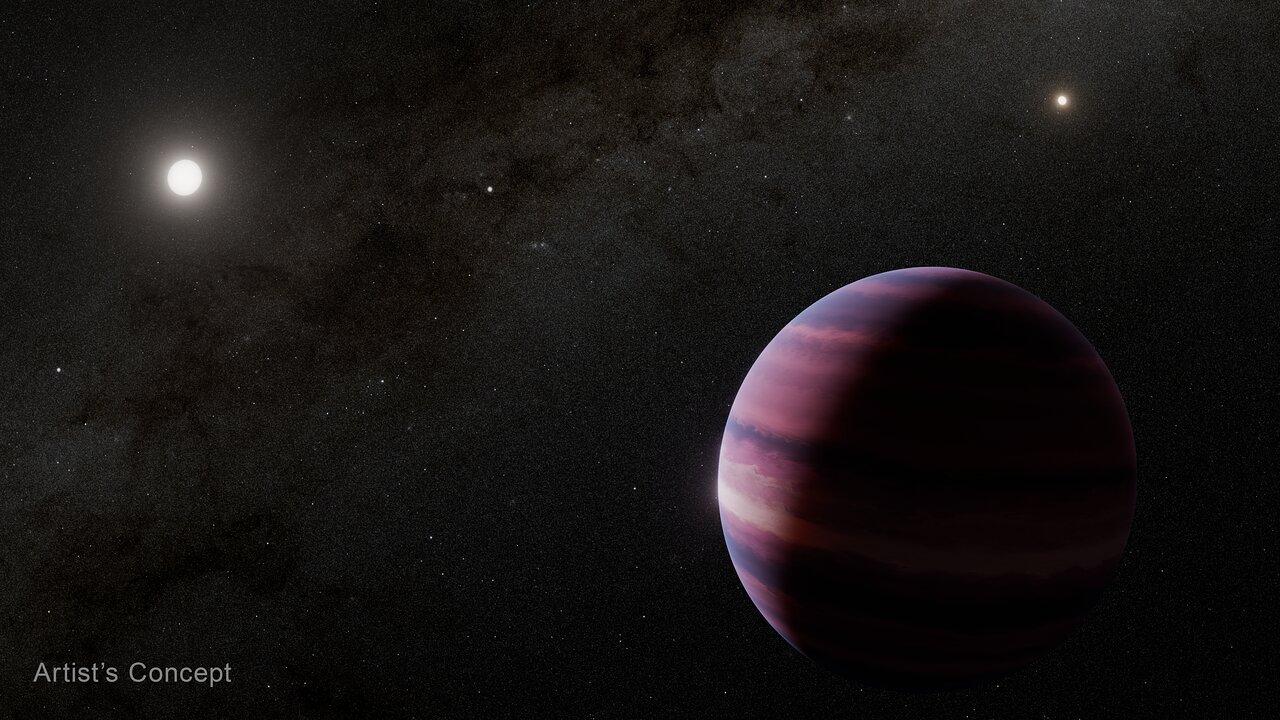
A planet can vanish by moving. The team simulated millions of possible orbits, using what Webb saw in August, what it didn't see later, and a faint candidate that the Very Large Telescope had picked up in 2019. They kept only orbits that would stay stable with Alpha Centauri B nearby. If the 2019 object and S1 are the same thing, there's a 52 percent chance Webb missed it both times because it had swung in too close to the star to see.
If the two sightings were the same planet, the orbits that fit take two to three years. They're stretched, and tilted about 50 degrees from the orbit of the two stars, or about 130 degrees if the planet goes around the other way. If S1 is real, the team's models make it a gas giant roughly the size of Jupiter, with about the mass of Saturn and a temperature around 225 kelvin, about −50°C. It would orbit in the star's habitable zone, the range of distances where a rocky planet could keep liquid water on its surface, but as a gas giant it couldn't support life as we know it.
"Of all the directly imaged planets, this would be the closest to its star seen so far," Sanghi said. "Its very existence in a system of two closely separated stars would challenge our understanding of how planets form, survive, and evolve in chaotic environments."
The same images also showed very little warm dust around Alpha Centauri A. Any dust cloud there is no brighter than a few times our own Solar System's, a limit about ten times tighter than for any other star. As for S1, it stays a candidate until Webb finds it again, somewhere an orbit can explain.
6. ☁️ The cloud that was supposed to feed our black hole
At the end of 2011, astronomers announced that something was falling toward the black hole at the center of the Milky Way, and they expected to watch it fall apart.
Reinhard Genzel's team at the Max Planck Institute for Extraterrestrial Physics had spent 20 years tracking stars around the black hole, Sagittarius A*, which has about four million times the Sun's mass. Among them they found something different: a cloud of gas and dust about three times the mass of Earth, much cooler than the stars, at about 280°C. They called it G2. Its speed had nearly doubled in seven years, to more than 8 million kilometers an hour, and it was on a long, narrow orbit that would take it within about 40 billion kilometers of the black hole's edge, 36 light-hours, in 2013.
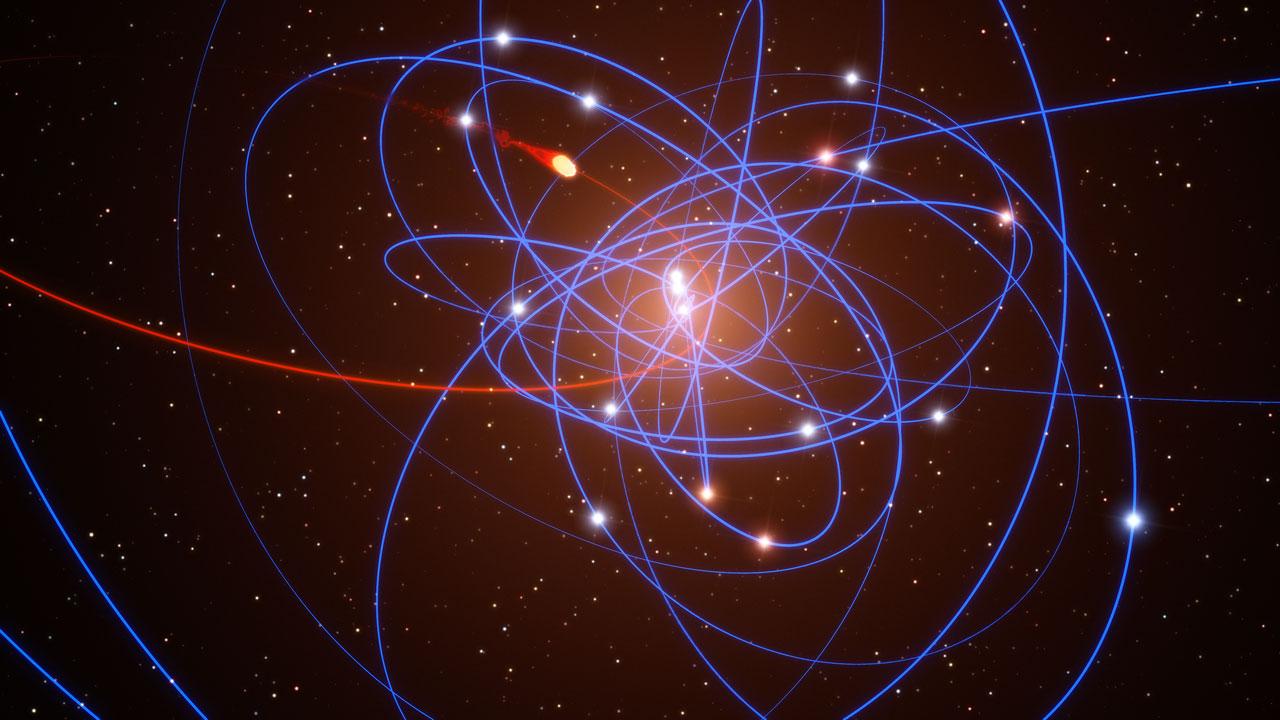
The forecast was dramatic. The cloud already seemed to be stretching as the black hole's gravity pulled harder on its near side than its far side. Near the black hole the gas would heat up and probably start giving off X-rays, and in the years after, the debris falling in would set the black hole flaring. Telescopes around the world watched. Sagittarius A* is a famously underfed black hole, and this looked like a chance to see it eat.
Closest approach came in May 2014, and the meal never arrived. Andreas Eckart's team at the University of Cologne followed G2 with the Very Large Telescope from February to September that year. Before the turn it was moving away from us at about 10 million kilometers an hour, and after it, toward us at about 12 million. Its glow stayed compact the whole time, and the black hole showed no sign of extra feeding. "It certainly does not behave like a coreless dust cloud," Eckart said. The Cologne team thinks G2 is most likely a young star, wrapped in dust and still gathering material.
That didn't settle it. Further tracking turned up something slowing G2 down: a drag force, detected with high confidence, from the thin gas flowing around the black hole. The researchers turned that into a measurement of how dense the gas is, about 4,000 particles in every cubic centimeter, at distances from the black hole between the ones other methods can probe.
Then more turned up. Anna Ciurlo and colleagues reported four more G objects in 2020, all within about 0.13 light-years of the black hole, on very different orbits. Whatever they are, they form a class, and they formed separately. In the team's words, the G objects "show the characteristics of gas and dust clouds but display the dynamical properties of stellar-mass objects", and "no broad consensus has yet been reached concerning their nature."
7. 💥 The supernova that weighed too much
The Supernova Legacy Survey, using the Canada-France-Hawaii Telescope, spotted SNLS-03D3bb on April 24, 2003. At first it looked like the most useful kind of exploding star.
It was a type Ia supernova, the explosion of a white dwarf, the dense, Earth-sized remains of a star like the Sun. A white dwarf holds itself up with the pressure of its electrons, which resist being packed into the same states. That pressure can hold up only so much mass. Add enough and the electrons are squeezed until they move close to the speed of light, and from then on their pressure grows too slowly to keep up with gravity. For a slowly spinning white dwarf without a strong magnetic field, the ceiling is about 1.4 times the Sun's mass. It's called the Chandrasekhar limit, although Wilhelm Anderson in 1929 and Edmund Stoner in 1930 published versions of it first.
In the classic picture, a white dwarf that grows close to the limit ignites carbon in its core and blows apart. Some probably explode below the limit by other routes. Either way, ordinary type Ia supernovas reach nearly the same peak brightness once astronomers correct for how quickly each one fades. That is what made them useful for measuring distances, and how astronomers found in 1998 that the universe's expansion is speeding up.
SNLS-03D3bb broke the pattern. Andy Howell and his colleagues found it was 2.2 times brighter than a typical type Ia, and too bright even for how slowly it faded. A type Ia shines on the decay of radioactive nickel, and a normal one makes about 0.6 Suns' worth. This one needed about 1.3, which, in the team's analysis, meant a white dwarf of about 2.1 times the Sun's mass. Its debris was also unusually slow, about 8,000 kilometers per second, which is hard to fit with an ordinary explosion.
Several explanations have been offered. A white dwarf spinning fast enough might hold extra mass. Two white dwarfs might merge into one heavier than the limit. Wolfgang Hillebrandt and colleagues asked whether an ordinary white dwarf igniting off center could look brighter from some directions. More of these overbright explosions have turned up since, and some have been read as needing a white dwarf of up to 2.8 Suns.
Banibrata Mukhopadhyay's group at the Indian Institute of Science has argued for more than a decade that magnetic fields could do it. Their newest simulations, published in The Astrophysical Journal Letters, use a stellar evolution code from Cambridge, modified to include magnetic effects, to follow magnetized stars from their hydrogen-burning lives all the way to white dwarfs. As a white dwarf pulls in gas from a companion and gets denser, its field is squeezed and grows stronger, and the field's pressure helps hold the star up against gravity. In one run, a magnetized white dwarf reached about 2.4 times the Sun's mass and stayed stable. In the paper's words, "while the 'Chandrasekhar limit' may be sacrosanct, its value severely depends on the underlying physics."
Whether white dwarfs with fields that strong could stay stable is disputed. Other researchers have argued they couldn't, and the authors say those critiques rest on errors. Nobody has seen one directly either. The group has suggested that a lopsided, spinning one could give off a steady hum of gravitational waves that the planned LISA observatory might pick up.
Howell's team ended their 2006 paper with a warning that still holds: since this supernova doesn't follow the rules that make type Ia explosions standard, studies of the universe's expansion will have to watch for others like it.
8. 🪨 The meteorite that fell just in time for Apollo
At 1:05 in the morning on February 8, 1969, a brilliant fireball came in from the southwest over the Mexican state of Chihuahua, lighting up the sky and the ground, and broke apart near the village of Pueblito de Allende.
Its pieces landed across one of the largest meteorite strewn fields known, about 50 by 8 kilometers of flat desert. More than two tonnes were picked up over the next 25 years. Allende is a carbonaceous chondrite, one of the most primitive kinds of meteorite. Before 1969 that class was known from a small number of uncommon meteorites, like Orgueil, which landed in France in 1864, and many of its members were small and poorly studied. Suddenly there was more of it than all the earlier falls combined.
The timing was lucky. Apollo 11 would bring back the first Moon rocks that July, so laboratories were being upgraded and new researchers were pouring into the field. Museums, the Smithsonian among them, sent expeditions to Mexico and came back with hundreds of kilograms. Allende has been called the best-studied meteorite in history.
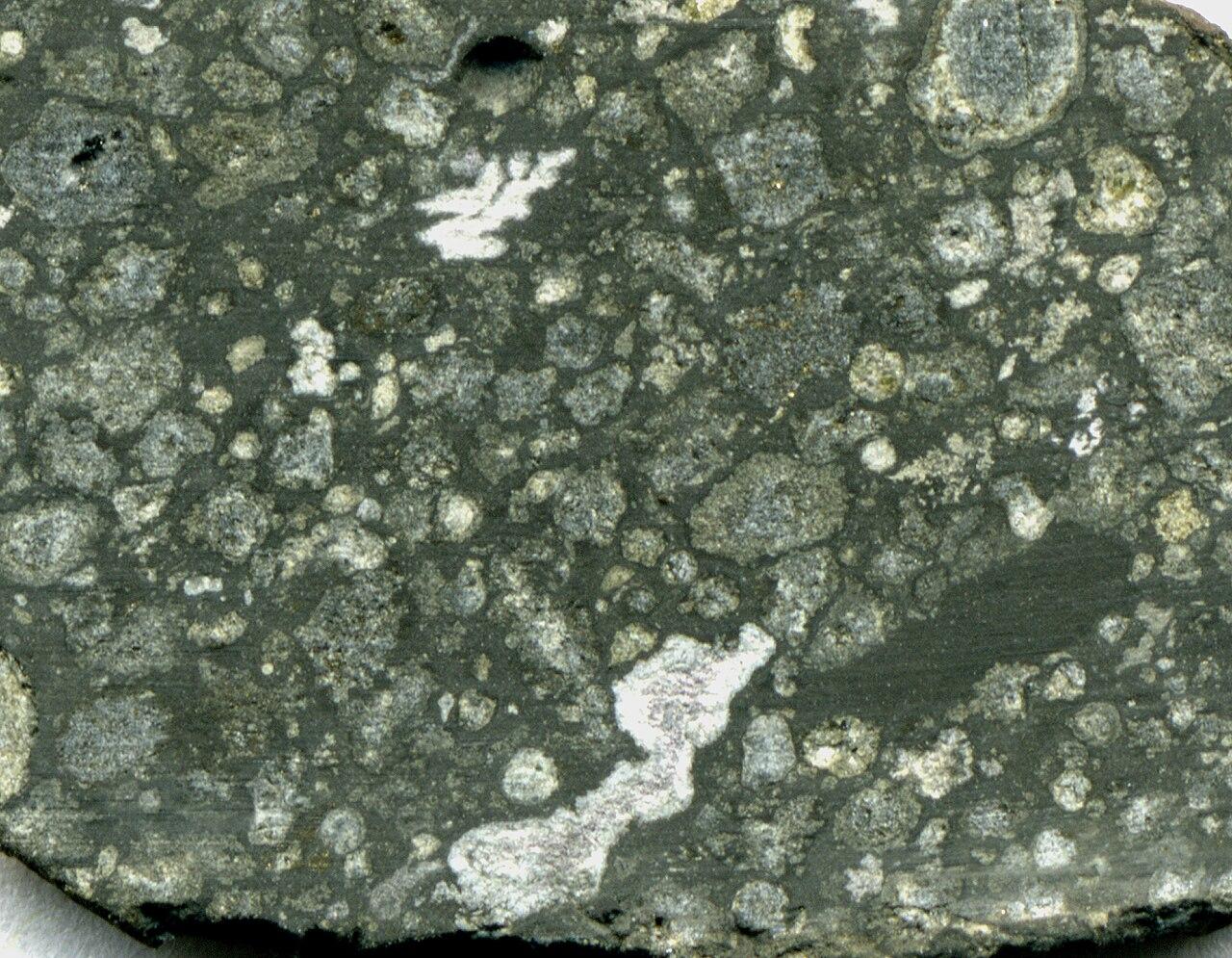
Cut one open and you see why. Scattered through a dark matrix are millimeter-sized chondrules, droplets of rock that were melted and cooled in space, and white, irregular lumps up to a few centimeters across called calcium-aluminum-rich inclusions, or CAIs. The CAIs are among the first solids that formed in the Solar System, and some carry unusual mixes of isotopes, versions of an element with different numbers of neutrons, left as traces of other stars that lived and died before the Sun formed.
That makes them the place to start the Solar System's clock. The standard method uses uranium, which decays into lead through two chains at two different rates. It relied on one assumption: that the ratio of uranium-238 to uranium-235 in meteorites is always the same, 137.88.
Gregory Brennecka, a graduate student at Arizona State University, took the question on in a class on meteorites, writing a research proposal about it as an assignment. He went on to test it on CAIs from Allende with his colleagues, and in 2010 they reported that it wasn't true. The ratio ranged from 137.409 to 137.885, which meant earlier ages could be too old by several million years. The pattern pointed to curium-247, a radioactive element that was still around in the young Solar System and decayed into uranium-235. None of that original curium-247 is left today. It survives only as that small surplus of uranium.
Two years later, James Connelly and colleagues measured uranium in each grain they dated, from several primitive meteorites. CAIs came out at 4,567.30 million years, give or take 0.16 million. The chondrules overturned an old picture. Instead of forming well after the CAIs, as had long been thought, the first ones formed at the same time, and they kept forming for about 3 million years, about as long as disks around young stars are seen to last.
Allende stones are still occasionally found in that desert, more than 50 years after the fall.
9. 🔭 One word on a glass plate made the universe bigger
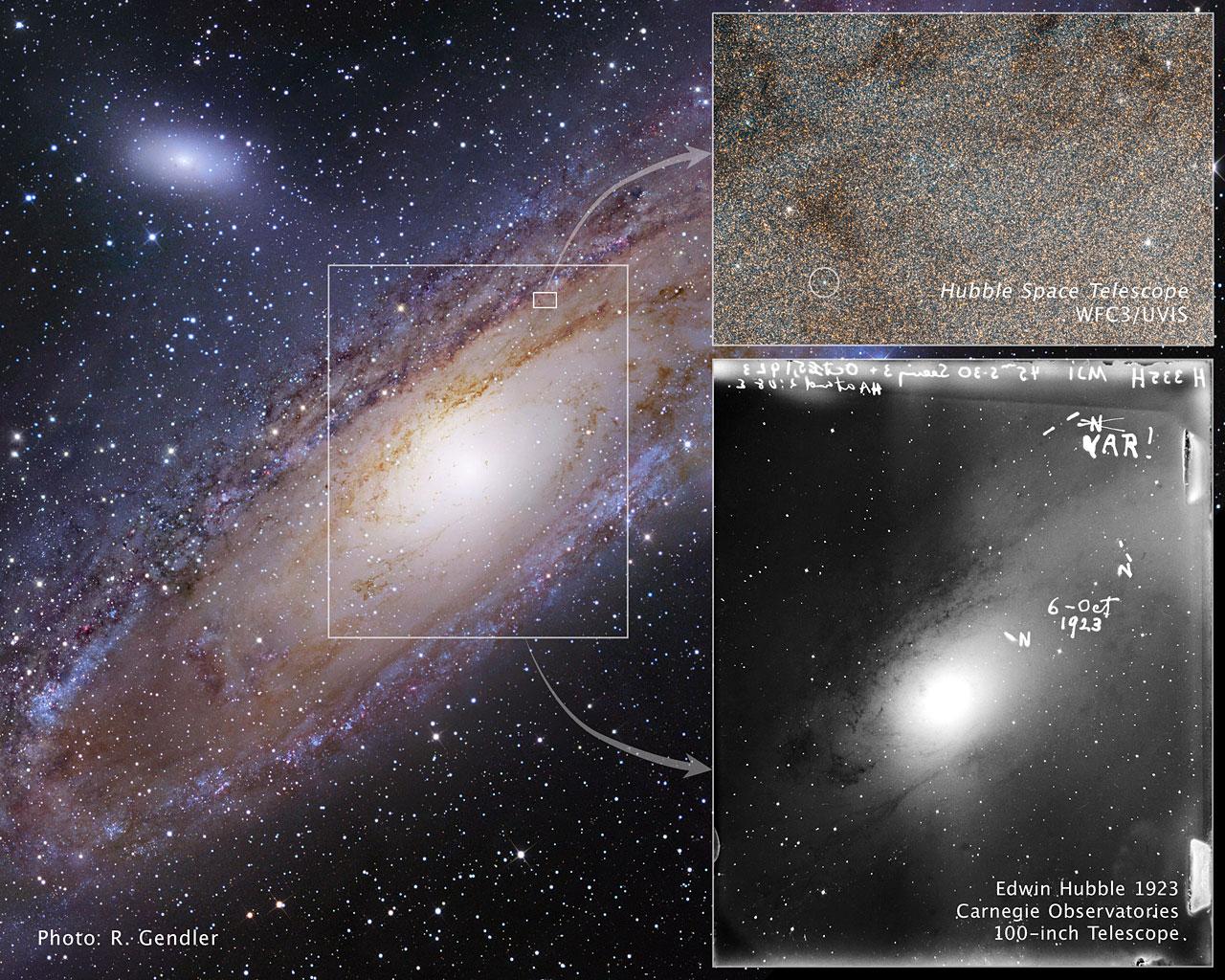
Edwin Hubble's photograph of the Andromeda nebula is dated October 6, 1923. He took it on a glass plate about 10 by 13 centimeters with the 100-inch Hooker telescope, the most powerful telescope of its day, and marked three new spots of light with an N, for nova.
He later realized that one of them wasn't a nova. It was a Cepheid, a kind of star that brightens and fades in a steady cycle, and he crossed out the N and wrote VAR, for variable. Cepheids with longer cycles are more luminous, so a Cepheid's rhythm tells you how bright it really is, and how faint it looks tells you how far away it is. This one, V1, was far beyond the Milky Way.
That settled an argument. In April 1920, Harlow Shapley and Heber Curtis had faced off in Washington, D.C., in what became known as the Great Debate. Shapley described a Milky Way 300,000 light-years across, so big that spiral nebulas like Andromeda had to be part of it. If they were separate, he argued, they'd have to be absurdly far away. Curtis described a Milky Way a tenth that size and argued that the spirals were galaxies of their own. No transcript survives. The arguments have been pieced together from Shapley's typed script, Curtis's slides and their letters.
In the papers they published a year later, each side leaned on evidence that turned out to be wrong. Shapley cited Adriaan van Maanen's claim that photographs taken years apart showed the Pinwheel Galaxy measurably turning, which would be impossible for something so large and distant. The measurements were mistaken. He also pointed to a nova in Andromeda in 1885 that briefly shone with roughly a tenth of the whole nebula's light, far too bright for any nova at that distance. It was a supernova, a kind of explosion nobody knew about yet. Curtis, for his part, had the Sun near the center of the galaxy, and Shapley was right that it's far out toward the edge.
Hubble sent Shapley a letter with V1's light curve. After reading it, Shapley reportedly told a colleague, "Here is the letter that destroyed my universe." Hubble's paper was read for him at a joint meeting of American scientific societies that opened at the end of December 1924, and it shared the prize for the best paper.
V1 put Andromeda about a million light-years away, more than three times Shapley's width for the whole Milky Way. By the end of 1924, using all 12 Cepheids he had found, Hubble settled on 900,000. Both numbers were too small. Andromeda is now known to be about 2.5 million light-years away.
Nearly 90 years after the plate, the Hubble Heritage team and the American Association of Variable Star Observers came back to V1. Amateur observers tracked it for six months in 2010, and the Hubble Space Telescope photographed it at its faintest and brightest. "V1 is the most important star in the history of cosmology," said Dave Soderblom of the Space Telescope Science Institute, who proposed the observations. Years earlier, he had made film copies of the 1923 plate. Ten of them flew on the space shuttle Discovery in 1990, on the mission that launched the telescope named after Hubble.
10. 🪐 The planet that won't show its air
When it was found in 2009, GJ 1214 b looked like the perfect planet for studying an atmosphere.
David Charbonneau and his colleagues caught it crossing in front of a small star about 42 light-years away. Their first estimates gave it 6.55 times Earth's mass and 2.68 times its width, between Earth and the ice giants Uranus and Neptune. Its density fit a planet made mostly of water under a thin layer of hydrogen and helium. Planets like this, called sub-Neptunes, are the most common kind astronomers know of, and the Solar System has none.
Because its star is small, GJ 1214 b blocks a big share of the starlight when it passes in front, which makes it a good target for transmission spectroscopy. During each crossing, some starlight passes through the rim of the planet's atmosphere. Molecules there absorb certain colors, so at those colors the planet looks a little bigger. A puffy hydrogen atmosphere would make big swings with color. A compact atmosphere of steam would make small ones.
What astronomers saw was flat. Laura Kreidberg and her colleagues used Hubble to watch the planet's crossings and got a spectrum with no features at all, precise enough to rule out cloud-free atmospheres made mostly of water, methane, carbon monoxide, nitrogen or carbon dioxide. "The planet's atmosphere must contain clouds to be consistent with the data," they wrote in 2014. Something high up was hiding everything below.
The James Webb Space Telescope tried another way in. Instead of catching starlight passing through the edge, Eliza Kempton and her colleagues watched the planet's own heat over whole orbits, as its day side and night side turned toward us. The day side came out at about 553 kelvin and the night side at about 437, roughly 280°C and 160°C. Both showed faint signs of water. Adding up the heat, they found the planet reflects about half the light that falls on it, and their models point to an atmosphere rich in heavy elements under a thick, bright layer of cloud or haze.
A 2024 study led by Everett Schlawin used another Webb instrument to watch crossings at near-infrared wavelengths, between the ranges of the Hubble and earlier Webb studies, and found possible signs of carbon dioxide and methane above the haze. The signal is faint, and they say more observations are needed to confirm it.
Seventeen years after its discovery, the best-studied sub-Neptune is still mostly showing us the top of its clouds.
11. 🌌 Is something beyond the horizon tugging on galaxy clusters?
Galaxy clusters are the heaviest things in the universe held together by their own gravity, and their gas is hot enough to glow in X-rays. That gas gives away how the clusters move.
Light left over from the Big Bang, the cosmic microwave background, passes through every cluster on its way to us. Its hot electrons scatter a small share of that light, and if the cluster is moving toward us or away from us, the scattered light comes out very slightly warmer or cooler. This is called the kinetic Sunyaev-Zeldovich effect. In WMAP's maps, the signal from any one cluster is lost in the noise. Averaged over many clusters across the sky, a shared motion could show up.
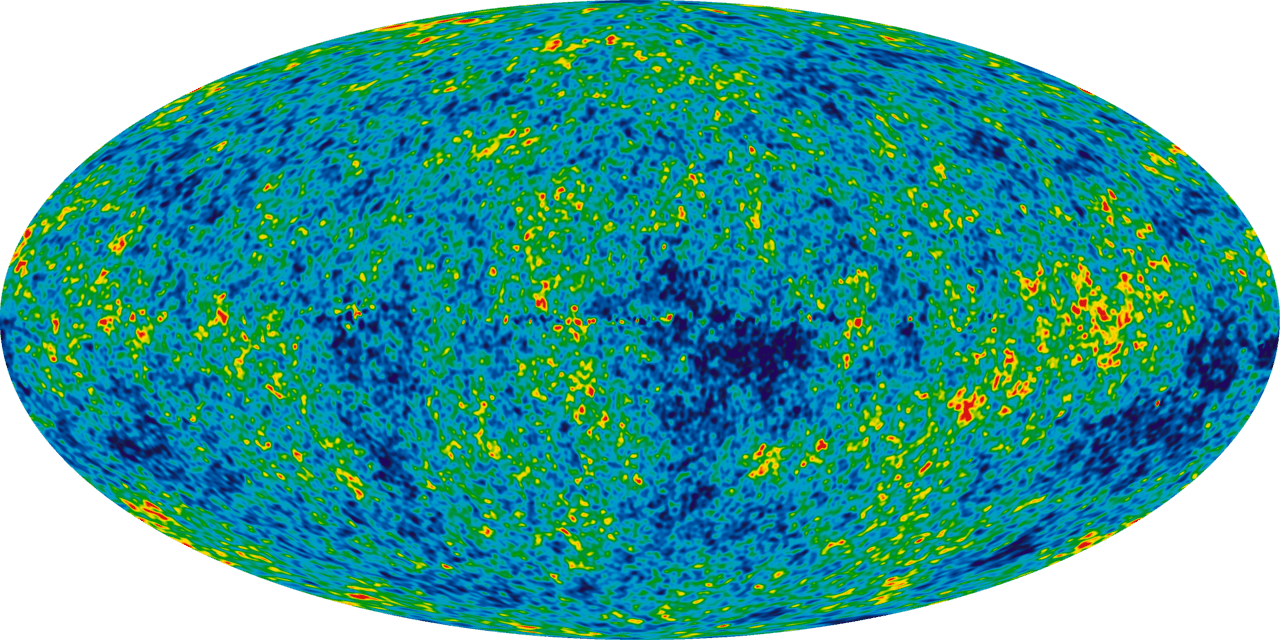
Alexander Kashlinsky of NASA's Goddard Space Flight Center and his colleagues tried it with the largest all-sky catalog of X-ray clusters assembled at the time and three years of data from WMAP. They reported a strong, coherent flow: the clusters seemed to be moving together, in one direction, out to at least 1.4 billion light-years, at 600 to 1,000 kilometers per second. The standard model of the universe says 95 percent of observers should measure flows slower than about 200 kilometers per second on those scales.
Gravity from anything we can see couldn't easily explain it. The team suggested something stranger: the pull of lumps in the universe from before cosmic inflation, a proposed burst of extremely rapid expansion in its first instant, now far beyond the horizon of what we can observe. The idea became known as the dark flow. A 2012 review by the same group said the signal reached at least 800 megaparsecs, about 2.6 billion light-years, and might extend across the whole observable universe.
Then came the Planck satellite, with sharper microwave maps. In 2013 the Planck team tried the same kind of measurement on a large catalog of X-ray clusters and found no detection of a bulk flow at any depth their sample reached, with an upper limit of 254 kilometers per second. They concluded that the universe is largely smooth on scales of billions of light-years, as the standard model expects.
Kashlinsky's side answered within days. Fernando Atrio-Barandela argued that the Planck team had overestimated its uncertainties, and that Planck's data actually showed a dipole, slightly warmer toward one side of the sky and cooler toward the other, like the one found with WMAP, at about the same significance once the errors were corrected.
Planck's full data later gave a related measurement. Rather than looking for one shared flow, a 2018 analysis measured how widely cluster speeds scatter, and found a spread that matched other studies and a universe that's statistically the same everywhere on scales of nearly 3 billion light-years. That doesn't directly answer the dipole that Kashlinsky's team reported, and the dark flow is still a claim waiting for a cleaner measurement.
12. 🌍 Will the Sun swallow Earth?
About 7.6 billion years from now, the Sun will reach its largest size as a red giant, and Earth's fate depends on a tug-of-war between two effects.
The first works in Earth's favor. A red giant blows off much of its outer layers in a wind, and the Sun is expected to lose about a third of its mass by the time it's biggest. With less mass pulling on it, Earth's orbit will widen. On its own, losing a third of the Sun's mass would make the orbit about one and a half times its present size.
The second works against it. Earth raises a tidal bulge on the slowly spinning giant Sun, and the bulge pulls back on Earth as it goes around. Near the giant's thin outer layers, Earth also feels drag. Both slowly rob Earth's orbit of momentum and pull it inward.
Klaus-Peter Schröder and Robert Connon Smith worked through both effects in 2008, step by step through the Sun's red giant phase, with a carefully tested model of how much mass the Sun will lose. Their answer was that Earth will not escape. Mass loss helps, but not enough. To survive, a planet would need to start out today at least 1.15 times Earth's distance from the Sun. Mercury and Venus are well inside that line. Mars, at about one and a half times Earth's distance, is outside it.
The model also changes the Sun's last act. It loses so much mass as a red giant that its last swelling, later on, won't get as big, and it may not have the power to throw off a proper planetary nebula, the glowing shell that many dying stars leave behind. They expected something smaller and fainter instead.
The planets farther out have a better chance, and there's now evidence that some survive. A star toward the center of the Milky Way briefly brightened in 2010 as another object passed in front and bent its light, an event called MOA-2010-BLG-477. The way it brightened showed a planet orbiting the foreground object. Years later, Joshua Blackman and his colleagues used the Keck telescopes to look for that foreground star and found nothing. A normal star of the mass the lensing pointed to would have shown up, so it had to be a white dwarf, the cooling core left behind by a star like the Sun.
Its planet has about 1.4 times the mass of Jupiter and orbits at least 2.8 times as far from its star as Earth is from the Sun. It's the first planet found in a Jupiter-like orbit around a white dwarf, evidence that giant planets in wide orbits can come through their star's red giant phase intact. The system is about 6,500 light-years away, and the authors describe it as a likely analog of what the Sun and Jupiter will become.
13. ⏱️ Ten minutes late, 350 years ago
Ten days from tonight, it will be 350 years since Ole Rømer, a Danish astronomer of 32, explained to the Royal Academy of Sciences in Paris why one of Jupiter's moons kept showing up late.
He hadn't been looking for anything about light. Before good clocks could go to sea, finding your longitude meant knowing the time at some reference place, and Galileo had proposed using the eclipses of Jupiter's moons as a clock in the sky. Giovanni Domenico Cassini, director of the new Paris Observatory, published tables predicting them. In 1671 his colleague Jean Picard went to the ruins of Tycho Brahe's observatory near Copenhagen to time the same eclipses from there, and the young Rømer helped him. Together they observed about 140 eclipses of Io, and Picard brought Rømer back to Paris.
Io goes around Jupiter every 42 and a half hours and disappears into Jupiter's shadow once each orbit. Rømer noticed that the time between eclipses wasn't constant. While Earth was moving away from Jupiter, the gaps grew longer. While it was moving toward Jupiter, they shrank. In the spring of 1672, for example, Io's apparent orbit came out 32 seconds longer over a run of observations than over the first few. That's tiny, but it adds up, and by the end of April an emergence from the shadow came a quarter of an hour after it should have.
Rømer's explanation was that the moon was keeping perfect time, and the news of each eclipse took longer to reach us when Earth was farther away. From about 30 eclipses observed between 1671 and 1673, he worked out that light takes about 11 minutes to cross the distance from the Sun to Earth. In August 1676, Cassini told the Academy he was changing how his tables were calculated. Rømer predicted that an emergence of Io in mid-November would come about ten minutes later than the old method said. He presented his reasoning on November 21.
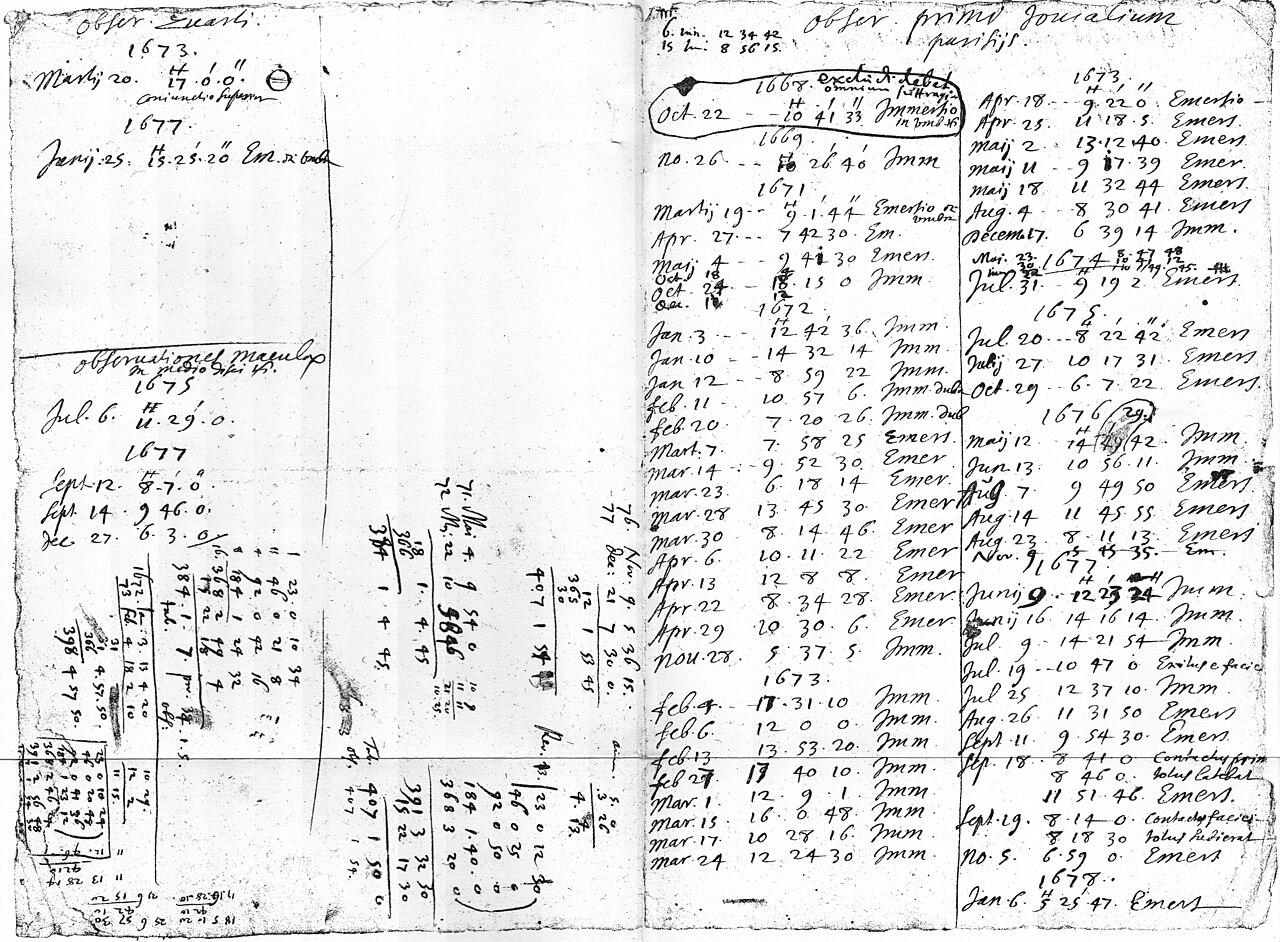
Cassini never fully accepted it. Jupiter's other moons didn't seem to show the same delay, and there were irregularities the idea couldn't explain, so he rejected it as incomplete. Christiaan Huygens took Rømer's side. In England, Edmond Halley supported him, and in 1704 Isaac Newton wrote in his Opticks that sunlight takes "seven or eight minutes" to reach us. In 1729, nearly two decades after Rømer's death, James Bradley explained the small seasonal shifts in the positions of stars as the effect of Earth moving through light that travels at a finite speed. His figure was 8 minutes and 13 seconds.
The real value is 8 minutes and 19 seconds. Rømer's eleven minutes was about a third too long. Bradley, measuring something else entirely, missed by six seconds.
🌙 One last thought before you sleep
I keep coming back to Cassini. He wasn't careless when he refused Rømer's explanation. He had real irregularities in front of him that it couldn't account for, and he wanted an account of all of them. Independent proof that light takes time only came with Bradley, half a century later, and the rest of the moons' wobbles waited even longer.
I wonder what evidence would have changed his mind sooner. And I wonder which of tonight's open arguments, the disputed dark-flow signal in the microwave maps or a planet that showed up once beside Alpha Centauri A, is waiting on its own Bradley.
That's all for tonight. Thanks for wondering along with me. Good night, and clear skies. 🌌
— Kasi