Three weeks ago, a scientist double-checking some search code found what may be one of the largest objects beyond Neptune. Telescopes had been catching it for ten years. Software kept losing it, because it sat in front of the crowded stars of the Milky Way, and even the observatory that finally found it has no catalog entry for it in most of the images that show it.
Also tonight: a radio mystery that ended in a staff kitchen, a Moon rock that may have started out on Earth, and a neutrino no other detector can match. The last stop is the one I can't shake: an explosion that may come after everything else in the universe has finished.
1. 🪐 A possible dwarf planet hid among the Milky Way's stars
On the evening of October 13, Matthew Holman of the Center for Astrophysics | Harvard & Smithsonian was running months of data from the new Vera C. Rubin Observatory through a search program written with a colleague, Kevin Napier. The program takes billions of detections of moving points of light and works out which ones belong to the same object. One of its results looked too big to be true.
"My first reaction was one of excited disbelief," Holman said in Rubin's announcement. "Objects like this are very rare, so I immediately started checking whether I or the code had done something wrong."
Nothing was wrong. Mario Jurić of the University of Washington searched Rubin's catalogs and images and found 20 more observations, going back to March 4. Older images from the Dark Energy Camera in Chile stretched the trail back to 2016. On October 27, the Minor Planet Center announced the object as 2026 ED138.
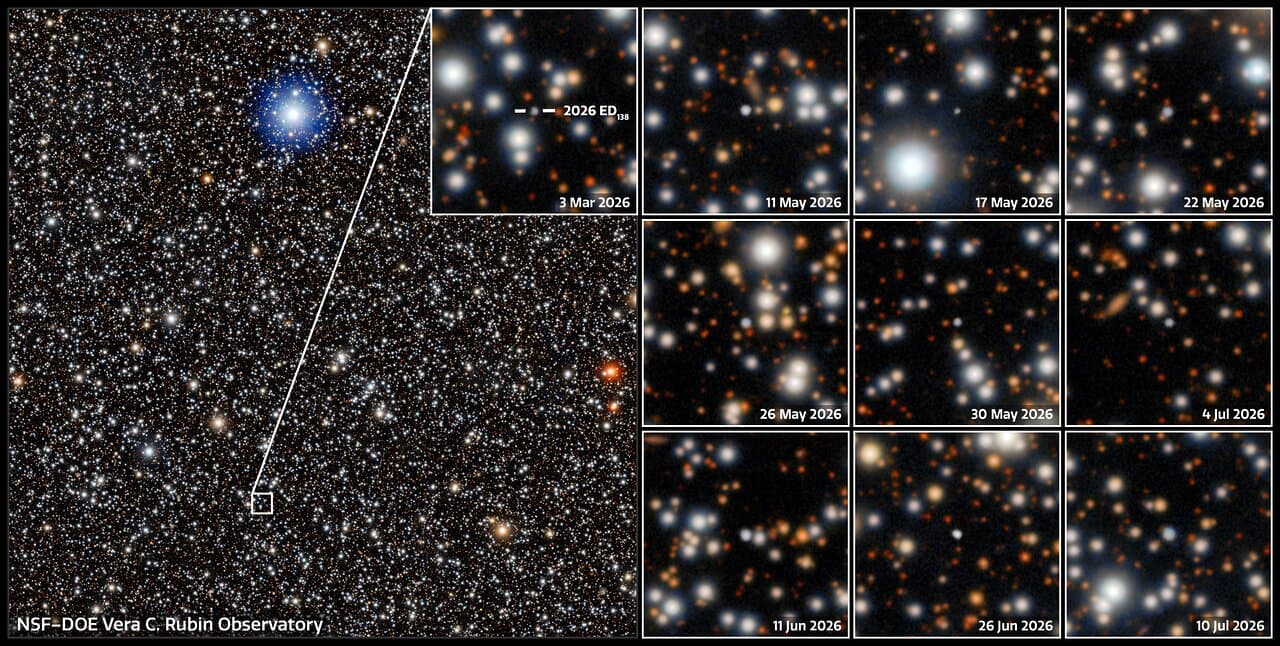
It's now about 46 times farther from the Sun than Earth is, on an orbit tilted almost 25 degrees from the plane of the planets. To Rubin it's only a point of light, which means its size has to be worked out from its brightness, and that depends on how much sunlight its surface reflects. If it reflects 4 percent, it's about 1,530 kilometers wide. If it reflects 25 percent, it's about 612. At 10 percent, close to what Quaoar and Gonggong reflect, it would be about 970 kilometers, roughly the width of Ceres.
Either way, the team's paper places it among the ten brightest objects known beyond Neptune, once you correct for distance. Icy bodies this large are expected to have pulled themselves round, which is what would make it a dwarf planet. The International Astronomical Union recognizes five. This would join them if measurements of its reflectivity and shape bear that out.
It's bright enough for the wide searches of the past two decades to have seen it, and those searches were thought to have found nearly everything this bright across most of the sky. It was simply in a bad spot. It lies far south, and from 2000 to 2023 it stayed within 10 degrees of the plane of the Milky Way, crossing that plane in 2011. Surveys tend to skip that band because the stars there are so crowded. The northern searches couldn't reach it. A southern one in 2010 was deep enough, but the object sat within about a degree of the edge of its fields. The Dark Energy Survey stayed about 19 degrees away.
Rubin nearly lost it as well. Its automatic catalogs have no entry for ED138 in 24 of the 38 visits whose images show it. In most of those, the software had merged the light of neighboring stars into blobs too large to pull apart, and it dropped everything inside them. The search that finally found it left out the whole zone within 10 degrees of the galactic plane, and ED138 was only about 2 degrees outside that line.
There may be more. Of the known large objects this search had a fair chance of finding, it found 8 of 10, and it turned up one new one. From that, the team estimates that about three more large objects remain away from the galactic plane, with a wide uncertainty, and they think that's an underestimate. The band closest to the plane hasn't been searched to this depth at all.
ED138 itself is bright enough to study properly. It lies toward the crowded center of the galaxy, so it will often pass in front of stars, and timing those blinks can measure its size directly. Its color has already ruled out one idea: its orbit resembles Haumea's, but it's too red to be a fragment of Haumea's old collision. In the team's model, its surface reaches only about 44 to 46 kelvin at its closest to the Sun, and at that temperature and size it should have lost its methane, nitrogen and carbon monoxide. A spectrum showing any of them would put that expectation to the test.
2. 💥 The new star of 1670 may have been a collision
In 1670, a star appeared where none had been, just below the head of the Swan. Johannes Hevelius, the astronomer famous for mapping the Moon, recorded it as nova sub capite Cygni, and Cassini followed it too. It was easy to see with the naked eye. Over the next two years it varied, then disappeared and came back twice before vanishing for good.
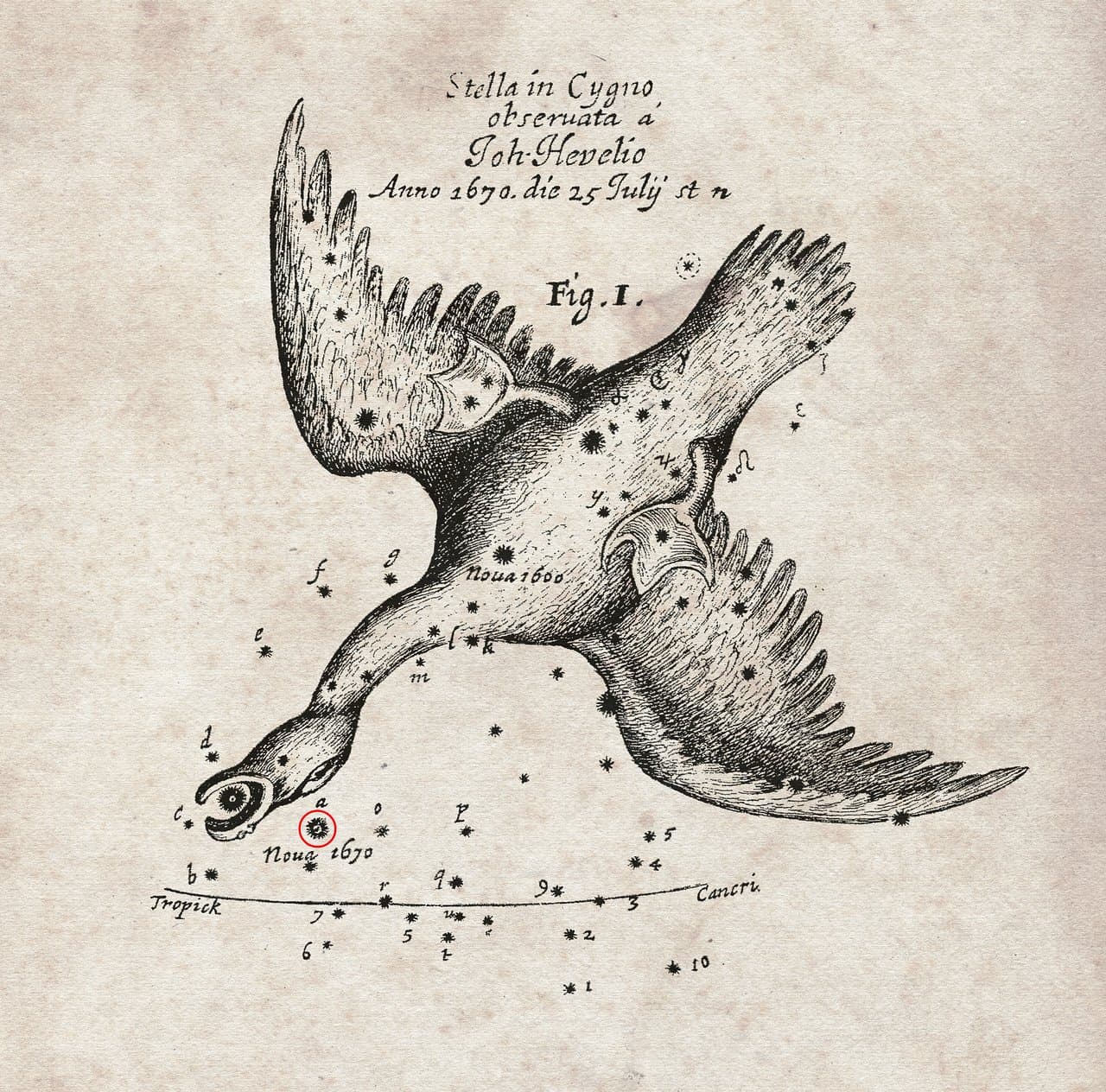
Astronomers came to call it Nova Vulpeculae 1670, or CK Vulpeculae, and filed it as possibly the oldest nova on record. A nova is an eruption on a white dwarf, the dense remnant of a burned-out star, that has been stealing gas from a companion, and the system survives it. The trouble was that this one seemed to leave almost nothing behind. A faint nebula wasn't found at the spot until 1982, and no star has been seen inside it.
Tomasz Kamiński and a group of colleagues went looking at much longer wavelengths than visible light, with the APEX, SMA and Effelsberg telescopes. They found the site bathed in cool gas rich in molecules. There was too much of that gas for a nova to have thrown off, and its mix of isotopes (versions of an element with different numbers of neutrons) didn't match what novae make. The more it was studied, Kamiński said, "the less it looked like an ordinary nova." In 2015 the team proposed the remains of a merger of two stars, a violent event brighter than a nova and fainter than a supernova. "This kind of discovery is the most fun: something that is completely unexpected!" said a co-author, Karl Menten.
Three years later, the same group found something stranger in the debris. Using the ALMA and NOEMA arrays, they picked up the signature of aluminum monofluoride containing aluminum-26, a radioactive form of the metal. It was the first definitive detection of a radioactive molecule in interstellar space. There was no laboratory spectrum of this rare molecule to compare, so researchers at the University of Kassel calculated its fingerprint from measurements of the stable version.
That aluminum is a clue to what collided. In a red giant, it should sit in a thin layer around the helium core, deeper than the star's churning outer layers can reach. To get it out into space, something has to rip the star open. "We are observing the guts of a star torn apart three centuries ago by a collision," Kamiński said. "How cool is that?"
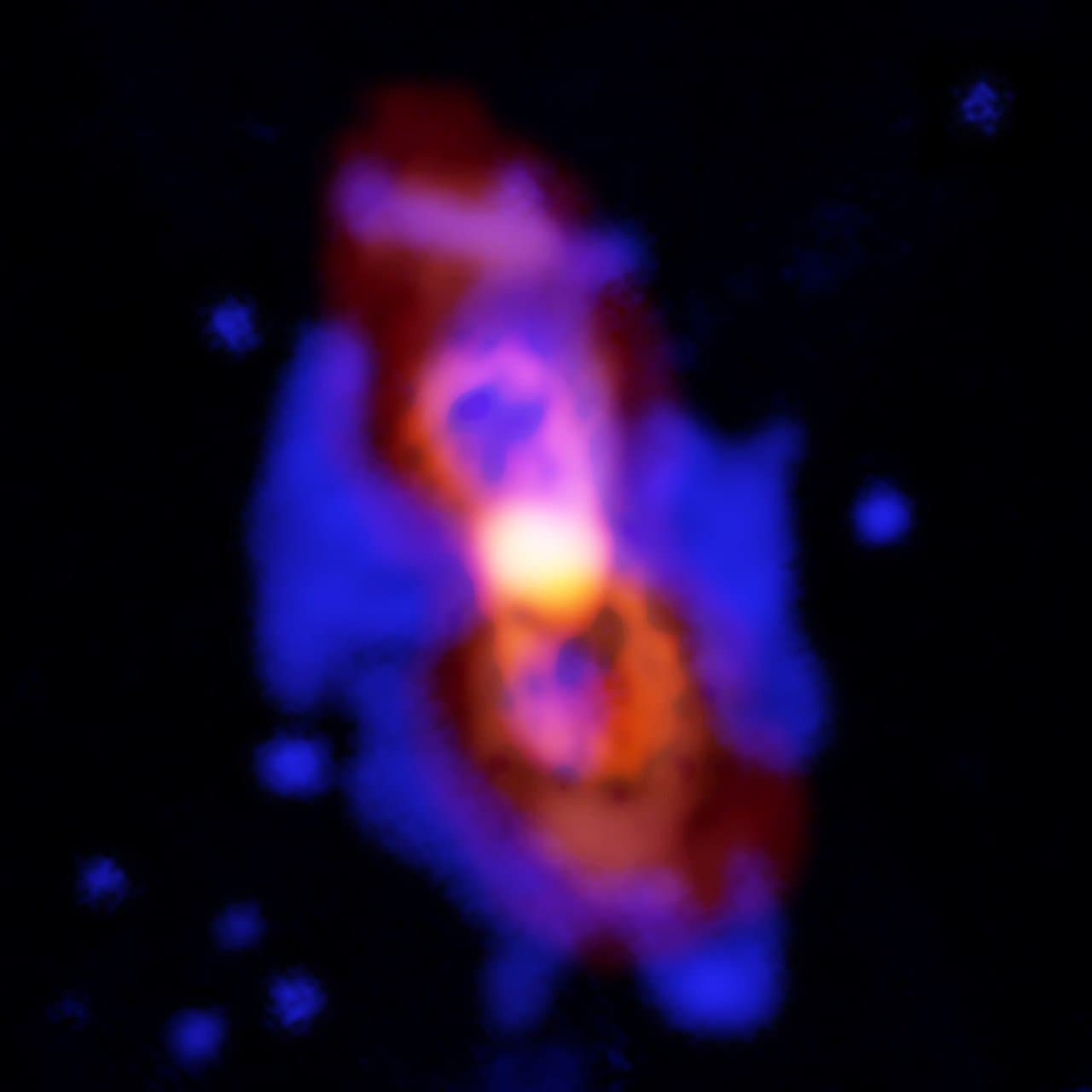
Not everyone read the wreck the same way. Also in 2018, a team led by Stewart Eyres combined ALMA maps of the debris with earlier optical work that had found lithium in the light of two background stars. Lithium is easily destroyed inside stars like the Sun but can survive in lower-mass brown dwarfs, objects too small to sustain ordinary hydrogen fusion. Along with the odd isotopes, that led them to a different pair: a white dwarf that tore apart a brown dwarf about a tenth of its mass.
In 2023, Romuald Tylenda and two colleagues, Kamiński among them, went through the evidence again. From the remnant's luminosity and chemistry, they concluded that the main star was a red giant of one to two solar masses, and they favored a helium white dwarf as its partner. They think the result is becoming an unusual carbon-rich star, though nobody has a direct view of it.
All of them agree on what it wasn't. After 350 years, the object Hevelius charted has lost its old label, and the star at the center of the wreck is still hidden.
3. 📡 The signal that came from the staff kitchen
The story starts with a single radio flash, reported in 2007 by Duncan Lorimer and colleagues, in old data from the Parkes telescope in Australia. It lasted a few milliseconds, and its high frequencies arrived slightly before its low ones. Space holds a thin scatter of free electrons, which hold back low-frequency radio waves more than high ones, so the delay measures how many electrons a pulse has passed. This one's delay suggested a source far outside the Milky Way. Today we call it the first fast radio burst.
Then it got awkward. Sarah Burke-Spolaor went through Parkes data looking for more, and in 2010 a team reported 16 pulses with the same kind of frequency sweep. These clearly came from Earth. They showed up in a way that meant they were entering the telescope from the side, close by. Something local could fake the very signature that had made the first burst look cosmic, and that cast doubt on the whole idea. The signals were named perytons, after a mythical winged stag that casts the shadow of a man.
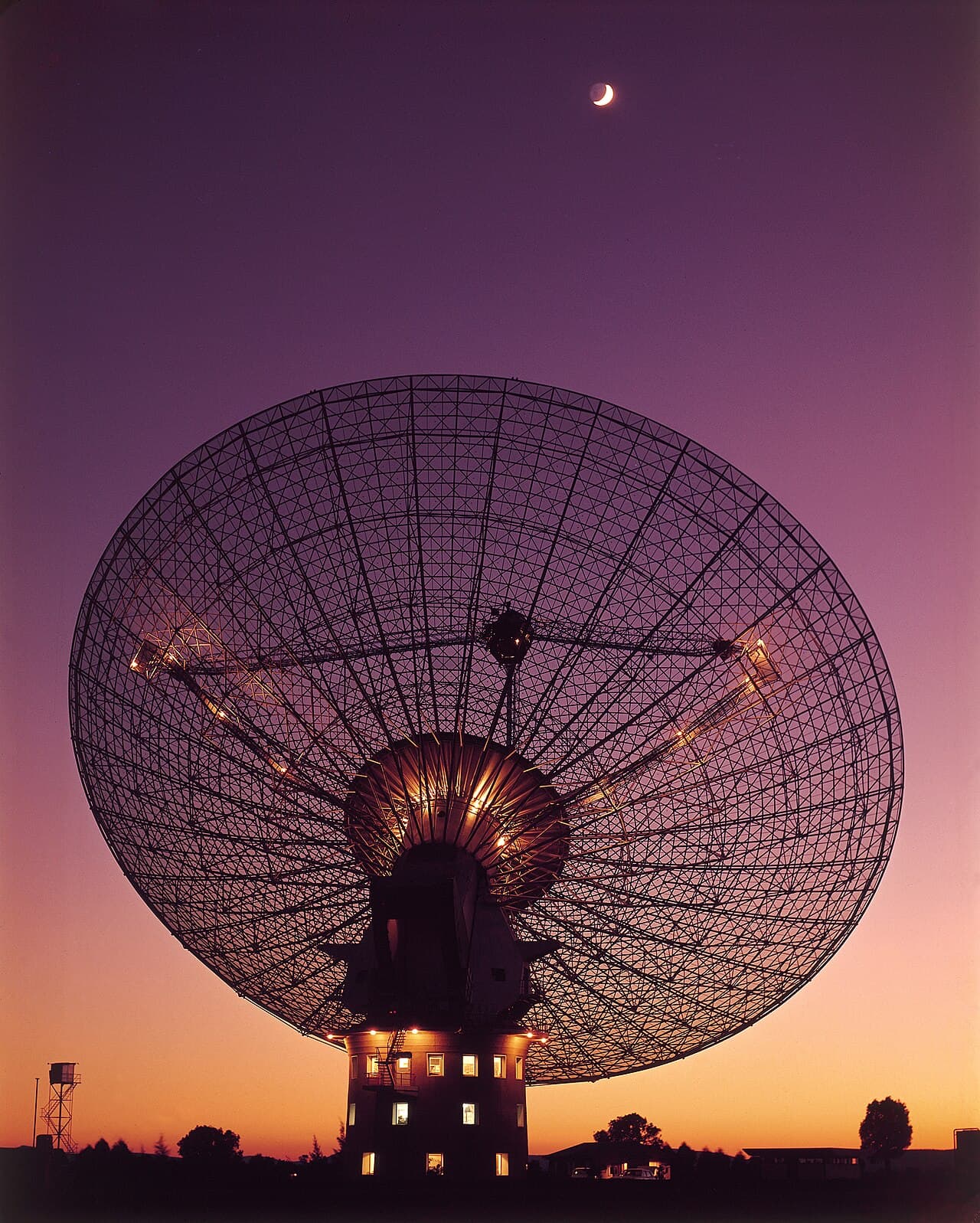
For years they stayed unexplained, and the clues were odd. The 25 perytons reported by then all came during office hours, mostly on weekdays. Their sweeps clustered close to that of the Lorimer burst. One 2014 paper asked whether they might be ball lightning.
The break came from a new piece of equipment. In December 2014, Parkes installed a monitor that scans for interference across a wide range of frequencies. In one week in January 2015, three new perytons appeared, and each one coincided with emission at 2.3 to 2.5 gigahertz from somewhere on the site. Emily Petroff's team knew what lives in that band. Wireless internet does, and so do microwave ovens.
They decided to test the ovens. On February 27, with the telescope parked, they ran the three microwaves near the dish with a ceramic mug of water inside. They got one peryton, during a test of the oven in the telescope's tower. That was a surprise, since the tower is shielded, and it turned out someone was also using the oven in the staff kitchen at the time, unrelated to the test. A second try on March 12, with the dish aimed where perytons were most common, gave nothing.
On March 17 they changed one thing. Instead of letting the oven finish, they stopped it by opening the door. Three bright perytons appeared in the data, at the exact moments the kitchen microwave's door was opened. It worked about half the time, and only with a clear line from the oven, about 100 meters away, to the telescope's receiver. The burst came from the magnetron, the tube that generates the microwaves, as it switched off. The oven in the visitors center produced perytons too, with a different apparent sweep, which helped explain why the data had always split into two groups.
Across 17 years of Parkes records there were 46 perytons. Sixteen of them came within seven minutes on June 23, 1998. The team thinks one oven was then cycling its magnetron on and off every 22 seconds, making a peryton at the end of most cycles, though they couldn't reproduce that with the door shut. They conjecture that something conducting, perhaps aluminum foil caught in the door, let the signal out. They also admit that the physical process behind the swept signal is obscure.
They then tested whether the ovens could explain the Lorimer burst, and found that the microwaves on site could not have made it. Fast radio bursts behave differently, too: they follow the sweep expected from electrons in space, they don't bunch up around office hours, and a real one shouldn't come with a matching blast at 2.4 gigahertz.
4. 🌌 What let the light out of the first galaxies?
For much of its first billion years, the universe was filled with neutral hydrogen, a kind of fog that soaks up ultraviolet light. Then radiation from early galaxies stripped those atoms into protons and electrons, until ultraviolet light could cross space freely. Cody Carr, now at the University of Michigan, calls this "the last major phase transition of the universe."
The leading suspects are small, compact galaxies crowded with young stars. They make plenty of the right light, called Lyman continuum: ultraviolet energetic enough to strip the electron from a hydrogen atom. But making it is the easy part, because a galaxy's own gas swallows it. The light has to get out, and in the framework commonly used in cosmological simulations, supernovae open the door. Massive stars die and explode, the blasts drive a wind through the galaxy, and the wind clears channels for light to escape.
Nobody can check this directly in the first galaxies, because the same fog absorbs the light we'd need to see. Astronomers study closer galaxies that look similar instead. Carr's team used Hubble to observe six compact starbursts, chosen to match closely in mass, in how fast they make stars and in their chemistry, but to differ in how much Lyman continuum they leak, from nothing to about 20 percent. If the galaxies are otherwise alike, their differences may mostly reflect age, like snapshots of one kind of galaxy at different moments in its burst. Gas absorbs particular wavelengths, and how far those dips in a spectrum have shifted shows how fast it's moving.
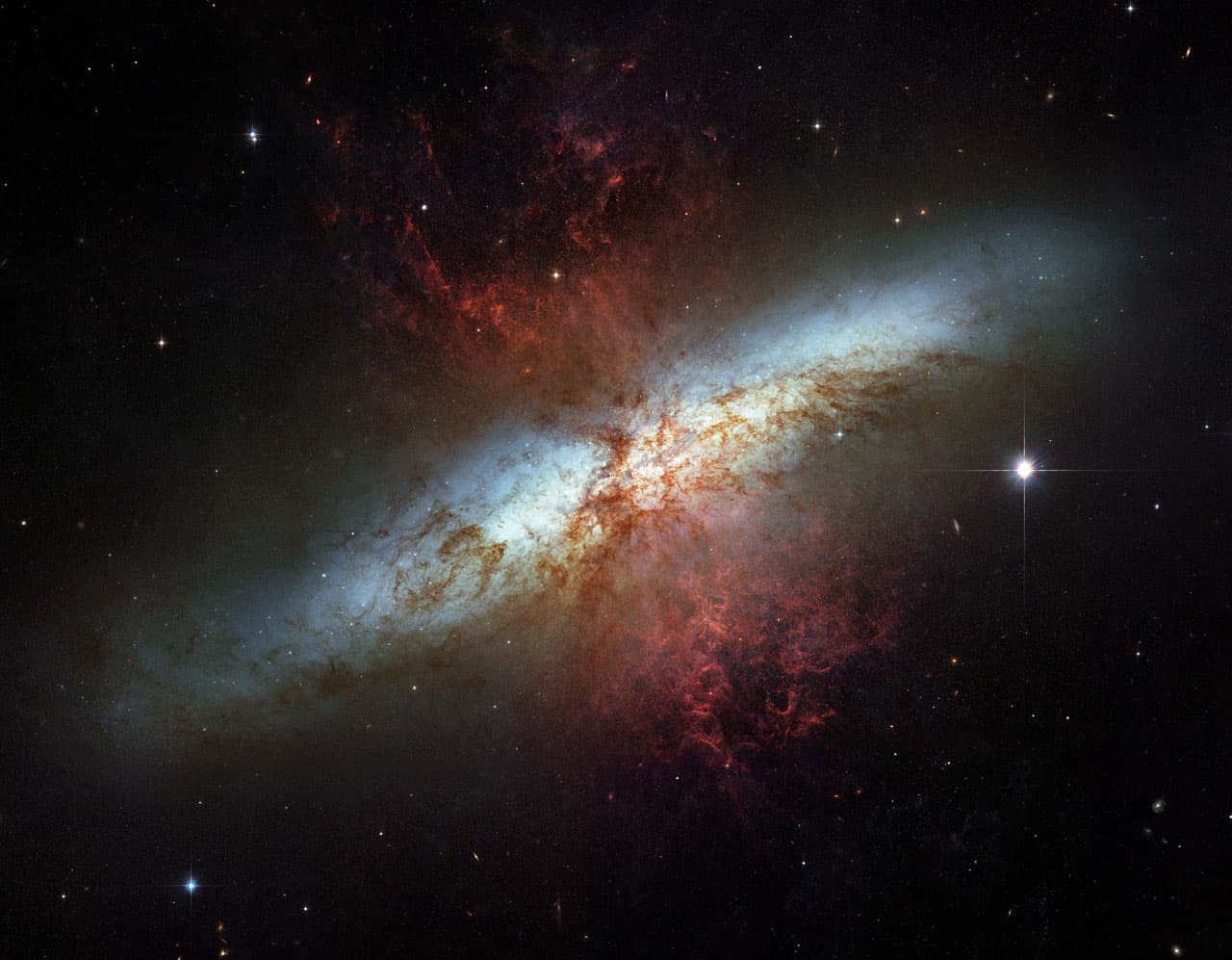
The pattern ran the wrong way. Their paper in Nature Astronomy, published October 15, finds that the leak peaks early, in bursts younger than about 3 million years, when radiation and the winds of living stars dominate and no fast galactic wind has formed. In the older bursts, the winds are faster and dustier, and less light gets out. "Basically, how these galaxies were leaking ionizing radiation isn't what we thought," Carr said.
Stephan McCandliss of Johns Hopkins, a senior author, suggests that energy from supernovae "has stirred up the surroundings and increased, rather than decreased, the coverage of neutral gas and dust." On this view, the light slips away first, before the big winds rise, and the explosions then make things worse.
I wouldn't call the question closed. Six galaxies is a small sample, and the authors say so. Several earlier studies linked faster winds to more leakage, though many relied on indirect measures of wind speed. These are also nearby stand-ins, seen long after the fog lifted. Less than a week after the paper came out, the THESAN-ZOOM simulation team posted a preprint in which energy from stars opens escape routes after a delay: in the most massive simulated galaxies, the escaping fraction of light typically rises about 16 million years after star formation. That sounds closer to the older story, though a high fraction of a fading population's light may not add up to much, and simulations are exactly what Carr's team says need rethinking.
The team is seeking more Hubble time to look at more galaxies.
5. 🌠 A falling rock dies in seven stages
Rocks from space give way far sooner than they should. One falling through the atmosphere starts to break up when the air pressing on its front reaches only about one-fifth of the strength measured in meteorites on the ground. That number comes from Peter Jenniskens of the SETI Institute and NASA Ames, who has a messier account of a meteor than the one we tell children. "We used to think that solid rocks would evaporate from the enormous heat and brilliant light generated in the air collision," Jenniskens said. "We found instead that first melting and then fragmentation controls how a rock loses mass."
The team's study in Meteoritics & Planetary Science rests on 75 documented falls, among them the fireball of asteroid 2023 CX1 over Normandy in February 2023. Every one yielded meteorites on the ground, which ties each fireball's light to the kind of rock that made it. Comparing them, the team splits a fall into seven phases.
The early ones are the familiar part. High up, the air becomes thick enough for a shock wave to form ahead of the rock, and both the surface and the surrounding gas start to glow. As the air thickens, the meteor brightens, and some flicker in a repeating pattern that gives away their spin. The fastest turned once every half second to five seconds.
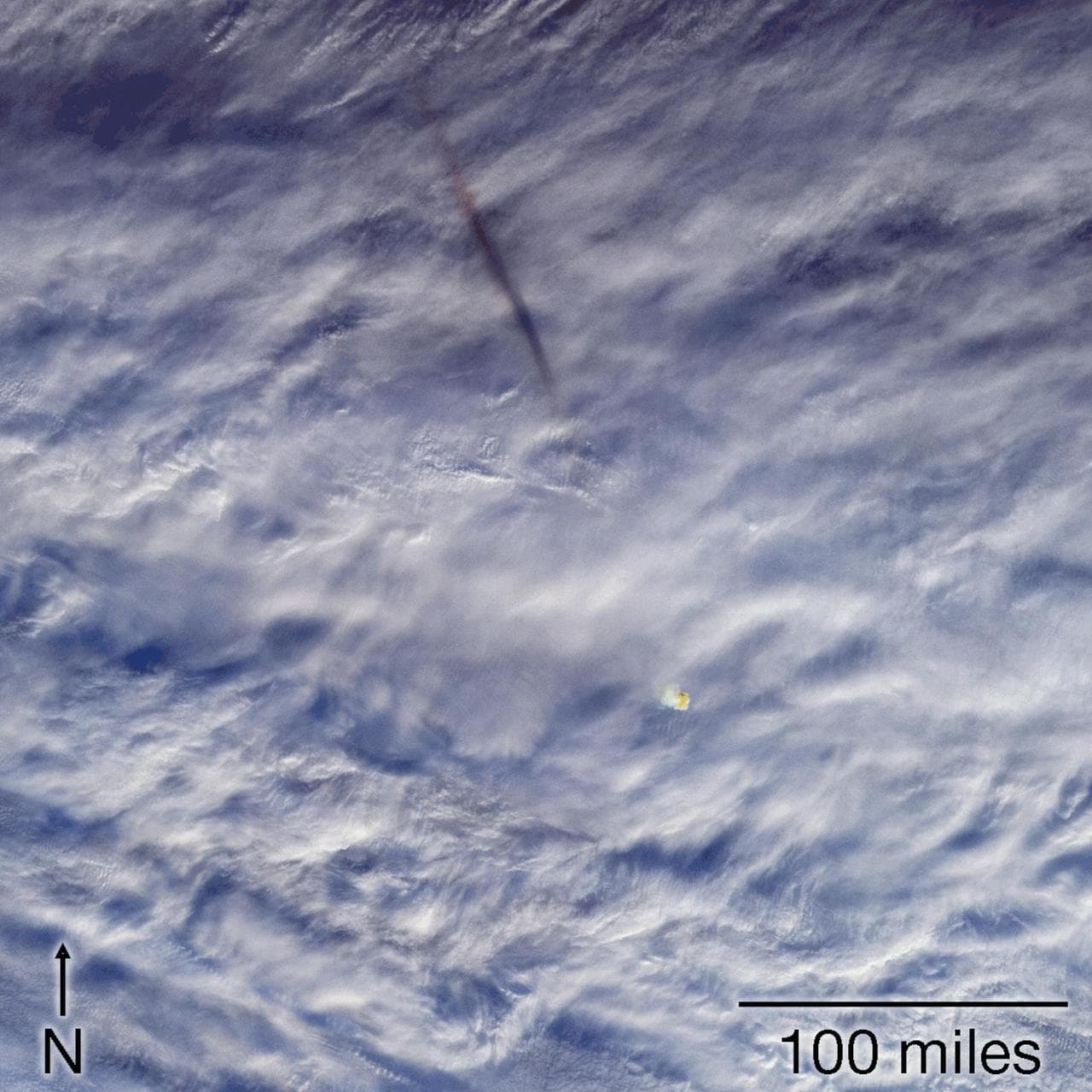
Then the old picture fails. Once the meteor is a fireball, melting takes over. Fast air strips molten rock from the surface in droplets, and those droplets go on evaporating after they've left. About 60 kilometers up, melting settles into a steady balance, and the brightness holds or climbs at a steady rate. Melting alone can remove as much as 40 percent of the rock. "In the laboratory, we cannot generate the amount of radiation that occurs in a natural atmospheric entry at those speeds," said Eric Stern, a co-author.
Next comes that early breakup. As the air gets denser, its pressure cracks the rock, and pieces come off in repeated flashes. The team suggests that heat and old cracks from collisions in space weaken the rock before it gets that far. The more it fragments, the faster it slows.
Something odd happens behind it. As long as the back of the rock stays intact, it pulls a low-pressure wake along with it, and small fragments flow into that wake. "Those small meteorites fall in a narrow strip on the ground," said Darrel Robertson of NASA Ames.
That arrangement ends when the rear of the rock finally breaks up in a last flare, and the pieces scatter at higher speeds. By then the meteor has slowed enough that this flash generally looks red, unlike the bright green often seen earlier. Meteorites heavier than about 20 grams tended to land more widely, and many came from close to the original surface, which must have been the rock's back side.
The surviving pieces slow until they stop glowing. Melting ends and leaves the thin fusion crust on every fresh meteorite. The last part of the fall is dark, and the wind may push the stones off course.
Jenniskens argues that asteroids up to tens of meters across are solid rocks too. "The 20-m diameter asteroid that caused the airburst over Chelyabinsk, Russia, in 2013 went through the same phases," Jenniskens said.
6. 🪐 The planet claimed in 1855 still hasn't turned up
In 1855, William Stephen Jacob of the Madras Observatory in India published a short paper about a double star. 70 Ophiuchi, a pair of stars about 16 light-years away, wasn't moving quite as its orbit predicted, and Jacob called it "highly probable" that a "planetary body" was connected with the system. It's the first known attempt to find an exoplanet from a star's motion, 140 years before a planet around a Sun-like star was confirmed.
It didn't hold up, but the idea wouldn't die. In the 1890s, T. J. J. See made a stronger case for a dark companion, and Forest Ray Moulton then showed that such a three-body system would be highly unstable. Louis Berman announced a dark body with an 18-year period in 1932. Eleven years later, Dirk Reuyl and Erik Holmberg claimed a planet-mass companion with a 17-year period, which caused a sensation before later observations wore it away. As for Jacob's original planet, it's now put down to an artifact of measuring tiny shifts by eye through a telescope.
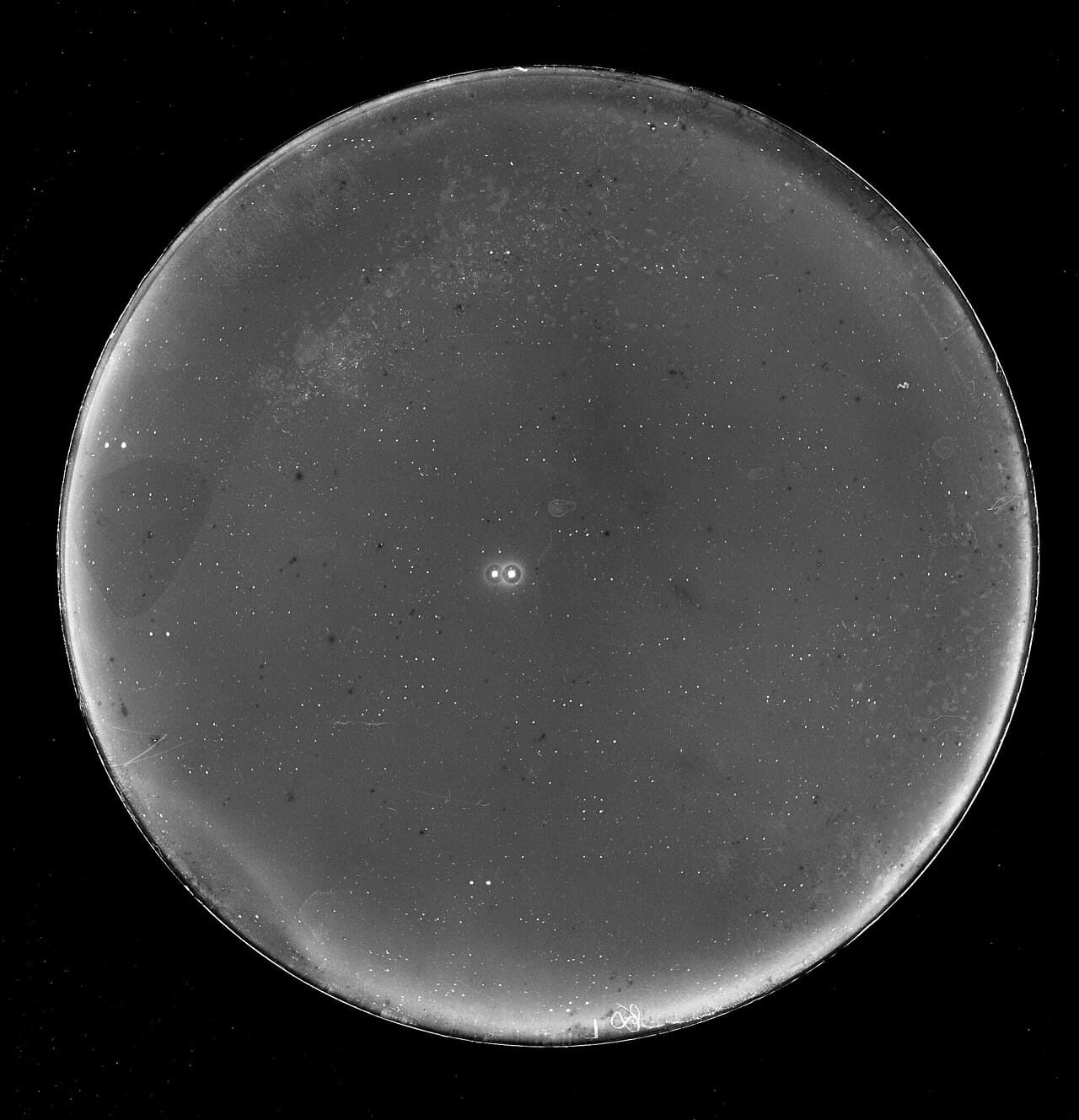
Modern planet hunters have a better method, since a planet's pull rocks its star slightly toward and away from us, shifting its light. Even so, 171 years of measurements hadn't fully closed the door on giant planets here. Yiting Li of the University of Michigan led a team that set out to do it. They took 499 new measurements of the brighter star and 334 of the fainter one with the Planet Finder Spectrograph on the 6.5-meter Magellan Clay telescope in Chile, from 2023 to 2025, then added decades of older velocities and more than a century of position measurements.
The result, published in The Astrophysical Journal, makes this one of the best-measured double stars nearby. The two stars take 88.126 years to go around each other on an oval orbit, and they weigh 0.88 and 0.73 times the Sun, known to better than 1 percent.
There's no sign of a planet. Around the brighter star, Jupiter-mass planets inside Earth's distance from the Sun are firmly ruled out. Farther out the search gets less complete, and the team's limits come from tests of how often fake planets could be recovered: about half the time for planets of roughly a third to half of Jupiter's mass at one to two times that distance. The 5-times-Earth's-distance limit for a Jupiter applies to planets in the same plane as the two stars, since one on an orbit nearly face-on to us would rock its star less along our line of sight. A wobble that could have passed for a giant planet turned out to come from the stars themselves. Around the brighter star, the strongest signals repeat at about 20 days, 10 days and 7 days, and 20 days is how long that star takes to rotate. Dark spots and bright patches carried across its face by its spin distort its light in a way that can imitate a planet. "It's a cautionary tale about how stellar activity can mimic planet signals using the radial velocity," said Michael Meyer, a senior author.
I find the ending more hopeful than that sounds. The search wasn't sensitive to small worlds. For planets aligned with the two stars, stable orbits around the brighter star extend to about 2.5 times Earth's distance from the Sun, well past the zone where liquid water might last, so a Saturn or something smaller could still be there, and a rocky planet would be far below what these data can detect. "The study sets an upper limit, not a ban, on planets," Li said. "Given how prevalent planets are in our universe and in the Milky Way, I would wager that we'll find there are other planets there."
The system is a target for SHERA, a proposed mission that focuses on double stars, and it could look for the smaller planets these measurements still leave room for.
7. 🧲 A half-second burst kept going for ten minutes
On July 4, 2025, An Li, a PhD student at Beijing Normal University, was on duty handling alerts from Einstein Probe, an X-ray satellite. A burst had come in. Other spacecraft caught it in gamma rays, a bright flash lasting less than half a second.
That's a familiar signature. Short gamma-ray bursts are thought to come mostly from the mergers of two compact objects, such as neutron stars, the extremely dense cores left when massive stars collapse. They flare and fade, leaving a dim afterglow. "However, instead of fading away, the source continued emitting episodes of soft X-rays for nearly ten minutes," Li said.
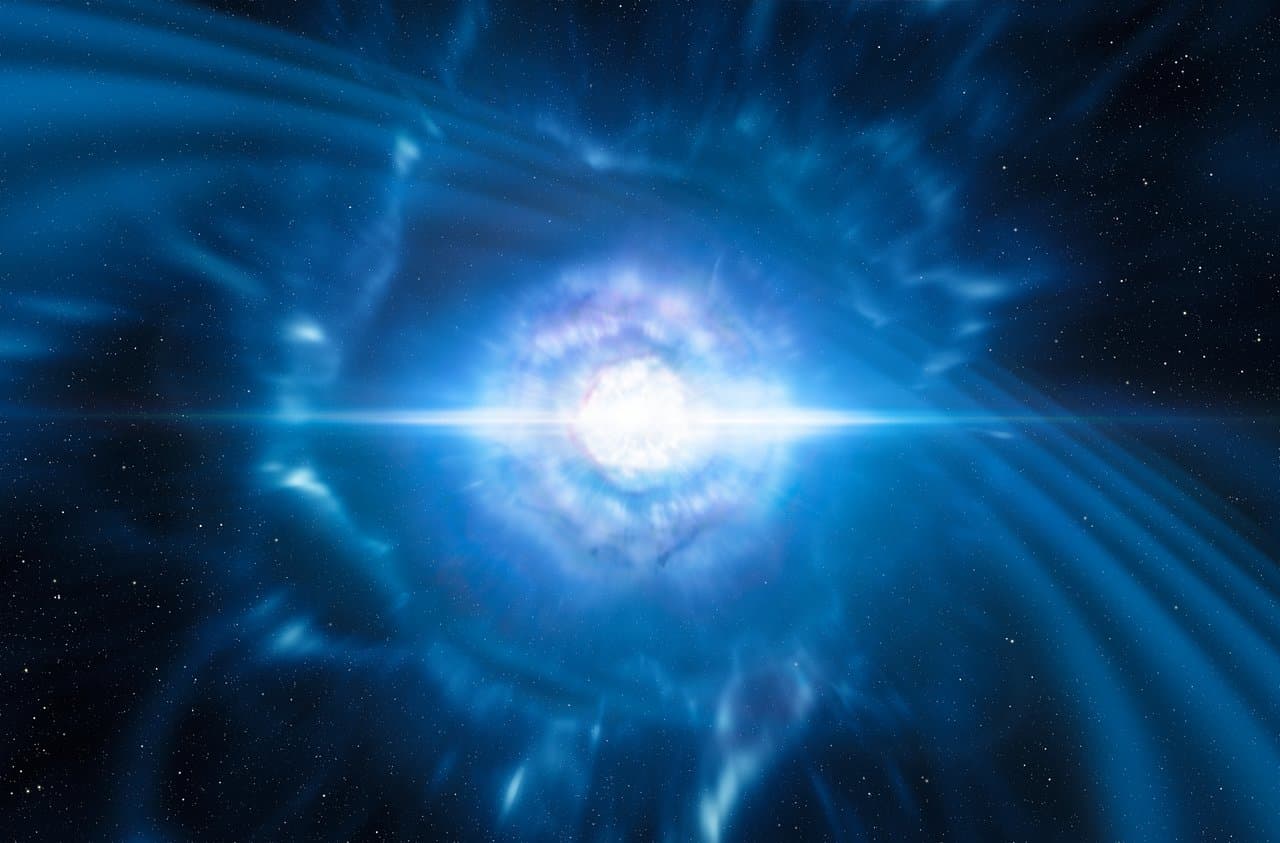
"Soft" here means low-energy X-rays, between about 0.5 and 4 kiloelectronvolts. In the team's paper, published in Science Bulletin, the gamma-ray flash, GRB 250704B, lasts about 0.4 seconds and the X-ray episode, EP250704a, about 560 seconds. That's 1,400 times longer. Astronomers had suspected such a phase, but earlier candidates were never confirmed.
Gamma rays alone would never have shown it. "Although this long-lasting emission carried substantial energy, its spectrum was so soft that, for a burst at this typical cosmological distance, it would have remained below the detection threshold of conventional gamma-ray instruments," said Bin-Bin Zhang of Nanjing University, who started the in-depth study. Most narrow-field X-ray telescopes wait for a gamma-ray alert before they turn to look, and by then much of this stage has passed. Einstein Probe's wide-field camera was already watching.
Most long gamma-ray bursts are tied to collapsing massive stars, and they can last for minutes. A group working with Eleonora Troja of the University of Rome Tor Vergata helped pin down the distance, a redshift of 0.661, which means the light left about 6 billion years ago. Deep optical observations found no supernova at that distance and rule out a broad range of them, which makes a collapsing star unlikely. Night 26 of this digest met a long burst that looked like a merger, so duration alone doesn't settle these cases.
The X-rays changed quickly and their spectrum shifted, which doesn't fit the standard picture of a flash followed by a blast wave running into surrounding gas. The team thinks something at the center of the wreck stayed active for all those minutes. Yi-Han Iris Yin of the University of Hong Kong calls a magnetar "one plausible explanation": a rapidly spinning, highly magnetized neutron star left behind by the merger. That's an interpretation and not an observation, and other engines may be possible.
Past bursts hint that this could be common. About 30 percent of short bursts have X-ray afterglows that fade quickly, which had been explained by long-lasting emission nobody had directly seen. The team argues that it's likely a regular feature of merger-driven bursts, and a promising way to find the light from future gravitational-wave events.
8. ☄️ Two worlds may have collided at Beta Pictoris in the last few centuries
Beta Pictoris is a young star 63 light-years away, about 18.5 million years old, and astronomers have been studying it for decades. It had the first dust disk ever imaged around another star, and Hubble found a second, tilted disk there. Then Isabel Rebollido's team reported James Webb Space Telescope images, in January 2024, showing something no one had seen: a curved branch of dust sweeping away from the tilted disk. They called it the cat's tail.
It's estimated to span about 10 billion miles, or 16 billion kilometers, and it appeared only in Webb's mid-infrared images. Its sharp angle may be largely an illusion. In the team's preferred model the arc leaves the disk at just 5 degrees, and our view of its curve makes it look steeper.
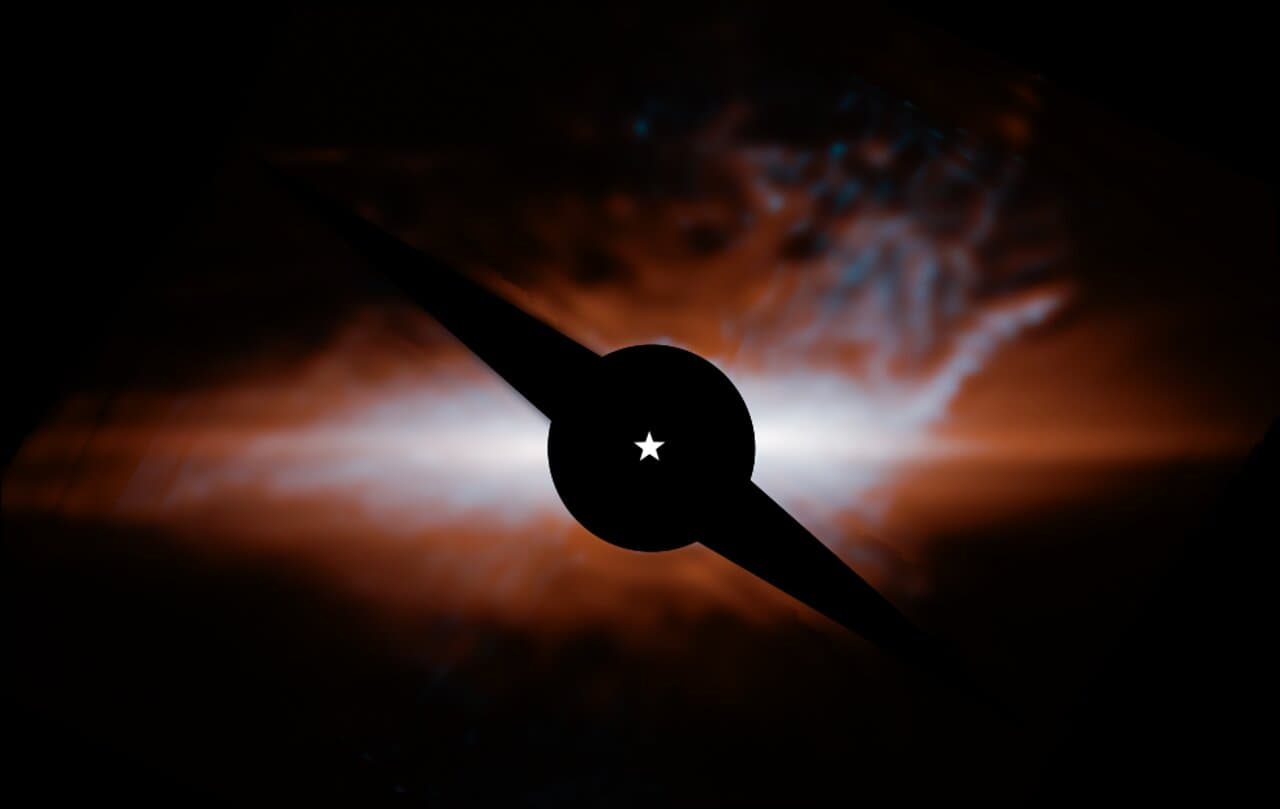
It also looked young. The team's strong hypothesis was a burst of dust from a mere century or so ago. Something collides, and the dust first follows the path of what it came from. Starlight then pushes the smallest, fluffiest grains out faster, drawing them into a long tendril. A clump of carbon monoxide that ALMA found in 2014 near the tail may fit too, because starlight should break that gas down in about 100 years, so it could be left over from the same event.
But if the tail is made of dust, why couldn't anyone see it in visible light? It's a bright, famous disk, and Hubble had looked at it many times.
Arin Avsar, a PhD candidate at the University of Arizona, went after that with deep Hubble imaging, combining six sets of observations taken between 2012 and 2025. The tail is there. It's just extremely faint, at about 0.1 to 0.4 percent of the flux in Webb's 15.5-micron image. "We think the Cat's Tail has eluded our observations in visible light until now because of what it's made of," Avsar said. "It consists almost entirely of what we call organic refractory material, which is heavily carbon-based. These long chains of carbon atoms absorb visible light, so they're quite black." Refractory means it resists evaporation.
That makeup gave the team a way to estimate what crashed. The earlier model needs about 10¹⁹ kilograms of this dust. Organic material like it reddens the surfaces of Kuiper Belt worlds, including Pluto, but that thin surface layer holds far too little, so the team favors material from inside the colliding bodies. Assuming two equal-mass colliders, the organic share of Solar System bodies and a particular spread of fragment sizes, they set a lower limit of roughly 1 to 3 × 10²¹ kilograms for each collider. That's comparable to Charon or Makemake, a few percent of our Moon.
Those are estimates built on comparisons with our own system, and they rest on assumptions about the colliders and their debris. There's a loose end too: bodies like these should hold plenty of silicate rock, and the tail has almost none, so the team is left asking where it went. Still, the picture from the 2024 work is hard to shake: an ongoing grinding-down of debris set off by a collision between two roughly dwarf-planet-sized bodies, about 100 to 200 years ago. Beta Pictoris has giant planets, including one that warps the disk, and that likely raises the rate of collisions there.
9. 🌙 A piece of early Earth may have come back from the Moon
Two grains of zircon inside a Moon rock may be the oldest known pieces of Earth. Alan Shepard of Apollo 14 picked up that rock in 1971, 9 kilograms of it, near the rim of Cone Crater, the largest of the mission's samples. Sample 14321 got its nickname, Big Bertha, from a World War I howitzer. It's a breccia, a rock made of older rocks broken up and welded together by impacts. Pieces of it were studied for nearly fifty years.
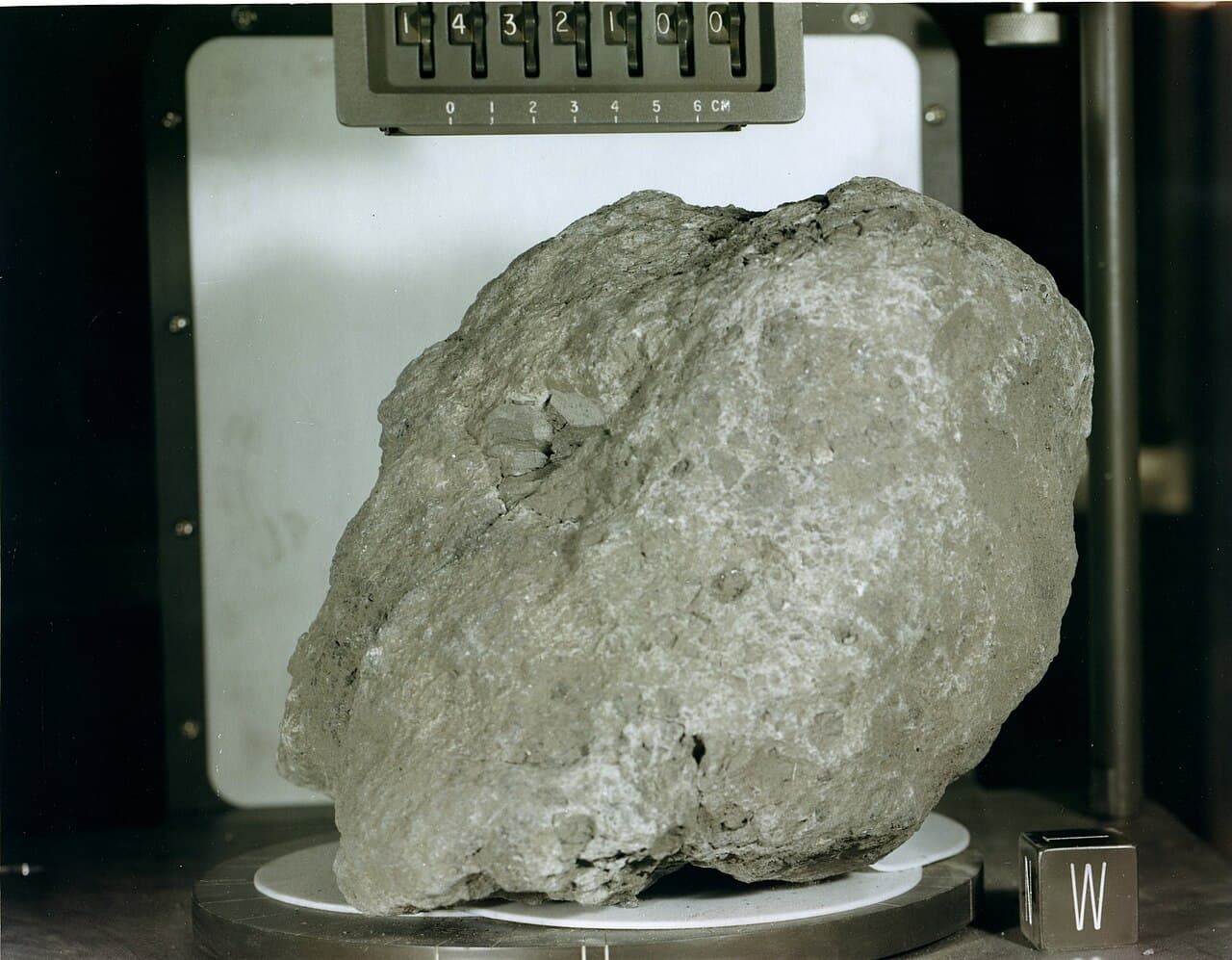
In January 2019, Jeremy Bellucci of the Swedish Museum of Natural History and colleagues reported on one small piece of it: a granite fragment weighing 1.8 grams, holding two grains of zircon. Zircon is very useful to a geologist, because it records both its age and the conditions it grew in. These grains date to about 4 billion years ago.
What bothered the team was how they formed. The minerals suggest crystallization at a temperature much lower than other lunar magmas, in an environment rich in oxygen and possibly water. Those conditions are unusual for the Moon and common in Earth's crust. Then there's the pressure. It corresponds to a depth of about 170 kilometers on the Moon, far below any place you'd expect such a rock to form. On Earth, the same pressure corresponds to about 20 kilometers, inside the crust.
Their proposal fits together in a few steps. About 4 billion years ago, an impact on the young Earth threw rock off the planet, and some of it landed on the Moon. Later impacts there mixed it with lunar rock. Eventually it ended up near the edge of Cone Crater, where it sat for millions of years until astronauts picked it up. If that's right, Big Bertha holds what may be the first Earth meteorite ever found.
It's a big claim built on two grains, and it's in dispute. The team allowed that the fragment could have formed on the Moon, though that would take conditions never inferred from lunar samples. Carolyn Crow of the University of Colorado Boulder, who wasn't involved, called the result "very intriguing" but cautioned that the minerals might not all have crystallized together. If they didn't, the argument for Earth could fail.
In 2020, Paul Warren and Alan Rubin argued for the Moon in the journal Icarus, on the grounds that trace elements such as gallium, germanium and zinc in the fragment differ significantly from those typical of terrestrial granite. I'd call the case open at best.
I still like the idea for what it would mean. Earth is very good at destroying its own past, and the Moon has no such habit. A fragment from the young Earth could sit there for 4 billion years, knocked around by impacts but otherwise left alone. The authors noted that other pieces may be waiting in the Apollo samples already on Earth.
10. 🧲 Geminga means "it's not there"
The source turned up in 1972, when NASA's second Small Astronomy Satellite picked out a strong patch of gamma rays in Gemini. When astronomers looked at other wavelengths, they found nothing that fit.
The satellite didn't help much. It had collected 121 gamma rays in four months, with a blurry view about 2.5 degrees across, five times the width of the full Moon. Four weak radio sources lay in the search area, with two supernova remnants on its edge, and none looked right. The team did report a hint of a 59-second pulse, but later data from Europe's COS-B satellite ruled that out.
The Italian astronomer Giovanni Bignami gave the source its name, a contraction of "Gemini gamma-ray source" that also says gh'è minga, "it's not there," in the dialect of Milan. It became the first example of what astronomers call an unidentified gamma-ray source. For about twenty years it stayed unidentified.
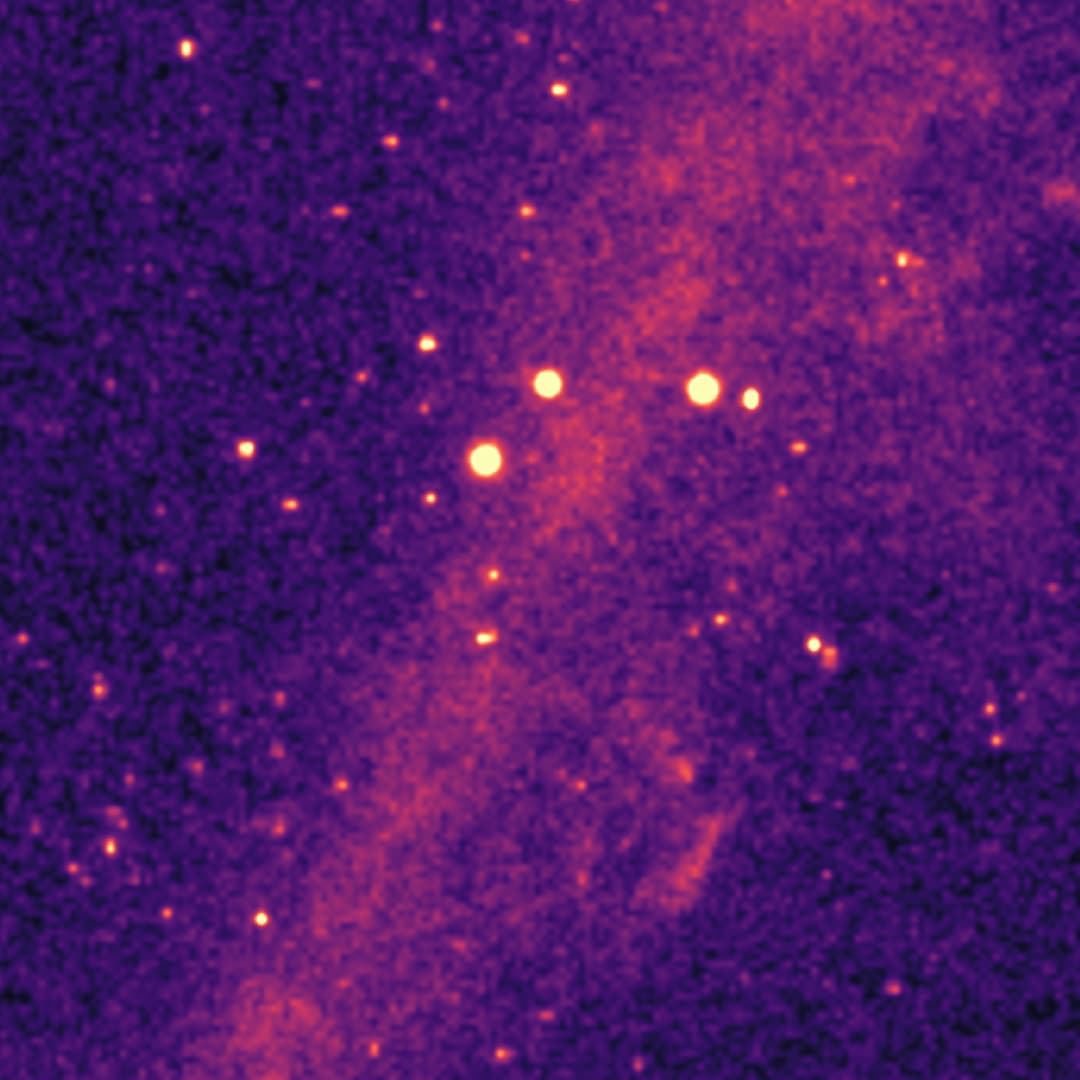
A lead came from X-rays. Bignami and colleagues pointed in 1983 to a source found with NASA's Einstein observatory, 1E 0630+178, inside the search area. It was an odd object: much brighter in X-rays than in visible light, with no radio emission that the Very Large Array could detect. But a position inside a blurry search area doesn't prove a link.
The proof came in March 1991, when Germany's ROSAT satellite found the X-rays flickering 4.2 times a second, a beat of 237 milliseconds. Once astronomers knew the rhythm, they found it in the gamma rays too, in new data from the EGRET instrument, and then, looking back, in the old COS-B and SAS-2 data. The pulse had been there all along.
Geminga was a neutron star, the crushed core of a star that exploded, and apparently the first radio-quiet pulsar. Later work has reported faint pulses at frequencies of 100 megahertz and below, so "quiet" may be the right word. It also turned out to be close, about 800 light-years away, and it's crossing the sky at about 211 kilometers per second.
The story took another turn in 2017. The HAWC observatory in Mexico saw a halo of very high-energy gamma rays around Geminga, thought to be made when fast electrons and positrons from the pulsar hit starlight and boost it to gamma-ray energies. Space experiments had long seen more high-energy positrons near Earth than expected, and nearby pulsars were suspects. HAWC's halo was small, which suggested those particles spread too slowly to reach us, and pointed to something more exotic.
Then Mattia Di Mauro and colleagues went through ten years of Fermi data at lower energies and found a much larger glow, about 20 degrees wide at 10 billion electron volts, similar in size to the Big Dipper. Lower-energy particles travel farther before they hit starlight. By their estimate, Geminga alone could account for as much as 20 percent of the high-energy positrons seen by the AMS-02 experiment on the space station. The object named for not being there may be sending us antimatter.
11. 🪐 A giant planet is sliding off the edge of its star
Astronomers find most exoplanets by waiting for them to pass in front of their stars, and a transit usually repeats like clockwork. TOI-1355 b, a new find, may have only about seven years of them left.
The planet is a brute. It weighs about 5.8 times as much as Jupiter, it's roughly 1.4 to 1.5 times as wide, and it circles its star in about 2.17 days. That makes it a hot Jupiter, a giant in a tiny orbit, and the orbit is slightly oval, with an eccentricity of about 0.22. The star is unusual too, an early A-type star at about 8,800 K, half again as hot as the Sun.
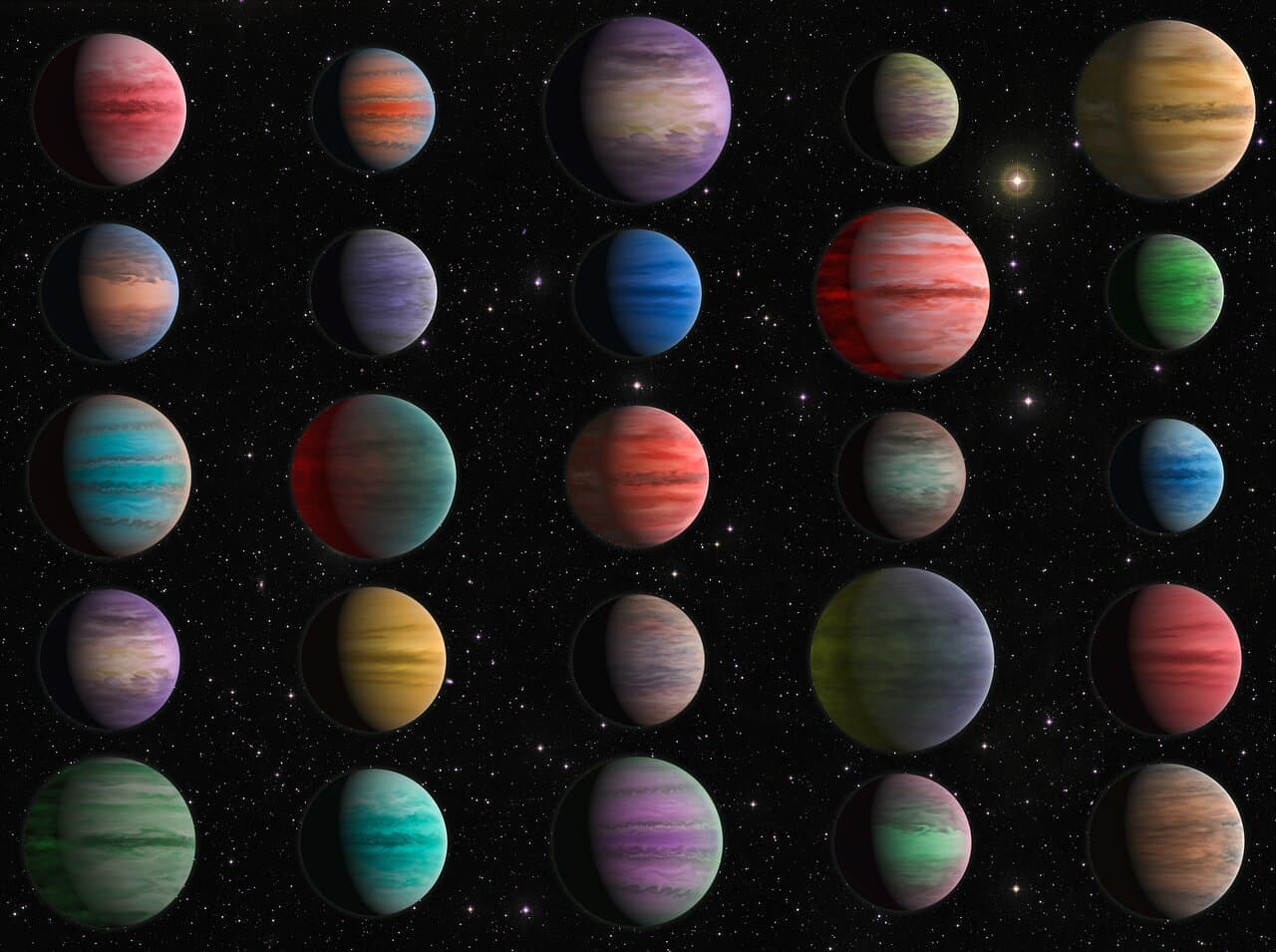
That combination is rare. Noriharu Watanabe and colleagues, who studied it with NASA's TESS satellite and telescopes on the ground, list only one other clearly eccentric hot Jupiter around a star this hot. Such an orbit could mean the planet is partway through a violent move inward, not yet circularized. Hot stars are good places to study that, because they lack the deep, churning outer layers that can help erase a mismatch between a star's spin and a planet's orbit.
TESS watched this star in 2019, 2020, 2022 and 2024, and the planet's path across it keeps shifting. Astronomers track this with the impact parameter, a number that runs from 0, for a path straight across the star's center, to about 1, for a path that clips its edge. For TOI-1355 b it's about 0.9, and it's climbing by about 0.016 a year. If the rate holds, the planet began grazing the edge at the start of 2024, and from the middle of 2033 there won't be a transit to see.
Nothing is wrong with the planet. The cause is the star's shape. This star spins fast, with its equator moving at 80 kilometers per second or more, and a star spinning that fast bulges at its waist. A bulge pulls unevenly on a planet whose orbit is tilted against it, and the orbit's plane slowly swivels in response, the way a spinning top leans and circles. This is called nodal precession. From Earth, we're watching the whole orbit tip out of our line of sight.
"There would be no major changes for the planet itself," the University of Tokyo's announcement notes, but astronomers won't be able to observe its transits for hundreds of years.
That gives the team a deadline. One model makes the day side hotter than expected. Molecules absorbing starlight high in the atmosphere could explain that, though inefficient movement of heat to the night side could also contribute. Watanabe's group is planning a proposal for the James Webb Space Telescope while the transits last.
12. ☄️ Hera is about to see what we did to Dimorphos
On October 18, a European spacecraft called Hera pointed its camera at a pair of asteroids from 1,280 kilometers away. Until then the pair had been a single dot. In this image the smaller one, Dimorphos, is about one pixel, but ESA's Michael Kueppers says that "even though Dimorphos is made up of only around one pixel in this initial image, it is clearly well separated from its parent body."
That pixel is a crash site. On September 26, 2022, NASA's DART spacecraft hit Dimorphos at 6.1 kilometers per second, and the little moon's orbit around the larger Didymos got about 33 minutes shorter. This digest covered that on night 16. Dimorphos is 151 meters across, about the size of the Great Pyramid of Giza, and it's now some 197 million kilometers from us.
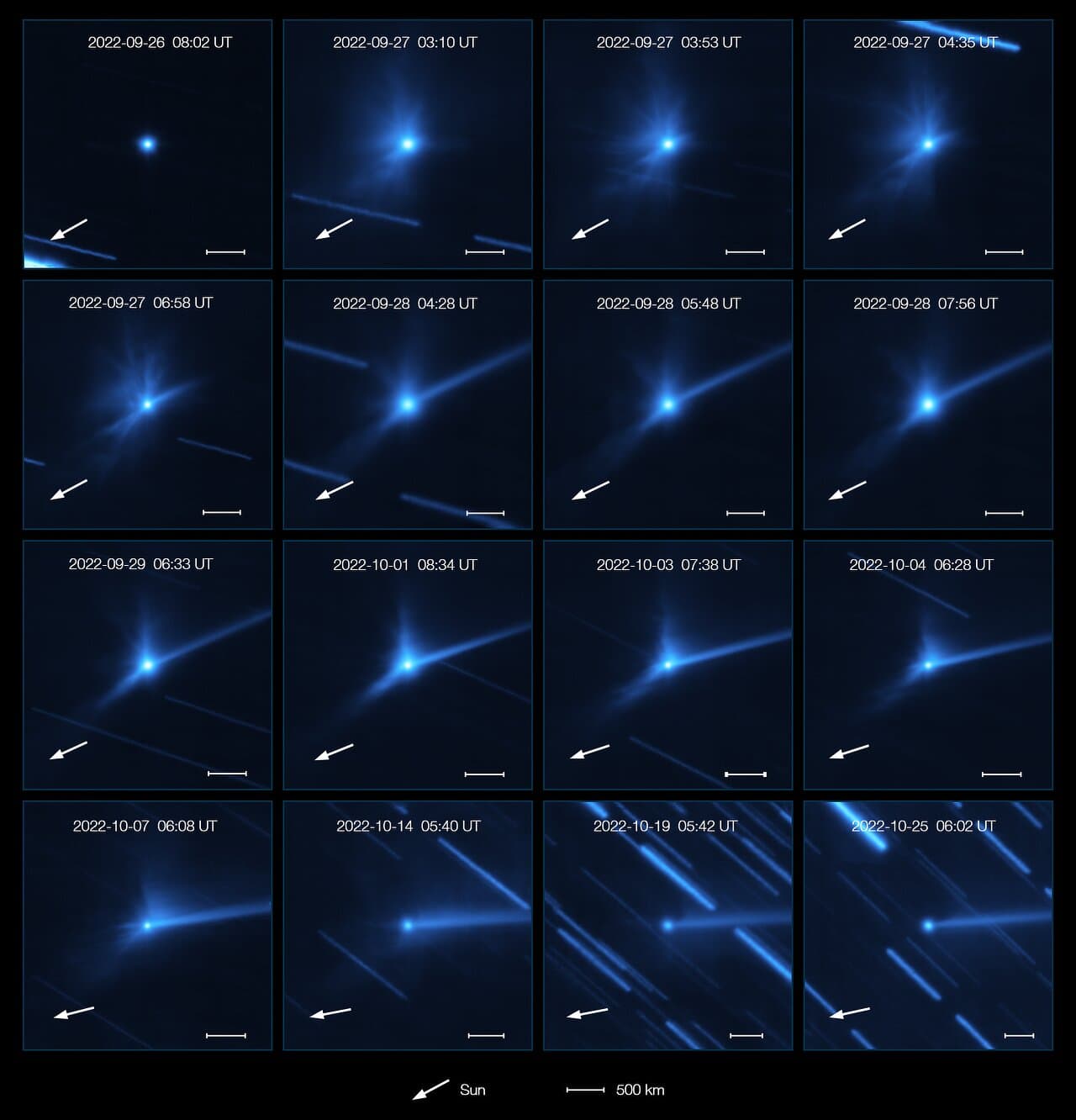
Hera is there for what happened next. ESA lists the questions plainly: did the impact leave a crater, or reshape the whole asteroid? What is Dimorphos made of, and how much does it weigh? And why did the push turn out so much greater than impact simulations predicted? That last one matters most if we ever have to do this for real. Thruster firings earlier in October slowed the spacecraft to just 20 meters per second relative to the asteroids, so it can approach gradually. ESA plans to release the first detailed images of Dimorphos on November 25.
Before those images arrive, a team led by S. D. Raducan has tried to predict what they'll show. In a paper posted last week, they simulated the impact into two versions of Dimorphos, both loose rubble piles, one with a large boulder at the center and one without. Then they followed what fell back for six hours.
In the simulations, the impact threw off about 13 percent of the asteroid's mass, and most of that came back down, resurfacing nearly the whole asteroid. The modeled debris lies more than 8 meters deep around the impact depression, and even on the opposite side it's a few tens of centimeters thick. Local gravity changed by up to about 10 percent.
If that's close to what happened, it complicates things for Hera. One of its aims is to work out the asteroid's internal structure, and the team concludes that the surface and gravity field it finds will have been substantially altered by the crash. In the model with a boulder, it affects the surface gravity only inside the impact depression, where the overlying material was removed.
Hera won't work alone. It carries two shoebox-sized CubeSats, Milani and Juventas, and Juventas's radar should look about 100 meters into the asteroid to see whether it's solid rock or rubble. Eventually, the mission will try landing.
We've seen the moment of impact, and we've measured the change in the orbit. On November 25, we start seeing what's left.
13. 👻 The neutrino nobody else can find
At 01:16:47 Universal Time on February 13, 2023, something crossed a half-finished detector 3,450 meters down in the Mediterranean, about 80 kilometers off the coast of Sicily. The KM3NeT ARCA array is a set of lines anchored to the seabed, holding light sensors in the black water to catch the faint blue glow from fast charged particles. Only 21 of a planned 230 lines were in place. This one event registered 28,086 hits and lit up more than a third of the active sensors.
The particle was a muon, a heavy cousin of the electron, with an estimated 120 petaelectronvolts of energy, give or take a lot: the range runs from 60 to 230. It flew nearly horizontally, just 0.6 degrees above the horizon, and that's the key to where it came from. Even the most energetic muons reach only about 60 kilometers through water, and a path this flat would cross the equivalent of about 300 kilometers. That makes a muon from Earth's atmosphere exceedingly unlikely. Neutrinos have no electric charge and nearly always pass straight through matter, but on rare occasions one strikes something and produces a muon. This muon was most probably made that way close to the detector, by a neutrino of even higher energy.
KM3NeT estimated that neutrino at about 220 petaelectronvolts, or 220 million billion electron volts, with a wide range of 110 to 790 around it. The most energetic neutrinos reported before reached about 10. On best estimates, a detector at a tenth of its final size had beaten the old record roughly twentyfold.
Then came the problem. IceCube, at the South Pole, is a cubic-kilometer detector that has been running for about 15 years, and its neutrinos top out near 10 petaelectronvolts. If particles like this were common enough for little ARCA to catch one in under a year of data, IceCube should have seen some too. It hasn't.
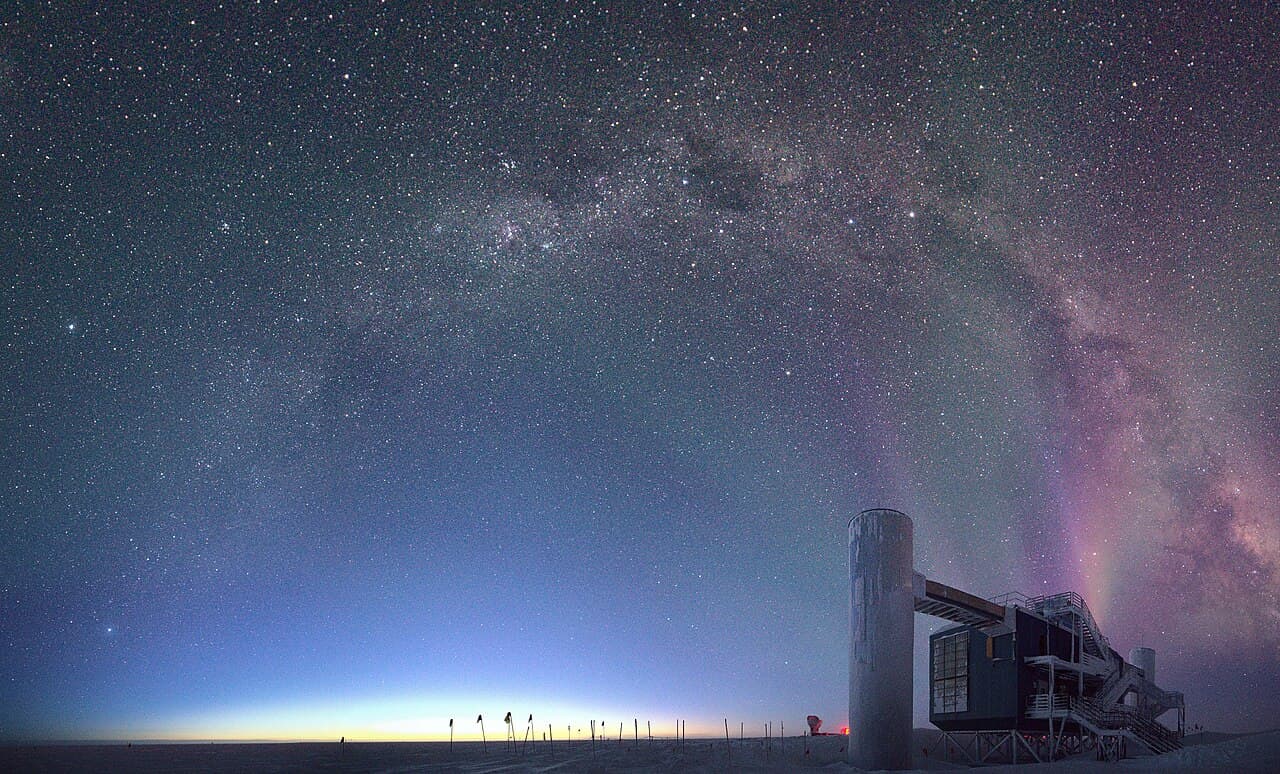
Physicists have started putting numbers on the mismatch. This September, IceCube searched 15 years of data from the direction of the KM3NeT event, for steady and flaring sources, and found nothing. An astrophysical source bright enough to explain the single event is, they say, strongly constrained for a variety of assumptions. In July, Dibya Chattopadhyay, Carlos Argüelles and Vedran Brdar combined the KM3NeT event with four odd events from ANITA-IV, a balloon experiment, and with IceCube's silence. Treating all five events as neutrinos, and testing all-sky fluxes in which the number of particles falls off smoothly with energy, their preprint finds a mismatch of roughly 7.5 sigma, a very strong disagreement in statistical terms. Short flares help only if they happen to line up very neatly.
The explanations on offer range from sober to wild. The neutrino may have come from a different kind of cosmic accelerator from whatever makes the lower-energy ones. It could be cosmogenic, born when an ultra-high-energy cosmic ray hit a photon of the cosmic microwave background on its way across the universe, which would make it the first of its kind ever detected. Theorists have also proposed an evaporating primordial black hole, and decaying dark matter. Those last two are ideas, with no evidence for them yet.
It may also just be luck. One event can't tell you much about a rate. But the question can be tested. ARCA is still being built, and if the sea catches a second one while the ice stays silent, the problem gets a lot harder to wave away.
14. ⚫ The last supernova may come after everything else has ended
Most stars don't die in explosions. The Sun will end as a white dwarf, an Earth-sized ball of light elements like carbon and oxygen with about as much mass as a star. Over the next few trillion years, white dwarfs dim and freeze solid.
Once they stop shining they're called black dwarfs, and earlier nights of this digest have left the story there, with the universe going dark. "It will be a bit of a sad, lonely, cold place," said Matt Caplan, a physicist at Illinois State University.
Caplan asked what could still happen to those frozen stars, and in 2020 published an answer. It rests on one assumption: that protons last forever. Night 28 covered the possibility that they don't. If they decay, black dwarfs dissolve long before any of this.
If they don't, time keeps working on a black dwarf. A nuclear reaction normally needs heat, because two nuclei have to overcome their electric repulsion. But quantum mechanics allows a very rare shortcut. Nuclei can tunnel through that barrier, and inside a dense crystal they sit close enough for this to happen even near absolute zero. "Fusion happens, even at zero temperature, it just takes a really long time," Caplan said. Freeman Dyson sketched the idea in 1979. Given enough time, the matter in a black dwarf should fuse all the way to iron.
That's where the trouble starts. A white dwarf is held up by its electrons, which resist being squeezed, and there's a limit to how much mass they can support: the Chandrasekhar limit, about 1.4 times the Sun's mass for a white dwarf today. The limit depends on how many electrons there are for each proton and neutron, and iron has fewer than carbon does, 0.464 against 0.5. As iron builds up, the limit falls by about 14 percent, toward 1.2 Suns.
The star doesn't have to gain anything. Caplan's paper calls this "amusingly like the inverse" of what happens today, when a white dwarf gains mass until it reaches the limit. Here, the limit comes down to meet the dwarf. Once enough iron has gathered in a heavy black dwarf's core, the electrons can't hold, and it collapses.
It would take a very long time. The heaviest black dwarfs would go first, starting about 10¹¹⁰⁰ years from now. That's a one followed by 1,100 zeros. "In years, it's like saying the word 'trillion' almost a hundred times," Caplan said. The universe's age today has eleven digits. Lighter ones would follow. A very rough estimate puts the last around 10³²⁰⁰⁰ years, though the calculation is especially uncertain for the lightest remnants.
Only black dwarfs above about 1.16 times the Sun's mass qualify. Caplan estimates that's about 1 percent of all the stars in the observable universe, around 10²¹ of them. The Sun's own remnant should be far too light.
These explosions would be unlike the ones we know. By then, in this picture, galaxies will have dispersed and black holes will have evaporated, so each one would happen in a universe with no one and nothing nearby. Caplan speculates that they'd resemble certain collapses of white dwarfs today, and that later ones might look like stars stripped of their outer layers.
"It's hard to imagine anything coming after that, black dwarf supernova might be the last interesting thing to happen in the universe," Caplan said.
🌙 One last thought before you sleep
I keep thinking about the red mark on Hevelius's chart. Nobody who saw that star could have known what it was, and nobody would for more than 300 years. But someone wrote down where it stood, and more than three centuries later, people with radio dishes had somewhere to look.
That's all for tonight. Thanks for wondering along with me. Good night, and clear skies. 🌌
— Kasi