In February 1946, a faint star in the Northern Crown suddenly became one of the brighter stars in the sky. An amateur astronomer near London reported it, and someone, apparently the man who ran his society's variable star section, penciled a note on the letter: "2026–27". Astronomers have spent the last few years predicting the star's next eruption much sooner than that, and so far it has let those dates pass. That old pencil note is still in the running.
Tonight also visits a moon that may have no ocean after all, and a twenty-year fight over the distance to the Pleiades. The last story is the one I keep thinking about: what the Sun's slow death could do to the planets that are left.
1. ⭐ The star expected to blaze up in 2024 still hasn't
T Coronae Borealis, T CrB to its friends, sits about 3,000 light-years away in the small arc of stars called the Northern Crown. Astronomers measure brightness in magnitudes, where smaller numbers mean brighter stars. Most of the time T CrB is around tenth magnitude, too faint to see without binoculars. Twice in recorded history, in 1866 and 1946, it has risen to magnitude 2.0, about as bright as Polaris, and then faded again within days.
It's really two stars. One is a red giant, a star near the end of its life that has swollen to many times its old size. The other is a white dwarf, the dense, Earth-sized core left behind by a star that has already died. The dwarf's gravity pulls gas off the giant into a flat, spinning disk, and the gas spirals slowly down onto the dwarf's surface. Over decades the layer gets deeper, hotter and more compressed at its base. When it reaches a critical point, the hydrogen there starts fusing all at once, and the layer blows off into space. That's a nova. The white dwarf survives it, so the cycle starts again.
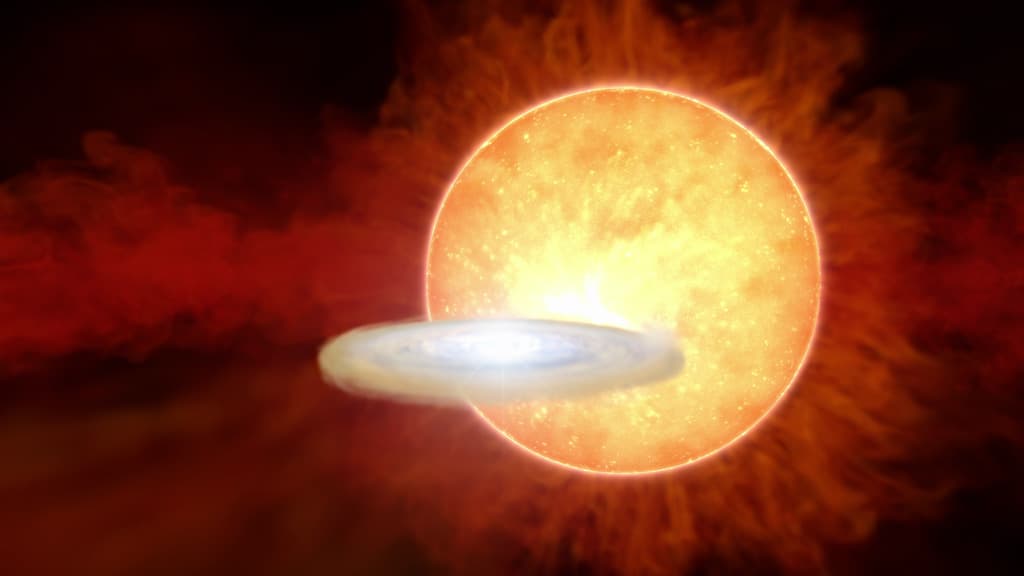
Most novae take many thousands of years to build up to another eruption. T CrB does it roughly every 80 years, and there seem to be older sightings that fit the rhythm. Bradley Schaefer of Louisiana State University tracked down two of them. Burchard, abbot of Ursberg in Germany, recorded a star that appeared in the Crown in the autumn of 1217 and "shone with great light" for many days. In late December 1787, the Reverend Francis Wollaston measured a star's position that lands exactly on T CrB, at a time when it should have been far too faint for his telescope unless it was erupting.
Then came 1946. At 05:40 Universal Time on February 9, N. F. H. Knight, an amateur observer in Stoneleigh, southwest of London, saw a new third-magnitude star in the Crown with his naked eye. He recognized it as a return of the 1866 nova. His letter went to W. M. Lindley, director of the British Astronomical Association's Variable Star Section, and it carries a pencil annotation, apparently in Lindley's hand: "2026–27". Jeremy Shears, who told the story in a 2024 research note, suggests it is what might be the first prediction of the next eruption.
If it is a prediction, it looks like simple arithmetic: 1866 to 1946 was 80 years. Modern astronomers thought they could do better. Schaefer gathered 213,730 brightness measurements going back to 1842 and found that the 1866 and 1946 eruptions looked the same. Around both, the system stayed in a bright state from about ten years before the eruption to nine years after, as gas poured onto the dwarf around twenty times faster than usual. Before the 1946 eruption, the system also dimmed for a while, and Schaefer used that light curve as a template for the current cycle. T CrB entered the same bright state in 2015, much as it had in 1936. In the spring of 2023 it started to fade, and Schaefer announced that the pre-eruption dip had begun. He gave a date: 2024.4, give or take about four months.
NASA passed on the forecast that the eruption could come by September 2024. When it does, it should stay bright enough to see without a telescope for a little less than a week, and observatories in space and on the ground have been lined up to watch. "It's a once-in-a-lifetime event," said Rebekah Hounsell, a nova specialist at NASA's Goddard Space Flight Center.
It didn't come, and later dates went by too. As I write this, at the end of October 2026, astronomers are still waiting.
In July, a team led by Songpeng Pei took stock. They combined the gaps between past eruptions, where the two stars were in their orbit at each one, and how the flow of gas onto the white dwarf has changed recently. One problem is that the famous 1946 dip is hard to explain. A simple slowdown in the flow of gas doesn't fit it, and neither does ordinary dust blocking the light. It may have involved both a change in how gas reached the white dwarf and something hiding part of the light. That makes it hard to know which recent fade matches it.
T CrB faded again in 2026. If that's the real counterpart of the 1946 dip, the team says an eruption around December 2026 is plausible. If the system stays dimmer than it was between 2014 and 2023, they estimate it may not have collected enough gas to erupt until about May 2029 at the earliest. From the history alone, and given that nothing had happened by July 11, they work out rough odds of 30 percent for the rest of 2026 and 57 percent within the following year, and they warn that these are empirical indicators, not physical predictions. The data, they write, "support conditional monitoring windows, not a unique date."
So far the precise dates have lapsed, and the rough window penciled on that letter in 1946 is still open. That may change in a few weeks, or in a few years. Either way, the eruption will finally test the assumptions behind every one of those predictions.
2. 🌙 Titan may have slush where its ocean was supposed to be
When Saturn's largest moon goes around its slightly oval orbit every 16 days, Saturn's gravity squeezes and stretches it. A moon with a liquid ocean under its ice should flex a lot. Earlier models predicted much less flexing for a Titan that was solid all the way through, the way a water balloon gives more than a billiard ball.
NASA's Cassini spacecraft measured that flexing during 10 close flybys of Titan devoted to its gravity. Tiny changes in the spacecraft's speed showed up as shifts in the frequency of its radio signal to Earth, and from those shifts scientists could map how Titan's gravity changed along its orbit. The answer was a big response, about twice what had been predicted before Cassini arrived. Cassini had already found hints of an ocean in the way Titan rotates, and the large flexing became the strongest evidence that Titan hides one. This digest repeated that conclusion back in night 6.
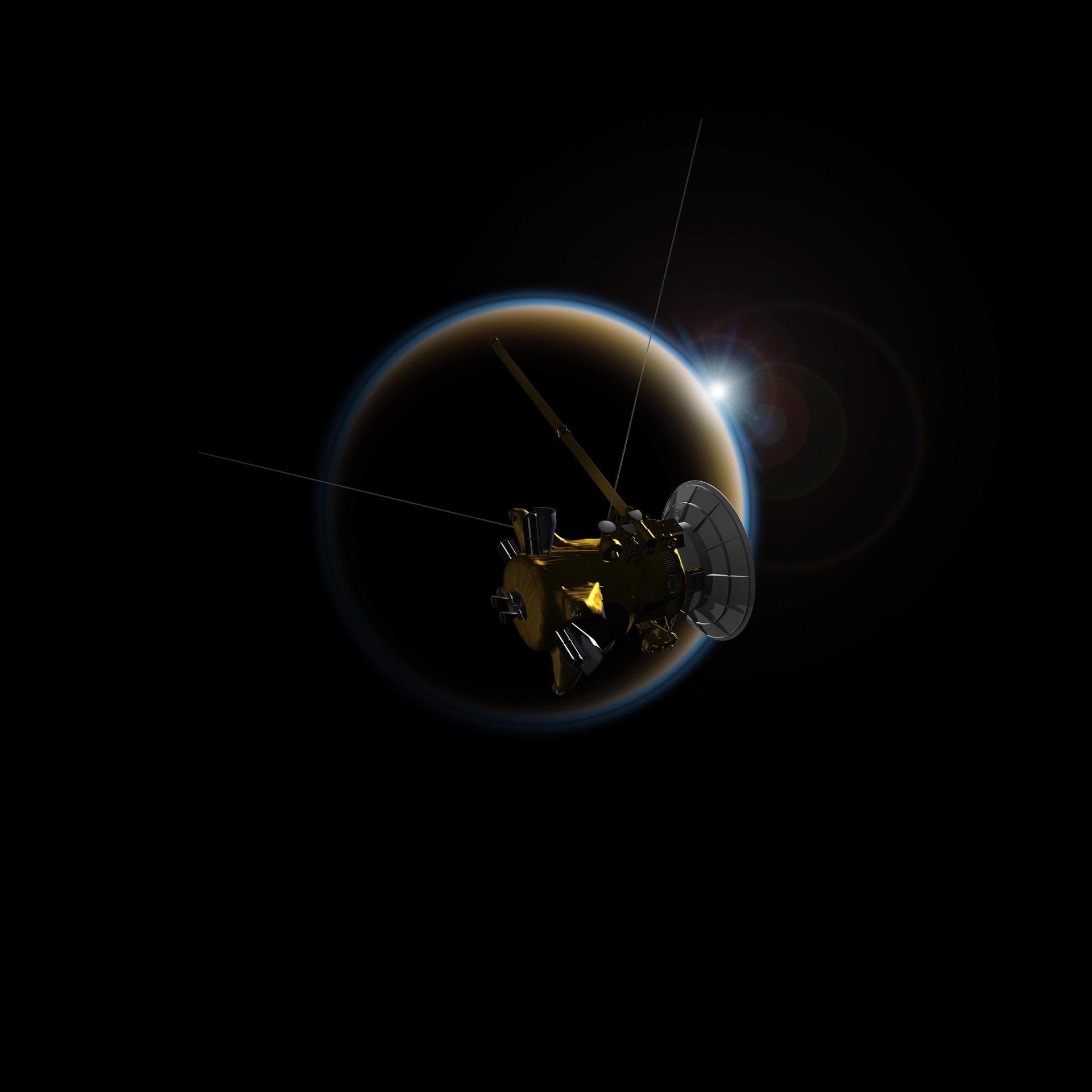
There was a second measurement hidden in the same data, and nobody had been able to pull it out. A body that flexes also loses energy as heat, through friction inside it, and that friction makes its shape lag behind the pull. The size of that lag shows how much heat is being made, which is a different clue to what's inside. Before Cassini launched, scientists had proposed using the two numbers together to settle the ocean question. But the lag was too small to see through the noise in the radio data.
Flavio Petricca, a postdoctoral researcher at NASA's Jet Propulsion Laboratory, went back to Cassini's raw radio recordings with processing methods developed for NASA's Juno and InSight missions. They cut the noise by about 25 to 30 percent. In a paper published in Nature last December, his team confirmed the large flexing and, for the first time, measured the lag directly. Titan's shape trails Saturn's pull by about 15 hours.
That lag means Titan turns about 3 to 4 terawatts of tidal energy into heat. "Nobody was expecting very strong energy dissipation inside Titan," Petricca said. A liquid layer cuts down the heating in everything below it, and none of the team's models with a global ocean could produce this much. The lag they measured is three to four times the largest those models allow. Astronomers rate this with a number called Q, where a lower Q means more energy lost on each squeeze. Earth's rocky body has a Q of about 300 and Mars about 90. Titan's came out around 5.
The team's explanation is slush. Titan's water layer is about 600 kilometers thick, and deep down the pressure squeezes ice into dense forms that don't exist on Earth's surface. In the team's model, that high-pressure ice sits close to its melting point, soft enough to bulge with each tide, and the crystals grinding against each other make the heat. Slow churning in the ice shell above carries the heat outward fast enough to stop a global ocean from forming. The deep ice may hold pockets of meltwater, perhaps as warm as 20°C, slowly working their way upward.
"Instead of an open ocean like we have here on Earth, we're probably looking at something more like Arctic sea ice or aquifers," said Baptiste Journaux of the University of Washington, whose lab measured how water and ice behave at those pressures. Petricca thinks the result makes Titan more interesting, and the team points out that any nutrients would be concentrated in small pockets of water instead of spread through an ocean.
The paper's title says the dissipation "precludes" an ocean. I'd treat that as a strong claim from one analysis of a hard measurement, and the same data have been read very differently before. In 2024, another team reanalyzed Cassini's tracking and got a much smaller flexing, still consistent with an ocean. This June, Daniele Durante, Luciano Iess and Valery Lainey replied in Nature Astronomy that this smaller value was far outside the error bars of four earlier analyses, and that Petricca's work confirmed the large one. In a reply published the same day, Sander Goossens and his colleagues said they didn't agree that differences in how the data were processed explain the gap. Most analyses now favor the large flexing, and what it means is still being argued.
The test will come from the surface. NASA's Dragonfly, a rotorcraft that NASA said last December would launch no earlier than 2028, will carry a seismometer. If Titan has quakes while it's listening, the way their waves travel through the interior could show whether there's an ocean down there or only slush.
3. ✨ The Pleiades and the satellite that measured them wrong
The Pleiades are the easiest star cluster in the sky to find, a little dipper of blue stars that has been known since antiquity. They matter to astronomers for a less romantic reason. The cluster is young and close, so its stars serve as a reference for what young stars are like, and the distance to them is a rung in the ladder used to measure distances to farther clusters and galaxies.
By the 1990s, astronomers thought they knew that distance. Comparing the brightness of the cluster's stars with what models of stars predicted gave about 134 parsecs, or roughly 437 light-years. A parsec is about 3.26 light-years.
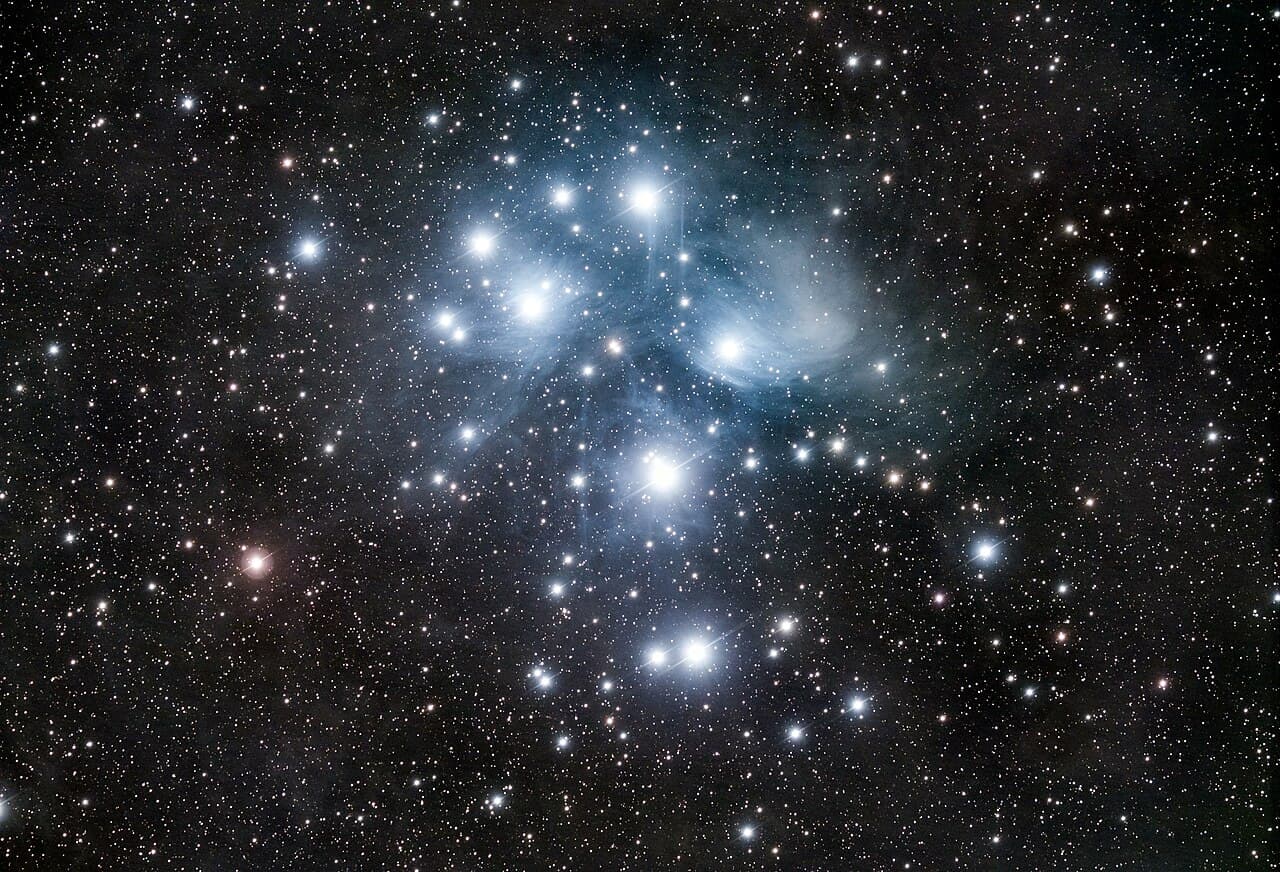
Then came Hipparcos. The European Space Agency's satellite, whose catalogue appeared in 1997, measured distances by parallax, the most direct method there is. Hold a finger up and close each eye in turn, and the finger jumps against the background. Earth's orbit does the same thing to nearby stars over a year, and the size of the jump gives the distance with nothing but geometry. When Floor van Leeuwen of the University of Cambridge combined the Hipparcos measurements of more than 50 Pleiades stars, he got about 120 parsecs. The cluster was about 10 percent closer than everyone thought.
That would have been a big problem. The stars look as bright as they look either way, so if they were that close, they must give off less light than models of stars said they should, and as Physics World put it, it raised questions about how much helium they held and even hinted at unknown physics in the early lives of stars. Either the satellite had a flaw nobody could find, or astronomers' understanding of ordinary young stars was wrong.
Neither side gave way. Astronomers named Pan, Shao and Kulkarni challenged Hipparcos in Nature in January 2004, with a result from a single Pleiades binary star, Atlas, which they had observed with an optical interferometer, an instrument that combines light from separate telescopes to tell apart stars too close together for one telescope. It put that star near the old distance. Michael Perryman, the Hipparcos project scientist, answered on ESA's website within a week, calling the paper "a misleading contribution to a difficult and important problem". He pointed out that the Hipparcos parallax of Atlas itself agreed with theirs within the stated uncertainties, and that one star might not stand for the whole cluster. He quoted the astrophysicist Bohdan Paczyński, who had called the dispute "one of the more dramatic controversies in modern astrophysics".
The deciding measurement came from radio telescopes. Very long baseline interferometry links radio antennas spread across the world so that together they see as sharply as a single telescope the size of Earth. Carl Melis of the University of California, San Diego, and his colleagues used it to measure the parallax of five Pleiades stars, and in 2014 they reported 136.2 parsecs, give or take 1.2. Their five stars ranged from 134.8 to 138.4 parsecs. "This is just reiterating it, and really hitting the hammer on the head of the nail and driving it into the coffin," Melis said.
Van Leeuwen wasn't persuaded. He questioned how the radio team had handled the motions of their stars and argued that no new physics was needed, only a fresh look at how deep the churning outer layers of these stars run.
Gaia, the successor to Hipparcos, settled it. Its second data release in 2018 measured parallaxes for many more Pleiades stars, and Guillermo Abramson worked out a distance from them of 136.2 parsecs, with an uncertainty of 5. That's the radio value, almost exactly. Abramson wrote that Gaia "comes to finally close the controversy" and that the Hipparcos value was too small, "most surely due to systematic errors."
What I like about this one is that the satellite was doing the most trustworthy kind of measurement there is. Parallax doesn't depend on any theory of stars. It still apparently came out wrong in one small patch of sky, and the stellar models it seemed to contradict turned out to be right.
4. 🧲 The lightest pair of neutron stars ever weighed
Neutron stars are what's left when the core of a massive star collapses in a supernova: more mass than the Sun crushed into a ball about 20 kilometers across. Some of them are pulsars, sweeping a beam of radio waves past Earth with each turn, so steadily that they work as clocks. Of the thousands of pulsars known, only about 30 orbit another neutron star.
In 2020, China's Five-hundred-meter Aperture Spherical radio Telescope, FAST, picked up a new one in a survey of the Milky Way's disk. FAST, in Guizhou province, is the largest single-dish radio telescope in the world. "We have discovered about 900 pulsars," JinLin Han of the National Astronomical Observatories of China told Live Science. "After a few follow-up observations, this one is very extraordinary."
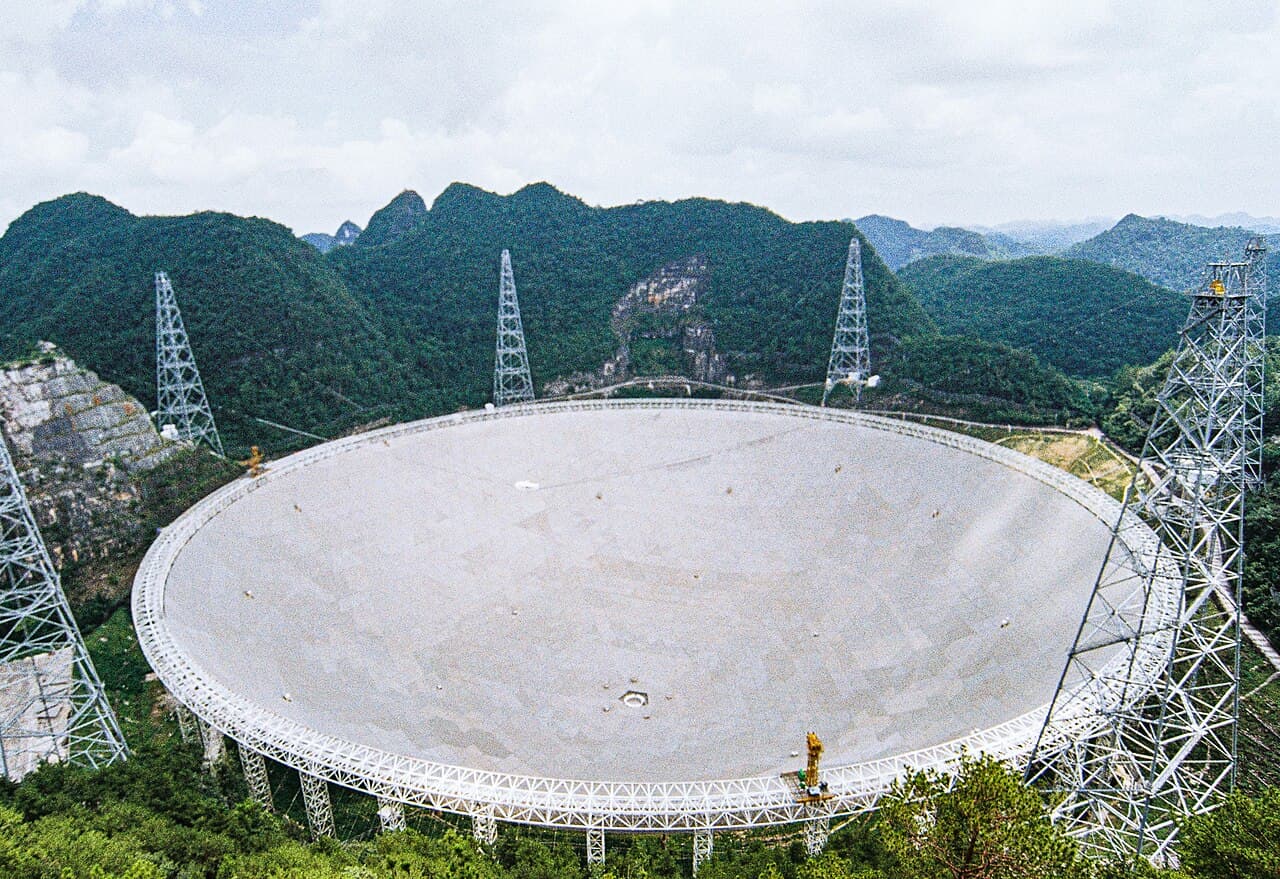
The pulsar, PSR J1856−0039, spins about 43 times a second. It and its partner go around each other in 2.36 hours, about twice the distance between Earth and the Moon apart, on a slightly oval path. Among known double neutron stars, only one orbit is shorter.
At that range, Einstein's general relativity makes the orbit behave in ways Newton's gravity doesn't, and a pulsar clock lets astronomers watch each effect. The team observed it 17 times with FAST between 2020 and 2025. The oval orbit turns around by 17.6 degrees a year, about 150,000 times faster than the extra drift general relativity adds to Mercury's orbit. The pulsar's ticks speed up and slow down by up to about half a millisecond as it moves along the oval, because both gravity and speed change how fast its time passes. And the orbit is shrinking. The pair loses energy in gravitational waves, and the two stars move about 2.7 meters closer each year.
Any two of those effects are enough to weigh both stars. The paper, published in Physical Review Letters in September, gives the pulsar 1.304 times the Sun's mass and its companion 1.185. Together they come to 2.48841 Suns, the lowest total of any double neutron star known, and the only well-measured pair under 2.5. The companion is close to the lowest mass that simulations of supernova explosions allow a neutron star to have, about 1.19 Suns.
The third effect is the check. If general relativity is right, all three measurements have to agree on the same two masses, and the shrinking of the orbit matches the prediction to about 1 percent. Some physicists hope a system like this will one day show a crack in Einstein's theory that points to something deeper. "Unfortunately, we could not beat this description of gravity," Han said. The famous double pulsar has tested the theory more tightly, but it took 16 years of data to do it; this pair has had about five.
The more interesting question to me is how this pair ends. In about 82 million years, the two stars will spiral together and merge, sending out a burst of gravitational waves like the one LIGO and Virgo caught in 2017. Because the pair is so light, the team estimates the merged object would weigh about 2.26 Suns. That's less than the two stars' combined 2.49, because some matter would be flung out, as in the 2017 merger, and because a more tightly packed neutron star weighs less than the matter that went into it. Nobody knows exactly how heavy a neutron star can be before it collapses into a black hole, but studies of short gamma-ray bursts and other observations put the limit around 2.3. So this merger will probably leave a single, heavy neutron star behind. It could still collapse, and the authors say so.
The team plans to keep timing the pulsar for decades. They hope to catch frame dragging, the way a spinning neutron star twists spacetime around it and makes the orbit wobble. How strong that wobble is depends on how the pulsar's mass is spread through its interior, and that would say something about how matter behaves at the crushing densities in a neutron star's core, one of the big open questions in physics.
5. 🌌 A ring of new stars, 2 billion years after the Big Bang
Every so often, a small galaxy falls straight through the middle of a bigger one. The bigger galaxy's gas gets shoved outward in a ring, like the ripple from a stone dropped in a pond, and as the ripple spreads, it piles up gas dense enough to form new stars. The result is a collisional ring galaxy, a bright loop of young stars around an older center. They're rare. Today only about one galaxy in 10,000 looks like this.
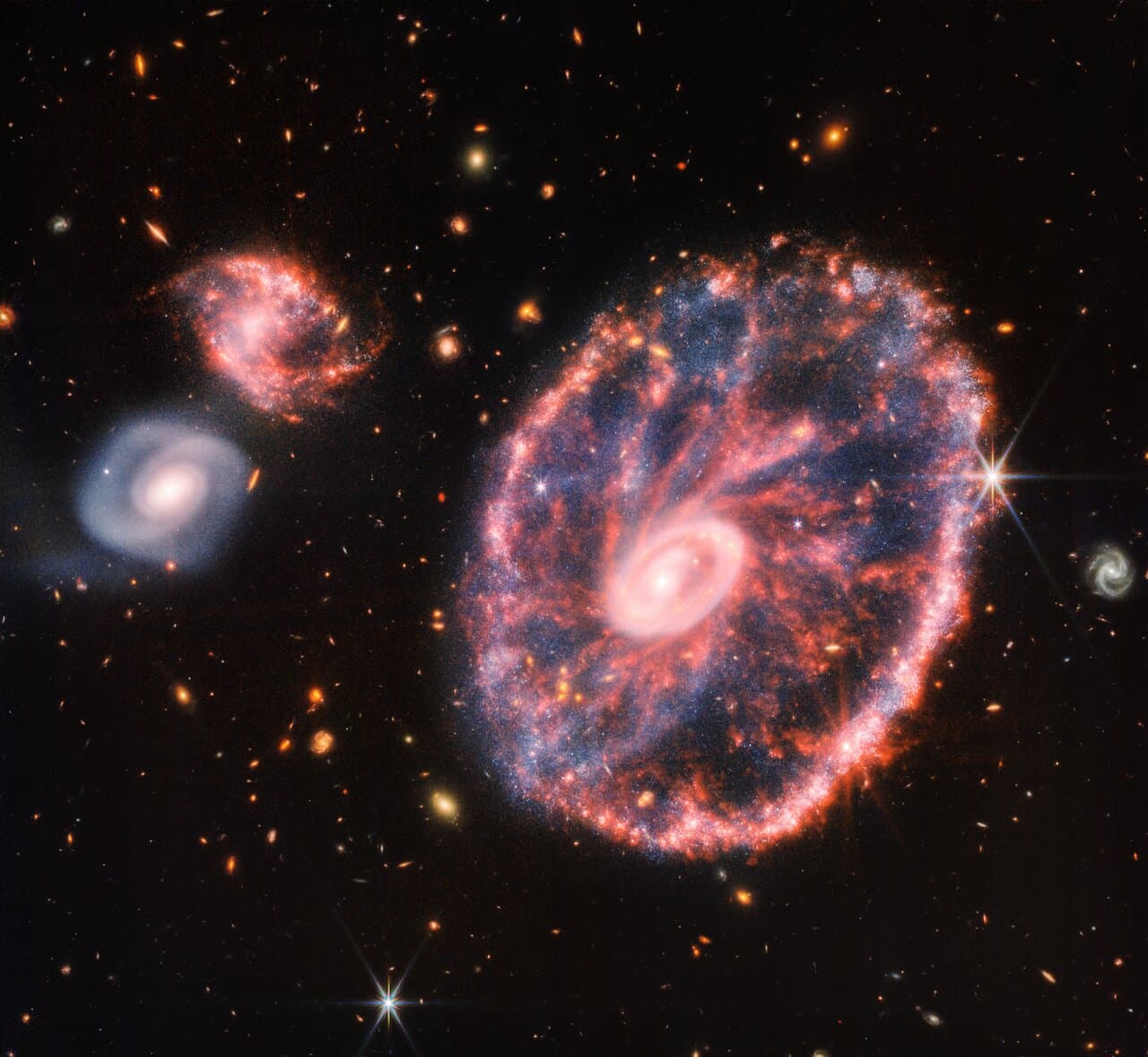
Michele Perna, of the Centro de Astrobiología in Spain, wasn't looking for one. His team chose a galaxy called GS18660 for the James Webb Space Telescope because it looked stretched out in older Hubble images. "We therefore did not target GS18660 specifically as a ring galaxy," he told Live Science.
They observed it with an integral field spectrograph on Webb's NIRSpec instrument, which takes a spectrum at every point across the galaxy at once. Each spectrum shows what the gas there is made of and, through the Doppler shift, how fast it's moving toward or away from us. Put together, the spectra map the galaxy's gas and its motions. That map showed a ring.
The expanding universe has stretched GS18660's light to about four times its original wavelength on the way here. We see it as it was about 2.1 billion years after the Big Bang, which makes it the most distant ring galaxy known, according to the team's paper, published in Astronomy & Astrophysics in September.
A ring alone doesn't prove a collision. The team built the case from several pieces. The gas in the disk rotates, as in any spiral galaxy, but it also has a motion straight in or out, at about 200 kilometers per second. The data can't tell which way, and the team reads it as expansion, which is what a spreading wave would do. The ring and the center are making stars at about 100 times the Sun's mass per year. Most of the newest stars, from the last 50 million years or so, are in the ring, and an estimated 10 to 20 percent of the ring's mass in stars formed in just the past few tens of millions of years.
Then there's the suspect. A small companion galaxy sits nearby, moving away at about 425 kilometers per second, with a bridge of gas linking it to GS18660. It lies roughly along the line where a galaxy that had punched through the disk would be expected to end up. From its speed and distance, the team estimates the collision happened 17 million to 42 million years earlier. That fits the age of the burst of star formation in the ring.
"It is not, by itself, definitive proof of a collision, but together with the bridge and the ring morphology, it strengthens the case for a recent impact," Perna said. If it's confirmed, the numbers change. Galaxies may have run into each other more often in the early universe, but a ring needs a nearly head-on hit, and earlier estimates suggested such rings were about as rare then as they are now, around one in 10,000. Finding one this early would mean, Perna said, that "we need to revisit our estimates of how frequently these systems occur in the distant universe."
There's another way a ring can form, though. A galaxy with a bar of stars across its middle can gather gas into rings at certain distances, where the bar's turning pattern keeps nudging it, with no collision needed. The team can't rule out that GS18660 recently grew a bar, so they call a collision their preferred explanation rather than a definitive conclusion. Christopher Conselice of the University of Manchester, who wasn't involved, thinks the collision is more likely, given the intruder galaxy sitting nearby.
6. 🪐 How long will the planets keep their orbits?
The planets look like the most reliable clock there is. We can predict eclipses centuries ahead, and spacecraft reach Pluto on schedule. On human timescales, as one review put it, "the planets do follow their orbits in a stately procession."
Over billions of years, though, the Solar System is chaotic. Each planet's pull keeps nudging the others, and when the rhythms of those nudges line up, in what are called resonances, small changes grow instead of averaging out. A difference in a planet's position too small to measure today grows into a completely different future. We can follow the planets' paths for hundreds of thousands of years. For billions, all anyone can do is run the Solar System forward many times, each with slightly different starting points, and count what happens.
Jacques Laskar and Mickaël Gastineau did that in 2009, for 5 billion years, with 2,501 versions of the Solar System. Each one started from a position consistent with everything we know. Mercury's oval orbit slowly turns around the Sun, and so does Jupiter's, and the two rates are close to a match. In about 1 percent of the runs, that near-resonance stretched Mercury's orbit until it could hit Venus or fall into the Sun. In one run, the trouble spread. About 3.34 billion years from now, the inner planets were thrown into disorder, and Mercury, Mars or Venus could hit Earth.
Einstein plays a part in this. Their model included general relativity, which speeds up the turning of Mercury's orbit slightly and keeps it away from the worst of the Jupiter resonance. Models without it make Mercury far more likely to go astray.
That 1 percent has had to survive some checks. In January, Hanno Rein, Kavi Dey and Daniel Tamayo reported that one widely used way of setting up these simulations, with time steps of a few days, quietly suppresses Mercury's instabilities. In their tests it produced none at all. With shorter steps, or another common setup, the rate went back to about 1 percent. The number held up, but a whole class of simulations had been making the Solar System look safer than it is.
The Solar System doesn't travel alone, either. Other stars drift past the Sun every so often, and Nathan Kaib and Sean Raymond added them to the simulations last year. Their study used the kind of setup Rein's team questioned, and Rein's team noted that its comparison runs without passing stars showed Mercury going unstable only 0.1 percent of the time. In Kaib and Raymond's estimate, over the next 5 billion years, passing stars raised the odds of Mercury going unstable by about 50 to 80 percent. They gave Pluto, perfectly safe in a lonely Solar System, about a 5 percent chance of being thrown off its path. They put the chance that Earth is caught up in a planetary collision or thrown out of the Solar System at about 0.2 percent.
The outer planets seemed safe from all of this. Left alone, Jupiter, Saturn, Uranus and Neptune should keep their orbits for something like a billion billion years, and even counting the Sun's eventual loss of mass and passing stars, about 100 billion. In September, Konstantin Batygin, Jim Fuller and Fred Adams posted a preprint saying that estimate rests on an assumption: that the Sun loses its mass smoothly as it dies.
When the Sun becomes a red giant, it will shed much of itself into space before shrinking into a white dwarf. Measurements suggest that white dwarfs get a small kick as they form, so a dying star must throw off its outer layers unevenly. The team modeled that as separate lumps of gas headed in different directions. Each lump gives the Sun a tiny shove, and the planets' orbits wander in response. In their simulations, with lumps as big as those kicks allow, the giant planets' orbits could start crossing while the Sun was still a red giant. About 40 percent of their runs were broken up or violently scattered before the white dwarf even formed. Within 3 billion years after it formed, depending on when the lumps were thrown off, 83 to 96 percent had gone unstable.
That last result comes from a single preprint, and it depends on how lumpy a dying star's mass loss really is, which is still uncertain. The general lesson is older. The review I quoted at the start, a 2001 paper by M. Lecar and three colleagues, argues that the planets with shorter-lived orbits were thrown out long ago, and its summary ends with a line I can't improve on: "The solar system is not stable; it is just old!"
🌙 One last thought before you sleep
I keep thinking about Cassini's radio recordings. The spacecraft stopped orbiting Saturn in 2017, and years later someone found a 15-hour lag hiding in the noise of signals it had already sent home. I wonder how many other answers are sitting in data we already have, waiting for someone with a better way of listening.
That's all for tonight. Thanks for wondering along with me. Good night, and clear skies. 🌌
— Kasi